 Ferndale Exterior
 Why Roof Quotes Vary So Much From One Contractor to the Next
If you've called around for roof replacement quotes in Ferndale or anywhere else in Whatcom County, you've probably noticed the numbers don't line up. One bid comes in low, another comes in double, and neither one tells you why. Most of that spread isn't one contractor padding their price — it's two contractors scoping the job differently. One is quoting a strip-and-reroof with minimal decking repair and builder-grade materials. The other is quoting a full tear-off, code-current ventilation, ice-and-water shield at the eaves and valleys, and a shingle line rated for wind-driven coastal rain. Both are "a roof." They are not the same job.
Before you can judge whether a number is fair, it helps to understand what actually goes into a roof, what our climate here near Bellingham Bay demands that drier regions don't, and where the real cost differences come from. That's the point of this page — not to hand you a single number, since no honest contractor can do that without seeing your roof, but to explain the variables so you can read a quote intelligently.
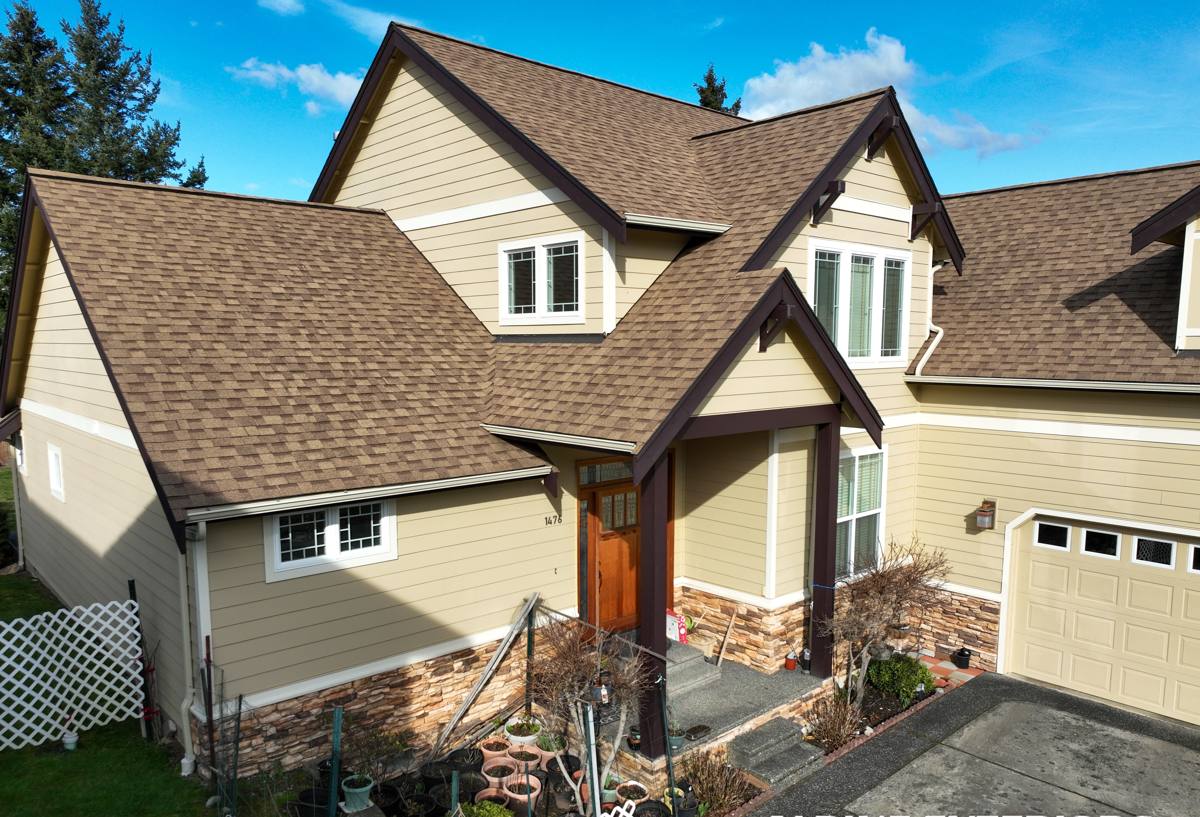
The Big Cost Drivers: Size, Pitch, and Access
Roofers price by the "square" — 100 square feet of roof area — and the first number that matters is simply how many squares your roof has. But square footage alone doesn't set the price. Three other factors move it just as much:
- Pitch (steepness): A low-slope ranch roof is faster and safer to work than a steep Cape Cod or a roof with multiple dormers. Steep pitches require more fall-protection setup, slower footing, and often more waste from cut angles.
- Complexity: Every valley, hip, skylight, chimney, and dormer is a place where water wants to get in. Each one needs flashing work done by hand. A simple gable roof with two planes reroofs fast; a roof with six intersecting planes takes real time even if the total square footage is similar.
- Access: Tight side yards, mature trees over the roof, or a driveway that won't fit a dumpster and material lift all add labor hours before a single shingle goes down.
Two houses with the same square footage can land tens of percent apart in price once pitch, complexity, and access are factored in. That's normal, and it's the first thing to ask a contractor to walk you through if a quote surprises you.
Material Choices: What They Cost and What They're Actually Suited For
Material is usually the second-biggest swing factor, and it's the one homeowners have the most control over. In broad terms, here's how the common options compare for a Whatcom County home:
| Material | Typical Lifespan Here | Relative Cost | Notes for Our Climate |
|---|---|---|---|
| 3-tab asphalt shingle | 12-18 years | Lowest | Budget option; shorter service life under constant moisture and moss pressure |
| Architectural (laminate) shingle | 20-30 years | Moderate | Best value for most homes here; heavier mat sheds wind-driven rain better than 3-tab |
| Synthetic/composite shingle | 30-40 years | Higher | Strong moisture and impact resistance; fewer local installers, so labor can cost more |
| Standing seam metal | 40-50+ years | Highest | Sheds moss and moisture better than any shingle; premium install skill required for coastal-grade sealing |
| Cedar shake | 20-30 years with upkeep | High | Traditional look but needs ongoing moss and moisture maintenance in our climate |
Notice that the cheapest material up front usually isn't the cheapest over the life of the roof. A 3-tab shingle that needs replacing at year 15 costs more over 40 years than an architectural shingle that lasts 25-30, once you count a second tear-off and disposal fee. When we walk homeowners through options, we're usually steering the conversation toward total cost of ownership, not just the number on page one of the quote.
What's Underneath the Shingles Matters as Much as the Shingles
Decking Condition
You can't know the condition of the roof deck until the old roofing is off. Soft, delaminated, or water-stained plywood has to be replaced before new roofing goes down — skipping this step is how roofs fail early no matter how good the shingle is. A fair contract should spell out a per-sheet price for decking replacement rather than leaving it as a vague allowance, so you know what you're paying for if extra sheets are needed.
Underlayment
Felt paper is the old standard; synthetic underlayment is more tear-resistant and sheds water better during the days a torn-off roof sits exposed mid-project. In our rainfall pattern, that exposure window matters — a contractor who plans around weather and uses a quality synthetic underlayment is protecting your house, not just following spec.
Ice-and-Water Shield
This self-adhering membrane goes at eaves, valleys, and around penetrations — the spots most likely to back up water under wind-driven rain or ice damming. It costs more than felt or synthetic underlayment per square foot, but it's the difference between a roof that handles a sideways Whatcom County rainstorm and one that leaks at the first hard blow.
Ventilation and Flashing: The Parts Nobody Sees Until Something Goes Wrong
A roof is a ventilation system as much as it's a weather barrier. Intake vents at the eaves and exhaust vents at the ridge keep moist attic air moving out instead of condensing on the underside of the decking. Get this wrong and you can void a shingle manufacturer's warranty and rot decking from the inside — a failure that has nothing to do with the shingle quality and everything to do with the install.
Flashing — the metal at chimneys, skylights, sidewalls, and roof-to-wall transitions — is where the vast majority of roof leaks actually start, not out in the open field of shingles. Reusing old flashing to save a few hundred dollars is one of the most common corner-cuts in this trade, and it's one of the first things worth asking a contractor about directly: are they replacing flashing, or reusing it?
Why Whatcom County's Climate Changes the Math
Ferndale sits close enough to Bellingham Bay that salt-laden air is a real factor for exposed metal — fasteners, flashing, and vents that aren't corrosion-rated will show it years before they should. Specifying stainless or coated fasteners instead of standard galvanized costs a little more upfront and saves a homeowner from rust streaks and premature failure down the line.
The long moss season is the other local factor that separates a roof quote written for our area from one written from a generic template. Shaded, north-facing slopes here can stay damp for months at a stretch, and moss doesn't just look bad — its root structure lifts shingle edges and holds moisture against the roof surface, accelerating wear. Zinc or copper strips near the ridge, adequate tree trimming, and material choice all factor into how much moss maintenance a roof will need going forward. And the driving rain that comes with our winter storm pattern is exactly why proper underlayment, ice-and-water shield placement, and flashing detail matter more here than in a drier climate — water finds the gaps a rushed install leaves behind.
Permits, Warranty, and What "Included" Should Actually Mean
Whatcom County and the City of Ferndale require permits for roof replacement, and a legitimate contractor pulls one as a matter of course — it's not an upsell, it's code. Be wary of any quote that's silent on permitting.
Warranty coverage typically comes in two layers: the manufacturer's warranty on the shingle material itself, and the contractor's workmanship warranty on the installation. These are not the same thing, and a material defect warranty means little if the leak was caused by bad flashing work that the manufacturer's warranty doesn't cover. Ask what the workmanship warranty covers, for how long, and whether it's backed by an installer certification with the manufacturer — some certification tiers extend material coverage specifically because the manufacturer trusts that installer's flashing and ventilation work.
A Homeowner's Checklist for Comparing Roof Quotes
When you're holding two or three quotes side by side, run them through the same checklist:
- Is the quote based on an actual measurement of your roof, or a satellite/desktop estimate?
- Does it specify full tear-off, or does it allow for a layover?
- Is decking replacement priced per sheet, with a clear allowance, or left vague?
- Does it name the underlayment type and where ice-and-water shield will be installed?
- Is flashing replacement included, or is old flashing being reused?
- Does it address ventilation — intake and exhaust — or just the shingle layer?
- Are fasteners specified as corrosion-resistant, given our proximity to the bay?
- Is a permit included in the price, and who's pulling it?
- What's the workmanship warranty length, separate from the manufacturer's material warranty?
- Is cleanup and haul-away, including magnetic nail sweep, spelled out?
A quote that answers all ten of these clearly is worth more than one that's simply the lowest number on the page, even if the total looks higher at first glance.
Getting a Number for Your Roof
Every one of the factors above — pitch, complexity, decking condition, material, and how much flashing and ventilation work is needed — is specific to your house. If you'd like a straight, itemized look at what your roof actually needs and what it will cost to do it right, we're happy to walk your roof and put together a free, no-pressure estimate.