 Ferndale Exterior
 Exterior Work Built for Sumas, Washington
Sumas sits at the far edge of Whatcom County, tucked against the Fraser Valley border in a landscape shaped by river bottomland, farmland, and the foothills that rise toward Mt. Baker. It's a different micro-climate than the coastal parts of the county, but it shares the same underlying problem every home in this part of Washington deals with: months of sustained moisture, driving rain that doesn't just fall but blows sideways into walls and trim, and a moss season that seems to start earlier and last longer every year. Add in the cold outflow winds that spill down out of the Fraser Valley in winter, and Sumas homes take on a specific kind of weather stress — not hurricane-force, but relentless and cumulative.
Ferndale Exterior Company works throughout Whatcom County, and Sumas is part of our regular service area. We're not driving in from Seattle or subcontracting through a national franchise. We know what this region does to siding, roofs, windows, and decks over a ten or twenty year span, and we build our recommendations around what actually holds up here — not what looks good on a spec sheet in a drier climate.
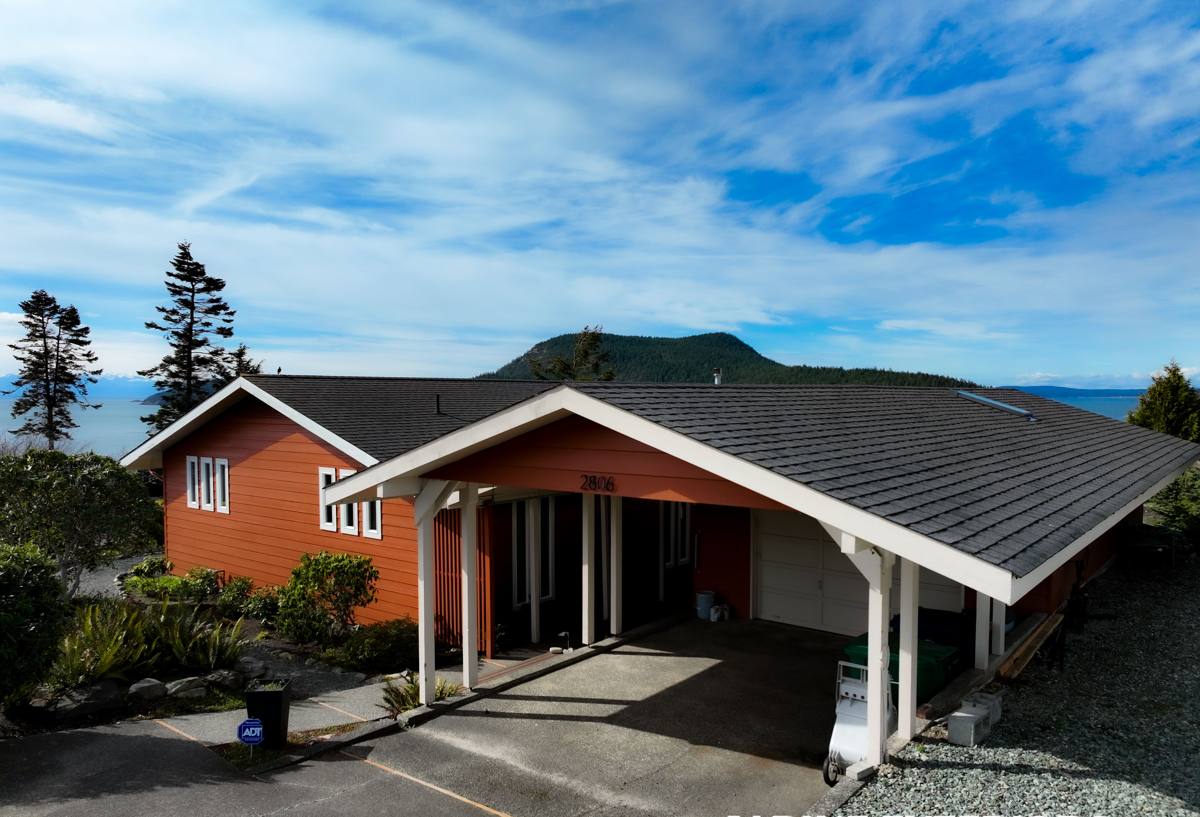
What the Local Climate Does to a House
Every exterior surface on a Sumas home is dealing with the same basic enemy: water that doesn't leave. Long stretches of drizzle and overcast skies mean wood, siding, and roofing rarely get a real chance to dry out between rain events. That changes how materials age.
Moss, Algae, and Shade
Properties near tree lines or with north-facing roof slopes see moss and algae growth start earlier in the fall and persist later into spring. On roofing, moss lifts shingle edges and holds moisture against the roof deck. On siding and decking, algae staining is mostly cosmetic but it's a sign that a surface is staying damp longer than it should.
Driving Rain and Wind-Driven Moisture
Rain in this region rarely falls straight down. Wind pushes it laterally into wall assemblies, around window flashing, and up under deck ledger boards. This is why flashing detail and water management at penetrations matter more here than in drier climates — a small gap that would never see moisture in Arizona becomes an entry point for rot in Whatcom County.
Freeze-Thaw and Outflow Wind Cycles
Sumas gets cold snaps that coastal Whatcom County doesn't feel as sharply, tied to cold air draining down from the Fraser Valley. Repeated freeze-thaw cycling stresses caulk joints, cracks in siding, and fasteners that have already been weakened by moisture. Materials that swell and contract with humidity are especially vulnerable to this cycle.
Siding: Why We Only Install James Hardie
Ferndale Exterior Company installs James Hardie fiber cement siding exclusively. We don't install vinyl, LP SmartSide, Cemplank, Allura, or primed wood species like spruce or cedar. That's a deliberate standard, not a sales preference, and it's worth explaining honestly rather than just asserting it.
Wood-based siding products — including engineered wood and traditional cedar — depend on an intact factory coating or field-applied finish to keep moisture out. In a climate where surfaces stay wet for days at a stretch, any breach in that coating (a nail pop, a cut edge, a scuff during installation) becomes a path for water intake, and wood-based substrates swell, delaminate, or rot from the inside out. Vinyl siding sheds water well enough but expands and contracts significantly with temperature swings, which opens gaps at seams and fastener points over time, and it's not a fire-resistant material.
James Hardie fiber cement is non-combustible and dimensionally stable — it doesn't swell, warp, or rot the way wood-based products can, and it holds up to the wind-driven rain typical of this region far better than vinyl's looser tolerances. Hardie's ColorPlus factory finish is baked on under controlled conditions, which gives a more consistent, longer-lasting color than field-applied paint, and it comes backed by a real transferable warranty. For a house that's going to sit in Whatcom County weather for the next several decades, that combination is why we standardized on it.
HZ5 vs. HZ10 Product Lines
James Hardie engineers its siding for different climate zones. Whatcom County, with its high humidity, straddles the line, and we help homeowners choose between the HZ5 line (built for freeze-thaw exposure) and the HZ10 line (built for the wettest, mildest climates) based on the specific site — elevation, tree cover, sun exposure, and how exposed the home is to wind-driven rain.
Roofing That Handles a Long Wet Season
Roofing in this area needs to do more than shed water on a clear day — it needs to keep performing during weeks of sustained overcast, moss pressure, and the occasional heavy wind event. We look at three things on every roofing job: the condition of the roof deck underneath, the quality of underlayment and ice-and-water protection at eaves and valleys, and the flashing detail around every penetration — chimneys, vents, skylights.
Roof deck rot is one of the most common hidden problems we find on older Whatcom County homes, usually traced back to a small, long-standing leak at a valley or penetration that was never properly flashed. Catching that early, during a re-roof or a repair call, saves a homeowner from a much larger structural repair later.
Windows: Managing Moisture and Heat Loss Together
Older single-pane and early dual-pane windows in this region tend to show two problems at once: condensation between panes (a sign the seal has failed) and drafts around the frame where old caulking and flashing have degraded. Both issues let moisture into the wall cavity, which is a bigger problem than the energy loss itself.
When we replace windows, we treat the flashing and integration with the surrounding siding as seriously as the window unit itself. A well-built window installed with poor flashing will leak; a modest window installed with correct water management will outperform it. That's especially true in a spot like Sumas where wind-driven rain tests every seam.
Decks: Built to Survive Standing Moisture
Decks take the most direct, sustained exposure of any part of a home's exterior — horizontal surfaces collecting rain, ledger boards tucked against the house where moisture lingers, and fasteners exposed to constant wet-dry cycling. The most common failure points we see are ledger board rot where the deck meets the house (usually a flashing problem), and framing hardware that's corroded because it wasn't rated for wet, coastal-influenced climates.
We build and repair decks with corrosion-resistant hardware, proper ledger flashing, and decking materials suited to a wet climate — whether that's a composite product or a wood species and finish schedule that can actually handle the moisture load here.
Comparing Exterior Materials for This Climate
| Material | Moisture Behavior Here | Maintenance Load |
|---|---|---|
| Vinyl siding | Sheds water but gaps at seams as it expands/contracts; not fire-resistant | Low, but limited long-term durability |
| Wood/engineered wood siding | Vulnerable to swelling, delamination, rot if coating is breached | High — repainting, caulk checks, moisture inspection |
| James Hardie fiber cement | Dimensionally stable, non-combustible, engineered HZ lines for this climate | Low — periodic wash, occasional caulk check |
| Composite decking | Resists moisture absorption and rot better than wood | Low to moderate — periodic cleaning |
What a Local Crew Actually Changes
A lot of exterior failures in Whatcom County trace back to details that are correct in a drier climate but wrong here — flashing laps installed backwards relative to prevailing wind direction, caulk used where flashing should have been, or a siding product installed without accounting for how long it stays wet after a storm. A crew that works this region regularly builds an instinct for where water actually goes on a house, not just where it's supposed to go on paper.
Working locally also means shorter response times for storm damage, follow-up service, and warranty work — something that matters more in a town like Sumas that's a bit further from where most contractors are based.
Signs Your Exterior Needs Attention
- Moss or dark streaking building up faster than it used to on the roof or siding
- Soft or spongy decking, especially near the house where the ledger board attaches
- Condensation forming between window panes, or persistent drafts near frames
- Paint or finish that's cracking, peeling, or chalking on wood-based siding
- Visible gaps or separation at siding seams, corners, or trim joints
- Water stains on interior ceilings or walls near the roofline
Getting Started
If you're in Sumas and dealing with an aging roof, siding that's showing its age, drafty windows, or a deck that's seen better days, we're glad to take a look. We'll give you an honest read on what's actually happening with your home's exterior and what it would take to fix it right for this climate — no pressure, no inflated scope. Reach out for a free estimate using the form below.