 Ferndale Exterior
 Cemplank Isn't a Bad Product — It's a Different Business Decision
We get asked about Cemplank often enough that it's worth answering honestly. Cemplank is a fiber cement siding product manufactured by Saint-Gobain (CertainTeed's parent company), and on paper it competes directly with James Hardie: cement, sand, and cellulose fiber pressed into planks, panels, and shingle-style siding that resists fire, rot, and pests better than wood or vinyl. It is not a scam product, and homeowners who have it on their homes are not sitting on a mistake. Our decision not to install it isn't about trashing a competitor's material — it's about what we've chosen to stand behind as a company working on homes in Ferndale and the rest of Whatcom County, where salt air off the Strait of Georgia, driving winter rain, and a long moss season punish exterior cladding harder than most inland markets.
We install James Hardie fiber cement exclusively. That's a narrow position for a siding contractor to take, and we think homeowners deserve to know why, rather than just being told "trust us."
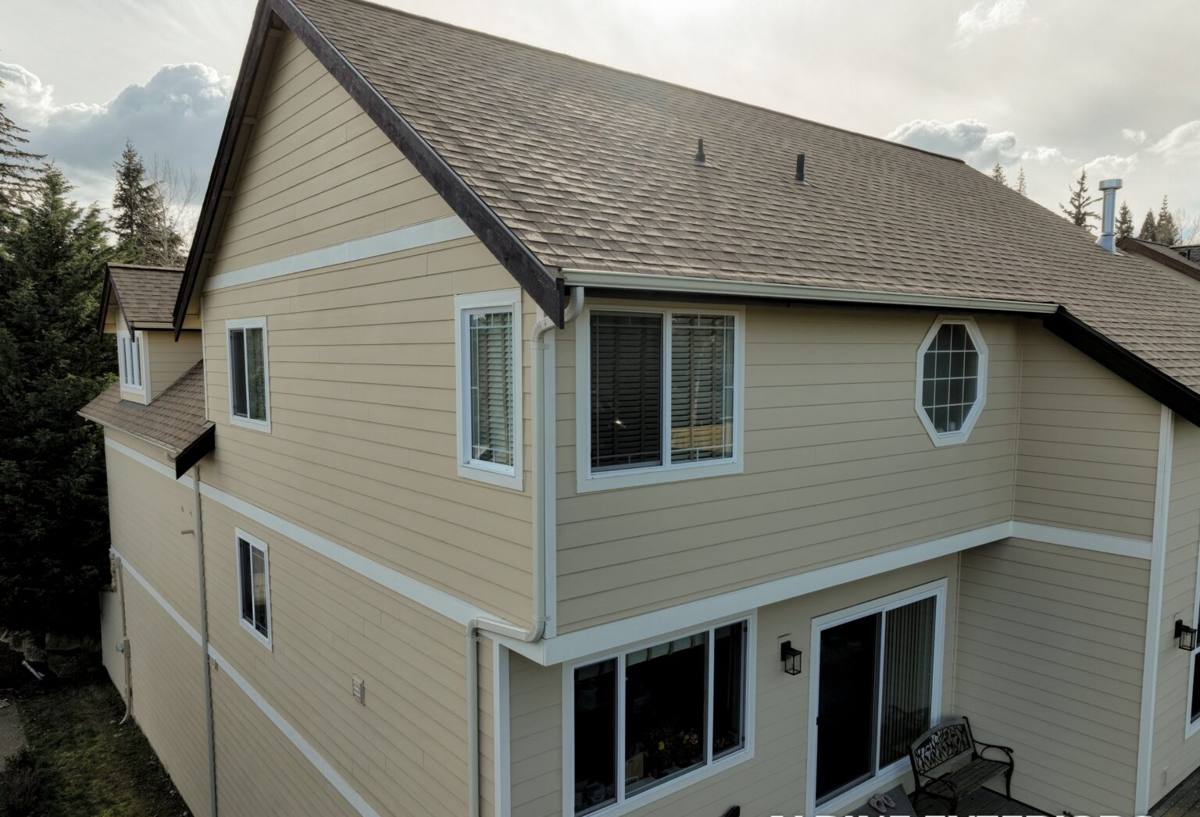
Why We Don't Install Cemplank
Factory Finish and Color Consistency
Fiber cement siding lives or dies on its factory-applied finish. A raw fiber cement board is porous and needs a baked-on finish system to resist moisture uptake, hold color, and avoid the chalky fading that plagues poorly finished products. Cemplank has offered both primed and factory-finished options over the years, and the finish lines and warranty terms attached to them have shifted more than once as Saint-Gobain has repositioned the product. When a finish system changes, so does the touch-up paint match, the repair protocol, and sometimes the warranty coverage on siding that's already on a house. We don't want to sell a homeowner a 30- or 50-year exterior and then have to guess which finish generation is on their wall when a color-match repair comes up ten years later.
Regional Distribution and Product Support
This is the practical reason as much as the technical one. Building material distribution in the Pacific Northwest runs through a smaller number of channels than in bigger markets, and product lines get discontinued, reformulated, or pulled from regional stock with little warning to the contractors who installed them. When that happens to a siding brand, a homeowner with damage from a fallen branch or a bad backer flashing can be stuck trying to match a discontinued profile or color years after installation. James Hardie has built a deep, stable distribution network across Washington state specifically, with a Northwest-engineered product line to match. That matters more to us than a slightly lower material cost on install day.
How Fiber Cement Behaves in a Wet, Salt-Exposed Climate
Ferndale sits close enough to the water that salt-laden air is a real factor in coating and fastener performance, and Whatcom County's fall-through-spring rain pattern means siding here spends months at a time saturated or near-saturated. Add a moss season that runs longer than most of the state's, and you have an environment where every seam, cut edge, and fastener penetration is a potential failure point over a 20-plus year timeline.
All fiber cement is dimensionally stable compared to wood and vinyl, and that's true of Cemplank as well — this isn't a durability knock on the raw material. The differences that matter to us are in the finish system's moisture resistance at cut edges and the manufacturer's documented, climate-specific installation guidance. Hardie publishes install specs by climate zone, including moisture-management details (rainscreen gaps, flashing overlaps, fastener patterns) tuned for wet marine environments like ours. We install to that spec on every job, and we'd rather work from a system we've vetted for this exact climate than adapt a generic install guide to Whatcom County conditions.
Cut Edges and Field Painting
Every fiber cement product, regardless of brand, needs its cut edges sealed in the field, because the factory finish only protects the face and edges of the board as manufactured — not the fresh cut a crew makes on site. Skipping this step is one of the most common causes of early moisture damage on any fiber cement siding job, Cemplank included. We treat this as a non-negotiable step on every cut, on every job, but it's also a reminder that fiber cement performance depends heavily on installer discipline, not just the board itself.
Installation Sensitivity
Fiber cement in general is less forgiving to install correctly than vinyl or LP SmartSide, and that's true across brands. Nail placement, gapping, flashing sequence, and caulking all have to be right, or the siding fails early regardless of how good the board itself is. What differs by brand is the depth and clarity of manufacturer training and installer accountability programs available to contractors.
James Hardie runs a formal contractor certification program (Hardie Preferred / Elite) with defined installation training, and the company backs it with inspection support and a warranty that's tied to correct installation by a trained crew. That structure gives us — and our customers — a documented standard to install against and a manufacturer relationship if a warranty question ever comes up. We didn't find an equivalent contractor-facing program behind Cemplank that gave us the same confidence going into a 30-year commitment on someone's home.
Warranty Structure: What to Actually Compare
Warranty length on the marketing page isn't the whole story. What matters is what's covered, whether it's prorated, and whether it transfers to a future buyer without a lot of paperwork.
| Factor | What to Ask About | Why It Matters in Whatcom County |
|---|---|---|
| Substrate warranty | Length and whether it covers cracking, rot resistance, and structural integrity | Long wet seasons stress the board itself over decades |
| Finish warranty | Separate coverage for fade, chip, and peel of the factory finish | UV and salt air both accelerate finish breakdown near the coast |
| Proration | Whether coverage value declines over the warranty term | A "50-year warranty" that's prorated after year 10 pays out far less than it implies |
| Transferability | Whether a new homeowner has to re-register or pay a fee | Affects resale value on a home with new siding |
| Installer requirement | Whether coverage depends on certified installation | Ties warranty validity to how the job was actually done, not just the material |
When we compared Cemplank's published warranty terms against Hardie's ColorPlus finish and substrate warranties side by side, Hardie's structure was clearer, less prorated, and easier for us to explain to a homeowner in plain language. That clarity is worth something when we're the ones who have to answer for it years down the road.
What We Install Instead: James Hardie
We standardized on James Hardie fiber cement for the reasons above, plus a few things specific to the Hardie system:
HZ5 Climate-Engineered Formulation
Hardie engineers its HZ product lines by climate zone, and the HZ5 formulation is built for regions with significant moisture exposure — which describes western Whatcom County well. That's an engineering decision made at the plant, not a field workaround.
ColorPlus Factory Finish
ColorPlus is a baked-on, multi-coat finish applied and cured under factory conditions rather than sprayed on site. It carries its own finish warranty separate from the substrate, and touch-up product is formulated to match specific ColorPlus colors, which keeps repairs looking right instead of patchy.
Non-Combustible Core
Fiber cement in general, Hardie included, is non-combustible, which matters for insurance considerations and wildfire-adjacent building codes even in a marine climate — Whatcom County isn't immune to dry summer stretches and regional wildfire smoke seasons.
A Practical Checklist If You're Comparing Fiber Cement Products
- Ask what climate zone the specific product line is engineered for, not just "fiber cement" as a category
- Get the finish warranty and substrate warranty in writing, separately, with proration terms spelled out
- Confirm whether your installer carries manufacturer certification and what that certification actually required
- Ask how cut edges and field seams are sealed on your specific job, and get it in the written scope
- Check how easy replacement pieces and touch-up finish are to source in Washington state if a repair is needed in year 10 or 20
- Ask what happens to your warranty if the manufacturer discontinues or reformulates the product line
Our Bottom Line
We're not going to tell you Cemplank is unsafe or doomed to fail — that's not a fair or accurate claim, and we won't make it. What we will say is that after weighing finish systems, regional product support, installer certification, and warranty structure, James Hardie is the fiber cement system we're willing to put our name behind on every job in Ferndale and across Whatcom County. Standardizing on one manufacturer also means our crews install one system, to one spec, over and over — which is its own quality advantage over juggling multiple products' installation quirks.
If you're comparing siding options for a home in the Ferndale area, we're happy to walk through what we'd recommend for your specific house and explain the reasoning — no pressure, no obligation. Request a free estimate below and we'll take a look.