 Ferndale Exterior
 Birch Bay Puts a Different Kind of Stress on Siding
Birch Bay sits right on the water at the edge of our Ferndale service area, and that shoreline position changes what a wall actually has to survive. A house here takes a heavier, steadier dose of salt-tinged marine air, more sideways-driven rain off open water, and a moss season that can run close to year-round on shaded or north-facing walls than a comparable home set back a few miles inland. None of that is unusual for Whatcom County in general — but in Birch Bay it's more concentrated, and it's exactly the kind of exposure that separates a siding job built to look right for thirty years from one that starts showing problems in five or six.
We install James Hardie fiber cement siding exclusively, in Birch Bay and across the rest of our Ferndale-area service territory. This page is specifically about what that means for a Birch Bay property: what the climate demands, what a correct Hardie installation actually involves out here, and why we treat a shoreline job in this neighborhood as its own project rather than a copy-paste of siding work done a few miles inland.
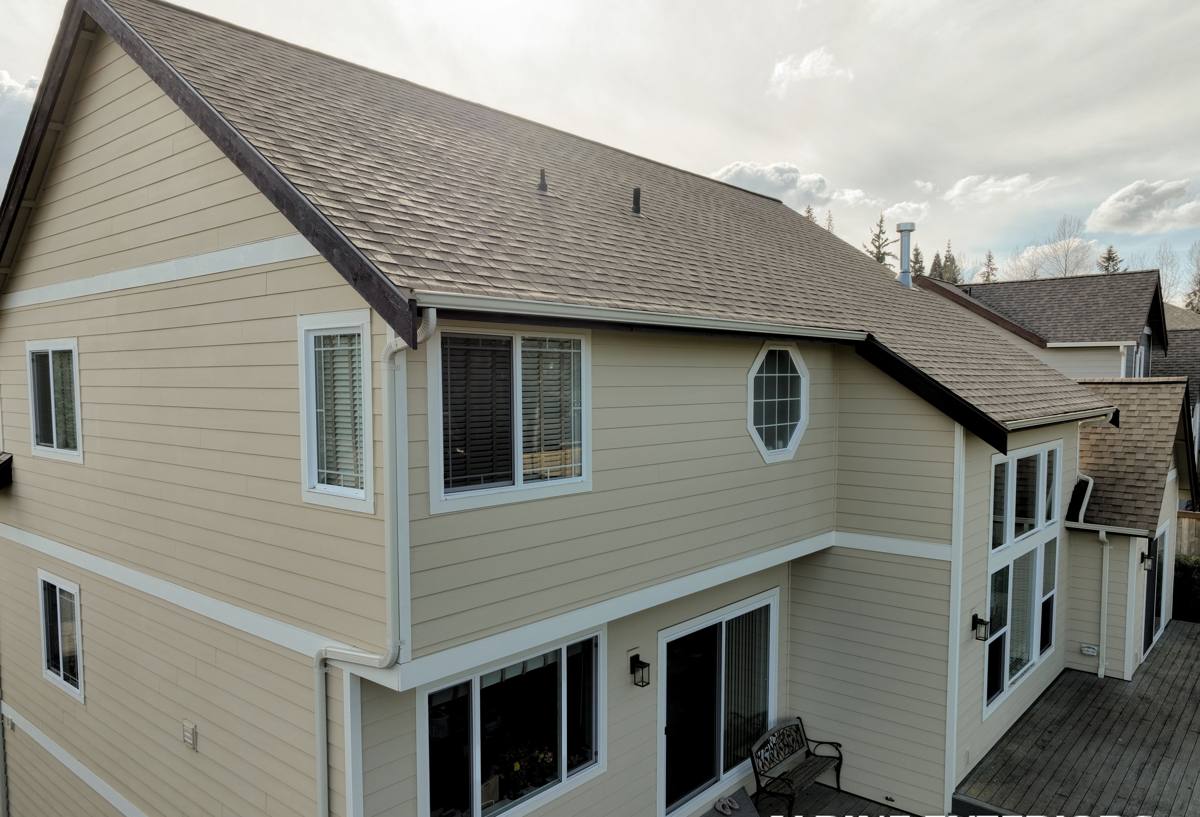
What Salt Air, Driving Rain, and Moss Actually Do to a Wall Out Here
Salt-Tinged Marine Air
Being close to the water means Birch Bay homes deal with more direct salt exposure than most of the surrounding county. Salt accelerates corrosion in fasteners, flashing, and trim hardware, and it wears down lower-grade finishes faster than a drier or more sheltered inland setting would. That's not a cosmetic issue alone — corroded fasteners and degraded flashing are how water eventually gets behind a wall, not just how a house looks from the street.
Wind-Driven Rain
Waterfront exposure also means more sustained wind, and wind-driven rain doesn't fall straight down onto a roof — it gets pushed sideways into siding laps, window and door flashing, and every joint in the wall assembly. That's a heavier, more directional moisture load than an annual rainfall number implies. A siding system that performs fine in a calm, sheltered location can still fail here specifically because water is finding its way in from the side rather than from above.
A Long Moss and Mildew Season
Mild temperatures, shade from tree cover on many lots, and near-constant moisture add up to a moss and mildew season that runs most of the year on the shaded and north-facing sides of a Birch Bay house. Any siding surface that's even slightly porous, or that holds moisture against the substrate instead of shedding it, becomes a growth surface over time. That growth traps additional moisture against the wall behind it, which is where a lot of long-term siding problems actually start.
Why James Hardie Fiber Cement Fits This Exposure
We used to install a wider range of siding products. We stopped, and the decision came from what we kept seeing on tear-offs and service calls on waterfront and marine-exposed properties like the ones in Birch Bay — not from a supplier relationship or a marketing angle.
The HZ5 Formulation
James Hardie engineers its siding for different climate zones rather than selling one formulation everywhere. The HZ5 line is built for regions with sustained moisture exposure and freeze-thaw cycling, which is a close match for a waterfront setting in northern Whatcom County. Using the correct HZ line for this climate is part of what lets a Hardie installation perform the way it's designed to over decades, not just the first few years.
Factory-Applied ColorPlus Finish
Instead of a coat of paint applied on-site, Hardie's ColorPlus finish is baked on in a controlled factory process, in multiple coats, before the boards ever reach the job. That finish holds up against salt air and repeated wet-dry cycling noticeably better than field-applied paint, and it carries its own warranty coverage separate from the substrate itself.
A Non-Combustible, Dimensionally Stable Core
Fiber cement is an inorganic material — a cured blend of Portland cement, sand, and cellulose fiber — so it doesn't have a wood-based or petroleum-based core that swells, cups, or warps after repeated wetting. It's also non-combustible, which matters for both safety and, in many cases, insurance considerations, independent of how close a property sits to the water.
A Warranty That Actually Transfers
James Hardie backs correctly installed siding with one of the more substantial warranty structures in the industry, and that coverage is transferable if the home changes hands. On a coastal property where buyers are often specifically asking about exterior maintenance history, a written, transferable warranty is worth more than it would be on a typical inland resale.
Choosing a Profile and Finish for a Shoreline Property
Hardie's product line gives Birch Bay homeowners real choices, not a single generic board. Lap siding is the most common choice and comes in different exposure widths and textures, from a traditional smooth finish to a wood-grain look. Panel systems and board-and-batten profiles work well for homes with a more modern or craftsman-style elevation, and Hardie shingle-style siding gives a cottage look without the maintenance burden of real cedar shakes on a wall that's taking direct salt spray. Trim and soffit products are engineered to match, which matters at the transitions where two materials meet and water most often finds a way in.
On color, darker finishes absorb more heat and UV, which can be a factor on a south- or west-facing wall with direct water views and little shade, while lighter finishes tend to show salt residue and water spotting less between cleanings. Neither is right or wrong — it's a conversation worth having up front, specific to which elevation of the house faces the water and how much shade the lot actually gets.
What Correct Installation Looks Like on a Birch Bay Property
Fiber cement only performs the way it's engineered to when it's installed to James Hardie's published specifications, and on a wall taking direct wind-driven rain off the water, those details carry more weight than they would on a sheltered inland elevation. A quality board installed loosely will still develop moisture problems here.
| Installation Detail | Why It Matters in Birch Bay |
|---|---|
| Correct fastener type, spacing, and depth (typically corrosion-resistant) | Salt air accelerates corrosion of the wrong fastener grade, and an under- or over-driven nail cracks the board or breaks the water seal |
| Manufacturer-specified clearance from grade, roofline, and deck | Keeps splash-back and standing moisture off the board edge, which is the most water-sensitive part of any fiber cement panel |
| Rain-screen or drainage-plane detailing behind the siding | Gives incidental moisture that gets past the surface a path to drain and dry instead of sitting against the sheathing |
| Properly lapped and sealed joints, especially at windows and doors | These are the transition points wind-driven rain exploits first on a directly water-facing wall |
| Factory-primed or factory-finished cut edges | An unsealed field cut is the one place on a Hardie board that can still absorb water if it's left exposed |
Why We Don't Install Anything Else on This Coastline
We won't install LP SmartSide, vinyl siding, Cemplank, Allura, primed spruce, or cedar. Every one of those products has a legitimate place in the broader market, and plenty of homeowners elsewhere are satisfied with them. But on a shoreline exposure like Birch Bay's, we've made a professional call to install one system we can fully stand behind rather than offer a lower-cost option that shifts long-term moisture and maintenance risk back onto the homeowner. Vinyl's lapped, unsealed seams aren't built for sustained wind-driven rain from one dominant direction. Engineered wood products depend on every field-cut edge staying sealed indefinitely in a climate that rarely gives a wall a long dry stretch to catch up. Cedar and primed spruce are organic and combustible, and they need a disciplined refinishing schedule to keep ahead of a moss season that runs most of the year here.
Our Process for a Birch Bay Siding Project
We start with an on-site walk of the exterior and pay close attention to how exposure varies wall by wall — a directly water-facing elevation and a shaded, tree-covered side of the same Birch Bay house can be dealing with genuinely different moisture loads. From there we put together a clear, written scope of work and timeline before any work begins, including which profile, color, and HZ specification make sense for that specific house. Correct flashing, drainage detailing, and fastener selection are standard practice on every Birch Bay project we take on, not optional upgrades priced separately.
Why Hiring a Crew That Already Works Birch Bay Matters
Two homes on the same short stretch of Birch Bay shoreline can have very different exposure profiles — one sitting close to the water with a full water-facing wall, another set back and shaded by trees on a slightly higher lot. A crew that already works this specific shoreline recognizes that variation on sight and adjusts drainage detailing, flashing laps, and fastener choice wall by wall, instead of applying one generic inland spec to the whole house. That local judgment is what separates a siding job that looks fine for a season from one that's still performing decades later.
- Ask what siding material they install and why, and whether it comes with a written, transferable warranty
- Confirm current Washington contractor licensing and active liability insurance
- Ask specifically how they handle a directly water-facing wall taking wind-driven rain versus a shaded, sheltered elevation on the same house
- Ask about their fastener and hardware choices for salt-air corrosion resistance
- Get a clear, written scope of work, product profile, color, and timeline before signing anything
Cost Factors for a Birch Bay Hardie Siding Project
Every proposal should reflect the specifics of the house, not a flat per-square-foot number pulled from an inland job. The factors below move the price more than most homeowners expect, and they're worth understanding before comparing bids.
| Factor | How It Affects the Project |
|---|---|
| Profile choice (lap, panel, shingle, board-and-batten) | Labor and trim requirements differ by profile; mixed profiles on one elevation add detail work |
| Water-facing exposure vs. sheltered walls | Directly exposed elevations typically need more robust flashing and drainage detailing, which adds labor |
| Condition of the existing wall assembly | Rot or moisture damage found once old siding comes off needs repair before new Hardie goes up |
| Number of window, door, and trim transitions | Each transition is a flashing detail that takes time to do correctly, especially on this exposure |
| Color and finish selection | Standard ColorPlus colors are typically more cost-effective than custom or premium finish options |
If you're weighing James Hardie siding for a Birch Bay home, we're happy to walk the property with you, look at how each wall is actually exposed, and give an honest read on what it needs. Reach out below for a free, no-pressure estimate.