 Ferndale Exterior
 Storm Damage Roof Repair in Birch Bay: What This Stretch of Coastline Does to a Roof
Birch Bay sits directly on the water in northern Whatcom County, and that location changes what "storm damage" actually looks like compared to a roof a few miles inland. Homes here take a steadier, harder version of the weather the rest of the county deals with only occasionally: salt-laden marine air, wind that comes off open water with nothing to slow it down, and rain that gets driven sideways and up under roof edges instead of falling straight onto the field of the roof. Add in a moss season that runs long on shaded, north-facing slopes, and a Birch Bay roof is working harder, year-round, than most homeowners realize until a storm finds the weak point.
We repair storm-damaged roofs in and around Birch Bay regularly, and most of what we find isn't dramatic. It's a section of lifted shingles, a flashing seam that finally gave out after one too many windstorms, or a soft spot that's been quietly taking on water for longer than anyone noticed. Catching that correctly, and fixing it right the first time, is what this page is about.
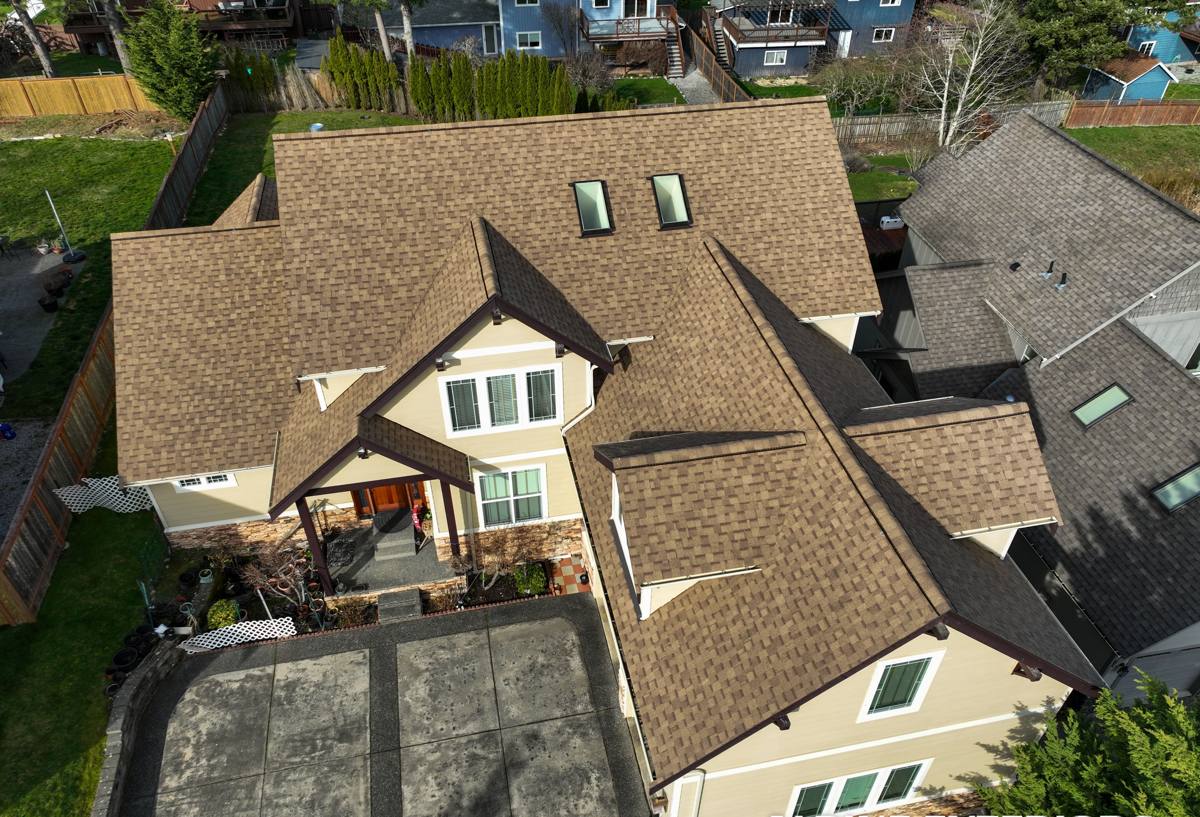
How Storms Actually Damage a Birch Bay Roof
Wind Uplift
Open-water exposure means Birch Bay roofs see stronger, more sustained wind during winter storm systems than roofs on sheltered inland lots. Wind doesn't need to reach dramatic speeds to do damage — hours of sustained gusts working at shingle edges can break the adhesive seal and lift tabs without tearing anything off outright. A roof can look fine from the ground the day after a storm and still have a section of shingles that no longer seals against wind-driven rain.
Wind-Driven Rain at Flashing and Transitions
Most storm-related leaks don't start in the open field of the roof. They start at flashing — valleys, chimneys, skylights, vent pipes, and roof-to-wall transitions. Wind-driven rain gets pushed sideways and even upward into these joints in a way straight-down rain never would, and a flashing detail that's marginal on a calm day can fail outright once wind starts forcing water into it. On a waterfront lot like Birch Bay, that pressure is higher and more frequent than it is on a roof a few miles inland.
Impact and Debris Damage
Storms bring loose branches and blown debris, and occasionally hail, any of which can crack, bruise, or puncture roofing material. Impact damage is sometimes obvious, like a cracked shingle or a visible hole, and sometimes subtle, showing up only as a soft spot or heavier-than-normal granule loss that isn't visible without actually getting on the roof.
What Happens When Storm Damage Sits Unaddressed
A small storm-related opening doesn't stay small. Once water gets under the roofing material, it tracks along the deck, soaks insulation, and can reach framing before it ever shows up as a stain on a ceiling. In Birch Bay's climate, that trapped moisture also feeds moss and mildew growth from underneath the roofing, which is a slower problem than an active leak but does just as much long-term damage. The gap between "storm damage happened" and "storm damage got fixed" is where a simple repair turns into a much bigger job.
What a Correct Storm Damage Repair Actually Involves
A proper storm repair starts with getting on the roof, not evaluating it from the driveway or off a satellite photo. That means checking the full roof plane, not just the area a homeowner noticed damage in, since wind and driven rain rarely limit themselves to one spot. From there, a correct repair covers a few things every time:
- Pulling back damaged material far enough to see the actual extent of the problem, not just patching the visible edge of it
- Checking the roof deck underneath for soft spots, staining, or rot before anything new goes down
- Replacing damaged underlayment, not just the shingles or roofing material sitting on top of it
- Re-flashing any valley, penetration, or wall transition in the damaged area to current standards, not just resealing the old flashing with caulk
- Matching new material to the existing roof as closely as possible in color, profile, and wind rating
Matching Materials on a Repair
An exact match isn't always possible, especially on an older roof where the original shingle line has been discontinued or has weathered to a different shade than new material. We tell homeowners upfront when an exact match isn't realistic, and talk through the options — matching as closely as the market allows, or, if the damage is spread across enough of the roof, considering whether a small section repair is really the right call versus replacing a full slope so the whole area looks and performs consistently.
Repair vs. Full Replacement After a Storm
Not every storm-damaged roof needs to come off. A lot of storm damage is legitimately fixable as a targeted repair, and that's the honest answer more often than homeowners expect. But there are situations where a repair is the wrong call — it costs real money and only delays the inevitable.
| Situation | Repair Usually Makes Sense | Replacement Usually Makes Sense |
|---|---|---|
| Damage extent | Isolated to one slope or a small section | Spread across multiple slopes or a large portion of the roof |
| Roof age | Roof is well within its expected service life | Roof is already near the end of its expected lifespan |
| Deck condition | Deck underneath is sound once exposed | Deck shows rot or long-term moisture damage |
| Material availability | A reasonably close match is available | Original material is discontinued and a patch would look visibly mismatched |
| Storm history | First significant damage event on this roof | Repeated storm damage calls on the same roof over a short span |
We'll tell you honestly which category your roof falls into. A repair that's genuinely sufficient is the right recommendation, and so is a replacement when the damage or the roof's overall condition calls for it — we don't default to whichever answer costs more.
Our Storm Damage Repair Process
- An on-roof inspection as soon as weather allows, documenting the damage with photos before anything is touched
- A clear explanation of what we found, including anything discovered beyond the original visible damage, like a deck soft spot or a second failing flashing point
- A written estimate outlining the repair scope, so you know exactly what's being done and why
- Temporary weatherproofing if the damage is active and the full repair can't happen immediately
- The repair itself, matched to the existing roof as closely as materials allow
- A final walkthrough so you can see the completed work before we consider the job done
Working With Insurance After Storm Damage
Many storm damage repairs in Birch Bay do end up going through homeowners insurance, particularly after a significant windstorm. We can document the damage with photos and provide a detailed, written repair estimate that you can hand to your insurance company or adjuster. What we won't do is promise a specific claim outcome or tell you what your policy covers — that's between you and your insurer, and coverage details vary by policy. If an adjuster has questions about the scope of repair work, we're glad to talk through it directly.
Cost Factors for Storm Damage Roof Repair in Birch Bay
| Factor | What It Affects | Why It Matters Here |
|---|---|---|
| Extent of damage | Labor and material quantity | Waterfront wind exposure can spread damage across a wider area than it first appears |
| Deck condition once exposed | Whether decking needs repair before new roofing goes on | Trapped moisture from a slow leak often damages decking before it's visible from inside |
| Flashing scope | How much flashing gets replaced versus patched | Wind-driven rain concentrates stress at flashing points more than on a sheltered inland roof |
| Material matching | Whether repair uses matching product or requires a broader section replacement | Older or discontinued shingle lines are harder to match exactly |
| Roof access and pitch | Labor time and staging needs | Waterfront lots can have steeper grades or tighter access than inland properties |
Exact pricing depends on the specific roof and the extent of the damage, which is why we inspect in person before giving a real number rather than quoting a range over the phone.
Signs Your Birch Bay Roof Has Storm Damage
- Missing, cracked, or curling shingles, especially after a windy storm
- Granule buildup in gutters or downspouts following heavy wind or rain
- Flashing that looks lifted, bent, or separated around chimneys, vents, or skylights
- Water staining on interior ceilings or walls near the roofline, particularly after a storm
- Soft or spongy spots felt when walking the roof, or visible sagging from the ground
- Moss or dark staining returning quickly after cleaning on shaded, north-facing slopes
- Daylight visible in the attic at roof-to-wall transitions or around penetrations
Why a Local Crew That Already Works Birch Bay Matters
After a significant windstorm, it's common to see out-of-area crews going door to door in coastal neighborhoods like Birch Bay offering fast repairs. Some of that work is fine. A lot of it isn't around to honor a warranty claim a year later, because the crew was never local to begin with. A contractor who works this stretch of Whatcom County regularly already knows how salt air, sustained wind, and driving rain behave on a real Birch Bay roof over a full year, not just how a shingle performs on a spec sheet. That shows up in practical decisions — how much flashing to replace versus patch, which slopes take the most punishment and deserve extra attention, and when a repair is genuinely enough versus when it's just delaying a bigger job.
Before You Hire Anyone for Storm Damage Repair
- Confirm current Washington state contractor licensing and active insurance
- Ask for a written, itemized scope of the repair, not a verbal quote
- Ask specifically how they'll handle flashing and deck inspection, not just visible shingle damage
- Be cautious of pressure to sign the same day or a large upfront deposit before material is ordered
- Ask whether they have a physical local presence, not just a phone number that routes elsewhere
If a recent storm has left your Birch Bay roof with damage, or you just want an honest second look after noticing something that concerns you, we're glad to come take a look. Reach out using the form below for a free, no-pressure estimate.