 Ferndale Exterior
 Why Cordata Homes Need Decking Built for This Climate
Cordata sits close enough to Bellingham Bay and the surrounding wetlands that homes here deal with a specific mix of weather stress: damp, shaded lots, long stretches of driving rain through fall and winter, and a moss season that can run most of the year if a deck doesn't get enough sun or airflow. Add in the salt-tinged air that drifts inland off the Sound, and you have conditions that are hard on fasteners, hard on wood fiber, and hard on any decking product that wasn't built with moisture in mind. A deck that looks fine on install day in July can start showing problems by the following spring if it wasn't designed for what Whatcom County actually throws at it.
Composite decking, installed correctly, handles this climate better than most alternatives. But "composite" isn't one product, and "installed correctly" isn't automatic. This page covers what Cordata-area homes specifically need from a composite deck, what a correct installation actually involves, and how we approach these projects.
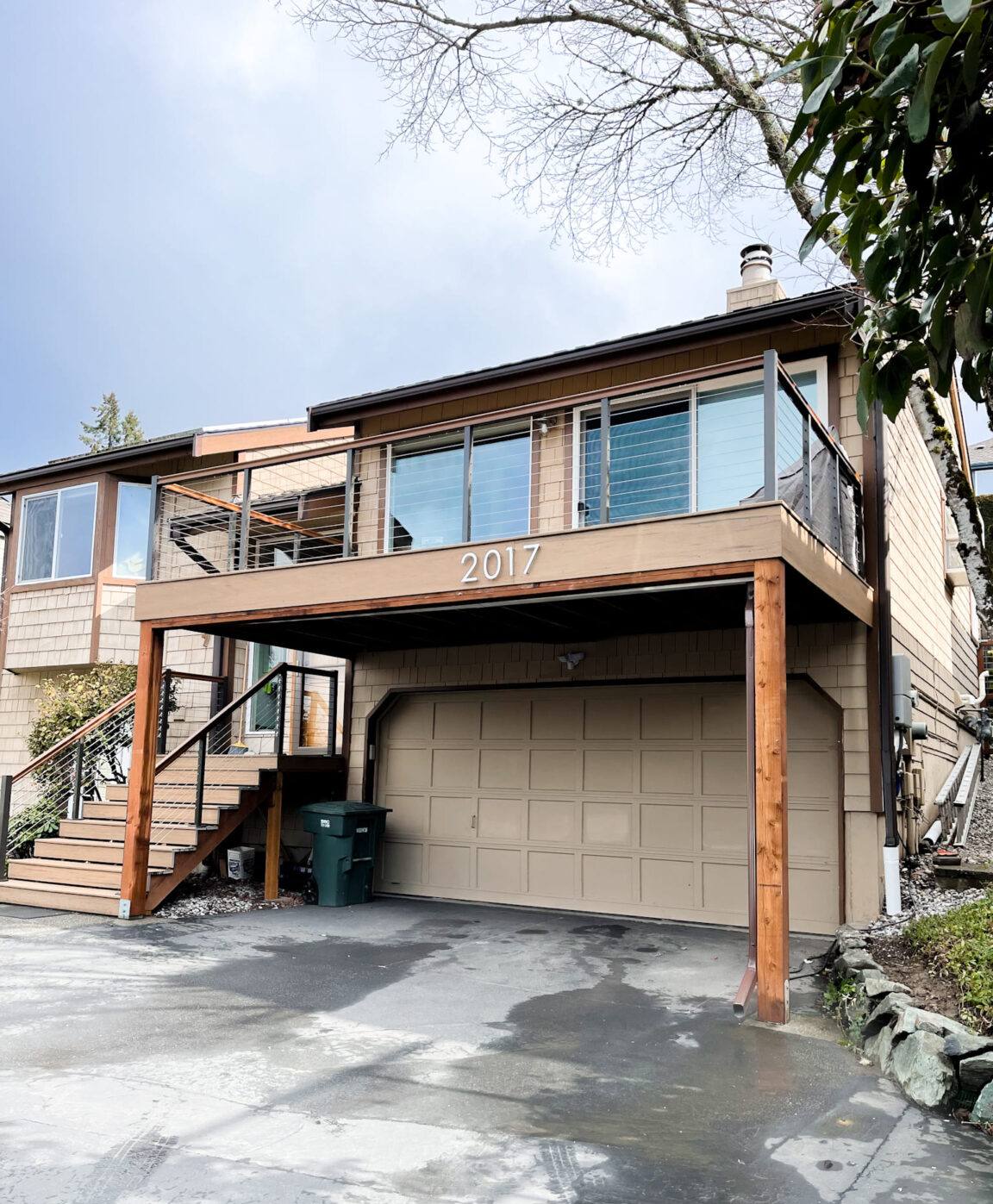
What Whatcom County Weather Does to a Deck
Moisture and Slow Drying
Cordata's tree cover and proximity to low-lying, damp terrain mean decks here often don't get the sun exposure needed to dry out quickly between rain events. Boards, framing, and ledger connections can stay wet for days at a stretch during the rainy months. Any material or detail that traps water instead of shedding it becomes a long-term liability.
Moss and Algae Growth
Moss doesn't need much — shade, moisture, and a surface it can grip. Textured deck boards in shaded, north-facing, or heavily landscaped yards are prime territory. Once moss establishes itself, it holds moisture against the board surface and makes the deck slicker underfoot, which is both a maintenance headache and a safety issue.
Salt Air and Fastener Corrosion
Homes closer to the water pick up airborne salt that accelerates corrosion on exposed metal — screws, brackets, joist hangers, and railing hardware. Standard hardware can start showing rust streaks and weakening well before a deck's structural lifespan should be up. This is one of the most overlooked failure points in decking projects in this region.
Composite vs. Wood Decking in This Climate
Wood decking isn't a bad product — it's a maintenance-intensive one, and Cordata's climate raises that maintenance bar significantly. Composite shifts the trade-offs.
| Factor | Wood Decking | Composite Decking |
|---|---|---|
| Moisture absorption | Absorbs and releases moisture, leading to cupping, splitting, and rot over time | Capped composite resists moisture absorption at the board surface |
| Moss and algae resistance | Porous surface gives moss and algae something to grip | Smoother, capped surface is harder for growth to establish on, though not immune in heavy shade |
| Annual upkeep | Sanding, staining, or sealing on a recurring schedule | Periodic washing; no sanding or refinishing |
| Fastener exposure | Often face-screwed, exposing more metal to salt air and moisture | Typically installed with hidden fastener systems, reducing exposed hardware |
| Upfront cost | Lower material cost | Higher material cost, generally offset by lower long-term maintenance |
We install both, and wood is a legitimate choice for the right homeowner and budget. But for a Cordata property with heavy shade, poor sun exposure, or proximity to the water, we'll tell you honestly if composite is going to save you a lot of grief over the life of the deck.
What a Correct Composite Deck Installation Involves
Composite boards are only as good as what's underneath and around them. Most of the problems we see on composite decks trace back to installation shortcuts, not the material itself.
Substructure and Framing
The framing underneath a composite deck still needs to be built to shed water, not hold it. That means proper joist spacing for the specific board product (composite often requires tighter spacing than wood), joist tape or flashing on top of framing members to protect them from moisture wicking up into the boards, and pressure-treated or otherwise moisture-rated lumber throughout.
Ventilation and Airflow
Low-clearance decks and decks built close to grade need enough airflow underneath to let the structure dry out between rain events. In shaded Cordata yards, this matters more than it would on a sun-exposed lot. Skimping on clearance or skirting design traps moisture against the framing and invites rot from below, even when the visible boards look fine.
Fastening and Board Spacing
Composite boards expand and contract with temperature more than wood does, and correct gapping between boards accounts for that movement while still allowing water to drain through rather than pool on the surface. Hidden fastener systems, done correctly, also reduce the number of exposed screw heads that salt air can corrode over time.
Flashing and Ledger Board Connections
Where a deck attaches to the house, proper ledger flashing keeps water from working its way behind the siding and into the wall assembly. This is one of the most common failure points on older decks in wet climates, and it's not optional on a job done right.
Our Process for Cordata-Area Decking Projects
- Site assessment — We look at sun exposure, shade patterns, drainage, existing structure condition (for replacements), and how close the property is to salt air exposure.
- Design and material selection — Board profile, color, railing system, and layout, matched to your budget and how the space will actually be used.
- Permitting — Whatcom County and local jurisdictions require permits for most deck construction and reconstruction; we handle that process rather than leaving it on you.
- Demolition (if applicable) — Removal of the old deck surface and inspection of the substructure underneath, which often reveals moisture damage that wasn't visible from the top.
- Framing and structural work — Built or reinforced to current code, with moisture-management details appropriate to this climate.
- Composite installation — Boards, fastening system, and railing installed to manufacturer spec, with attention to the gapping and drainage details that matter most here.
- Final walkthrough — We go over the finished deck with you, including what maintenance (if any) it actually needs going forward.
Choosing the Right Composite Decking Material
Not all composite decking is built the same way, and the difference matters more in a wet climate than a dry one.
Capped vs. Uncapped Composite
Capped composite boards have a protective outer shell bonded around a wood-plastic composite core, which resists moisture absorption and staining better than uncapped composite, where the core material is more directly exposed. In a climate with this much sustained rain and shade, we generally steer homeowners toward capped products for anything beyond a budget-driven decision, because the core is the part most vulnerable to long-term moisture damage.
Color and Heat Considerations
Darker composite boards absorb more heat in direct sun and can also show moss and pollen buildup differently than lighter tones. In a shaded Cordata lot, heat retention is less of a concern than in a fully sun-exposed yard, so color choice can lean more toward aesthetic preference than performance.
Railing Systems
Composite decking is usually paired with either composite, aluminum, or cable railing. Aluminum and cable hold up well against salt air with minimal maintenance; wood railing on a composite deck reintroduces some of the upkeep the composite boards were meant to reduce.
Maintaining a Composite Deck in Whatcom County's Climate
Composite decking is low-maintenance, not no-maintenance. In this climate, that distinction matters.
- Sweep debris (leaves, needles, seed pods) off the deck regularly — trapped organic matter holds moisture and feeds moss growth.
- Wash the deck surface periodically with a soft-bristle brush and a composite-safe cleaner to prevent moss and algae from establishing, especially in shaded areas.
- Keep gutters and downspouts near the deck clear so runoff isn't draining directly onto or under the deck surface.
- Trim back overhanging vegetation where possible to improve sun exposure and airflow across the boards.
- Inspect fasteners and railing hardware periodically for early signs of corrosion, particularly if the home is closer to the water.
- Avoid pressure-washing at close range or high PSI, which can damage the board's protective cap over time.
Why Local Experience in Cordata Matters
A contractor who mostly works drier inland regions can still build a technically sound deck on paper and still get the moisture details wrong for this area. Framing that would be fine in a dry climate isn't automatically fine under Ferndale's rainfall totals. Ventilation clearances that pass code minimums aren't always enough for a shaded, low-drainage lot. A crew that regularly works Whatcom County properties has already seen where decks fail here — usually at the ledger connection, the framing underneath, or the fastener hardware — and builds to avoid those specific failure points rather than generic ones.
Working locally also means we know the permitting process for this jurisdiction, understand realistic timelines around the wetter months, and aren't guessing at how a given composite product performs after a few Pacific Northwest winters — we've seen the results.
Questions to Ask Before You Hire
- Will the framing and ledger connection be flashed and moisture-protected, or just built to minimum code?
- What fastener hardware is being used, and is it rated for coastal or high-moisture exposure?
- Is the composite product capped or uncapped, and why is that recommendation right for your specific lot?
- Who is pulling the permit, and is that included in the quote?
- What does the manufacturer's warranty actually cover, and what voids it?
If you're weighing a new composite deck or a replacement for an aging one in Cordata, we're happy to take a look and give you a straightforward assessment — no pressure, no upsell. Use the form below to request a free estimate.