 Ferndale Exterior
 Building a Deck That Can Actually Handle Birch Bay
Birch Bay sits right on the water in Whatcom County, and that changes what a deck needs to survive. A deck built the same way you'd build one ten miles inland — same fasteners, same wood, same framing details — will show its age in Birch Bay years before it should. Salt-laden air moves off the water and settles on everything, driving rain comes in sideways more often than it falls straight down, and the region's long, damp fall and winter give moss and algae months to take hold on any horizontal wood surface. A "custom" deck, in our view, isn't about fancy shapes or upgraded railings. It's a deck engineered for the specific exposure of the lot it's built on — which in Birch Bay means treating salt air, wind-driven moisture, and moss as the starting design constraints, not an afterthought.
We build decks throughout Ferndale and the surrounding Whatcom County area, and Birch Bay properties get their own set of decisions from us on material, fasteners, and framing details specifically because of the coastal exposure. This page walks through what that actually means in practice.
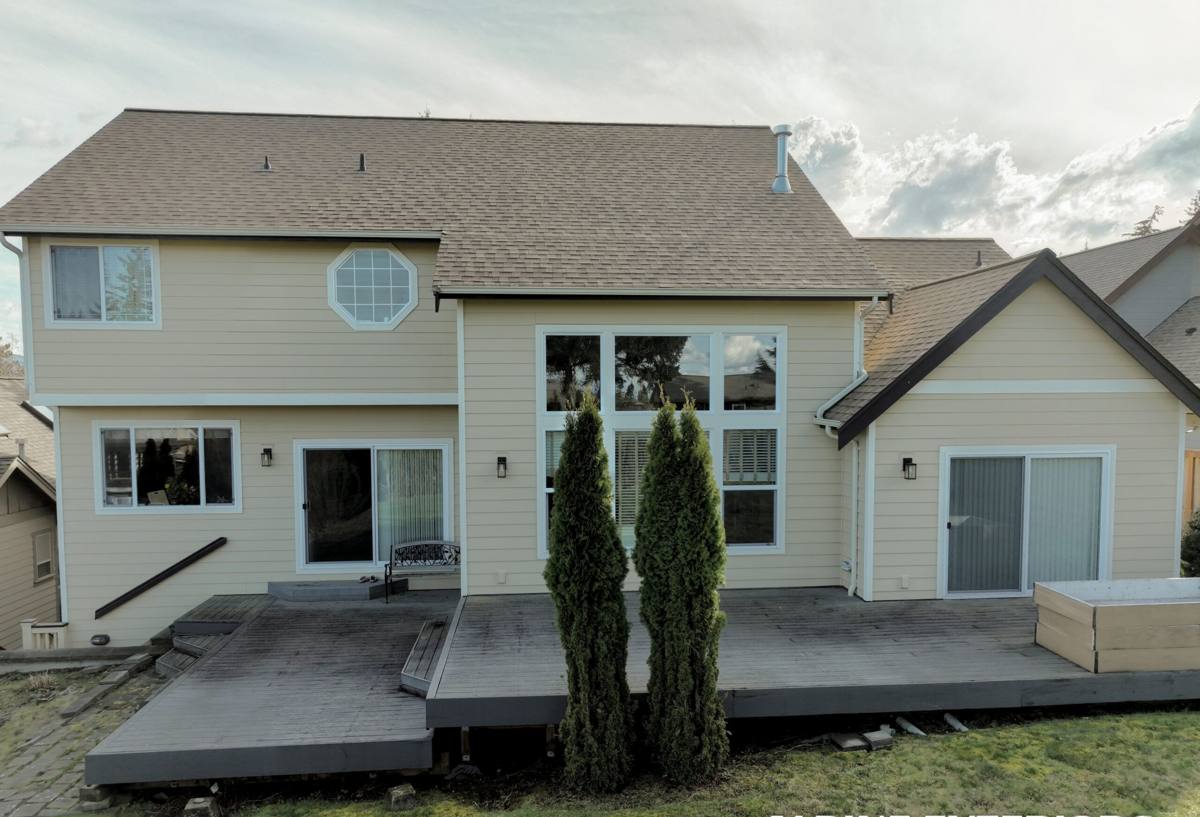
What Coastal Exposure Actually Does to a Deck
It helps to understand the specific ways a waterfront or near-waterfront deck fails, because it explains almost every material and construction choice that follows.
Salt Air and Corrosion
Airborne salt is a slow, steady corrosive. It doesn't take a direct ocean spray to cause damage — salt-bearing air drifts inland and settles on metal surfaces day after day. Standard electro-galvanized screws, nails, and joist hardware that hold up fine in a drier inland yard can start rusting within a few seasons in Birch Bay. Once a fastener rusts, it weakens, stains the wood or composite around it, and eventually needs replacing — which usually means partially disassembling the deck to get at it.
Wind-Driven Rain
Rain in this part of Washington rarely just falls straight down; it comes in on the wind, which means it gets pushed sideways into places a "normal" rain event wouldn't reach — up under railing caps, behind ledger boards, into the gap between decking boards and the house. Over time, wind-driven rain finds every weak point in flashing, caulking, and board spacing. A deck that isn't detailed for this kind of exposure will trap moisture in exactly the places you can't see it.
The Long Moss Season
Low winter sun angles, extended cloud cover, and consistent dampness give moss and algae a long window to establish on horizontal wood surfaces — decking boards, stair treads, and railing caps in particular. Beyond looking bad, a mossy deck surface holds moisture against the wood fibers underneath and becomes genuinely slick underfoot, which is a real fall hazard on stairs.
Choosing a Decking Material for This Climate
There's no single "correct" material for every Birch Bay deck — it depends on your budget, how much upkeep you want to do, and how much sun exposure the deck gets. But the trade-offs are worth understanding before you decide.
Wood Decking (Cedar and Pressure-Treated)
Cedar has natural rot resistance and a look a lot of homeowners want, but it's a softer wood that needs regular sealing to hold up against wind-driven rain — skip a season of maintenance near the bay and you'll see it. Pressure-treated lumber is more affordable and structurally solid, but it's also more prone to cupping and checking in a wet-dry-wet climate cycle, and it needs the same ongoing sealing commitment as cedar. Wood is a legitimate choice, but it's the one that requires the most consistent owner involvement to stay ahead of moss and moisture.
Composite Decking
Composite boards resist moisture absorption far better than wood and won't rot, which matters a lot in a climate with this much sustained dampness. They still need to be kept clean, since moss and algae can grow on the surface of any decking material, but they don't need sealing or staining. The trade-off is upfront cost and the fact that not all composite products handle UV and moisture cycling equally well — quality varies more than people expect between brands and product lines.
PVC and Vinyl Decking
Fully synthetic decking is the most moisture-indifferent option — it doesn't absorb water at all, which removes rot and most moisture-related structural concerns entirely. It's typically the highest upfront cost of the three, and some products have a more obviously "manufactured" look than wood-grain composites, so it comes down to priorities: if long-term moisture performance with minimal upkeep is the top priority, it's worth a look.
| Material | Moisture/Salt Resistance | Maintenance Needed | Typical Cost Tier |
|---|---|---|---|
| Pressure-Treated Wood | Fair — needs consistent sealing | High — annual cleaning and sealing | Budget-friendly |
| Cedar | Good naturally, fair if unsealed | High — regular sealing/staining | Mid-range |
| Composite | Very good | Low — periodic cleaning | Mid to upper-mid |
| PVC/Vinyl | Excellent | Low — periodic cleaning | Upper tier |
Framing, Fasteners, and the Details That Fail First
The decking surface is the part homeowners think about, but on a coastal deck, the framing and hardware are usually what fails first — and they're the hardest part to inspect once the deck is built. This is where we make different calls in Birch Bay than we would on an inland job.
- Stainless steel or heavy-duty coated fasteners rated for coastal/marine exposure, not standard electro-galvanized hardware
- Corrosion-resistant joist hangers and structural connectors at every framing junction
- Proper ledger board flashing where the deck attaches to the house, to keep wind-driven rain from tracking behind it
- Joist tape or equivalent moisture barrier on top of framing members before decking goes down
- Post bases that keep structural posts off direct ground contact and standing water
- Adequate board spacing and airflow underneath the deck so trapped moisture can actually dry out
None of these are visible once the deck is finished, which is exactly why they matter — they're the difference between a deck that's still structurally sound in fifteen years and one with hidden rot or rusted-through hardware by year seven.
Design Considerations Specific to Birch Bay Properties
Beyond materials, a handful of site-specific factors shape how we lay out a deck near the water.
Wind Exposure and Railings
Open water views often mean open wind exposure. Railing design needs to account for wind load, not just code minimums, and we think about how gaps, glass panels, or solid sections will perform in sustained wind rather than just how they'll look on a calm day.
Orientation
There's usually a pull toward orienting a deck to maximize the water view, and that's reasonable — but it can also mean orienting the deck directly into prevailing wind and rain. We talk through that trade-off with homeowners rather than defaulting to view-first without discussing the maintenance and comfort consequences.
Drainage and Grading
Many Birch Bay lots have some slope toward the water, and a deck built without accounting for that grading can end up channeling runoff toward the foundation instead of away from it. Getting drainage right under and around the deck is part of the design, not something addressed after the fact.
Permits and Working Near the Shoreline in Whatcom County
Deck projects in Whatcom County generally require a building permit, and properties near the water can also fall under shoreline or critical area review depending on proximity to the bay and the scope of the project. We handle the permit process as part of the job, but we also tell homeowners upfront when a project's location or size is likely to trigger additional review, rather than letting that surprise come up mid-project. If you're not sure whether your property falls into a shoreline review zone, that's a fair question to ask us during the initial estimate.
Our Process, Start to Finish
Site Visit and Design
We start by walking the property, looking at sun and wind exposure, existing drainage patterns, and how the deck needs to connect to the house. This is also where we talk through material options honestly, including what each one will actually cost you in upkeep over time.
Permitting and Planning
Once the design and material are set, we handle the permit application and confirm any shoreline or setback requirements that apply to the specific lot.
Construction
Framing goes in first, with the corrosion-resistant hardware and flashing details covered above, followed by decking, railings, and stairs. We inspect our own connections as we go rather than treating framing as a step to rush through to get to the visible finish work.
Final Walkthrough
We walk the finished deck with you, cover basic care for whatever material you chose, and make sure everything meets what was discussed at the start — no surprises at the end.
Maintenance Checklist for a Birch Bay Deck
Whatever material you choose, a little seasonal attention goes a long way in this climate. A reasonable annual routine looks like this:
- Rinse salt residue off railings, hardware, and decking surfaces periodically, especially after windy weather off the water
- Inspect visible fasteners and hardware for early rust staining
- Check ledger board flashing and any caulked joints for gaps or wear
- Clean moss and algae off decking boards and stairs before it builds up, particularly going into fall and winter
- Reseal wood decking on a regular schedule — don't wait until it looks dry and gray
- Confirm stairs and railings are still solid, since these get the most direct weather exposure and the most physical stress
- Make sure drainage under and around the deck hasn't gotten blocked by debris
Why a Local Crew Matters for This Job
A deck built to a generic spec sheet can look identical to a coastal-appropriate deck on the day it's finished. The difference shows up two, five, and ten years later, in the fasteners you can't see and the flashing details nobody checks until something leaks. Working regularly in and around Birch Bay means we've seen firsthand which details hold up to this exposure and which ones don't — not from a manufacturer's spec sheet, but from opening up decks that were built without them. That's the practical value of hiring a crew based in Ferndale that already works this specific stretch of Whatcom County coastline, rather than a general contractor building the same deck they'd build anywhere else in the state.
If you're planning a new deck or replacing one that's showing its age, we're happy to take a look and talk through honest options for your property. Reach out for a free, no-pressure estimate using the form below.