 Ferndale Exterior
 Deck Building in Lynden: What the Climate Actually Demands
Lynden sits inland from Bellingham Bay, in the Nooksack River valley, and homeowners there sometimes assume they're spared the coastal wear that hits properties closer to the water. That's only partly true. Lynden doesn't get the direct salt exposure that decks in Ferndale proper or along the bay deal with, but it still sits squarely in Whatcom County's wet, gray, moss-friendly climate — long stretches of drizzle, heavy dew, low winter sun angles, and short drying windows between rain events. A deck built here has to manage moisture first and cosmetics second, or the cosmetics won't last anyway.
The practical result is that decking, framing, and hardware choices that work fine in a drier climate can fail early in Lynden. Untreated or poorly sealed cut ends rot from the inside out. Ledger boards that aren't flashed correctly let water track into the house framing where nobody sees it until there's a soft spot on the rim joist. Decking installed tight with no drainage gap turns into a moss farm by year two. None of this is exotic — it's just what happens when a structure sits outside, in the rain, for years, and the build didn't account for it.
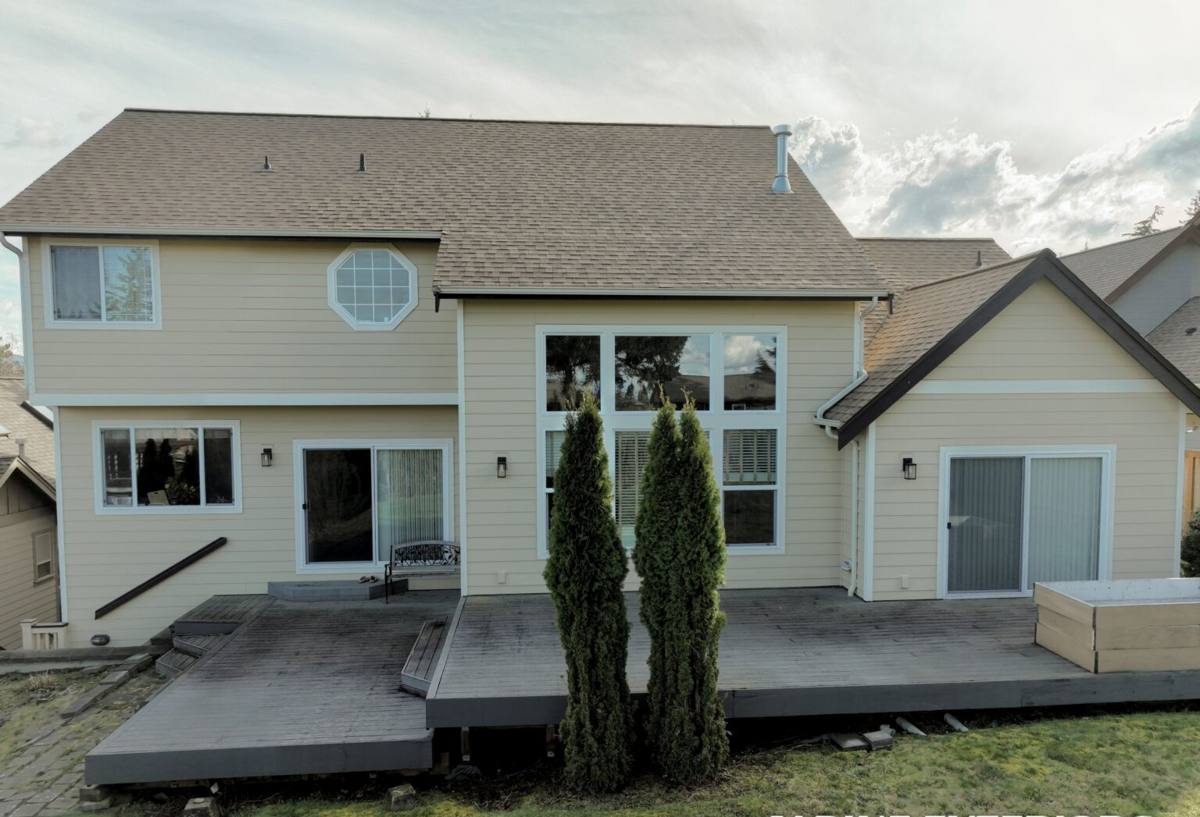
Where Decks in This Area Usually Go Wrong
Moss and surface buildup
Moss needs shade, moisture, and time — Lynden's long wet season provides all three. On decking with a rough or overly porous surface, or in shaded yards under mature trees, moss can establish within a season or two if the boards don't shed water and dry out between rains. It's not just cosmetic: moss holds moisture against the board surface, which accelerates rot in wood and can stain and roughen the surface of some composite products over time.
Driving rain and end-grain exposure
Rain in this region rarely falls straight down — wind-driven rain gets under rail caps, into fastener holes, and into any cut end that wasn't sealed. Cut ends are the single most common failure point on wood decks we get called to repair, because factory-treated lumber is only treated on the outer surface; every field cut exposes untreated wood unless it's sealed on site.
Freeze-thaw cycling
Whatcom County doesn't get deep freezes often, but it gets enough freeze-thaw swings each winter to matter. Water that's soaked into a joint, a post base, or a crack in aging wood expands when it freezes and works the damage wider each cycle. Over several winters, that's how a minor moisture problem becomes a structural one.
What a Correctly Built Deck Includes
A deck that's going to hold up under Lynden's conditions for decades, not years, comes down to a handful of non-negotiables:
- Proper footings — sized and set below frost depth per local code, not just poured on grade
- Ledger board flashed correctly — with flashing that directs water away from the house band joist, not a bead of caulk standing in for real flashing
- Joist tape or cap protection — on the tops of framing lumber so fastener penetrations don't become entry points for water
- Correct board spacing — a consistent drainage gap between deck boards so water and debris don't sit and hold moisture
- Sealed or factory-treated cut ends — every field cut sealed before install, not left raw
- Code-compliant guardrails and stair geometry — rail height, baluster spacing, and stair rise/run built to current code, not "close enough"
None of this is visible once the deck is finished, which is exactly why it matters. A deck that looks identical from the surface can be built two very different ways underneath — one that sheds water for 25 years and one that's rotting from the inside by year five.
Decking Material Comparison for This Climate
There's no universally "best" decking material — the right choice depends on budget, maintenance appetite, and how much shade and moisture the site sees. Here's how the common options actually perform in Whatcom County's wet, mossy conditions:
| Material | Moisture Behavior | Maintenance | Typical Lifespan Here |
|---|---|---|---|
| Pressure-treated pine | Resists rot when sealed regularly; end cuts need re-sealing | Annual cleaning; re-seal or stain every 2–3 years | 15–20 years with upkeep |
| Cedar | Naturally rot- and insect-resistant; still needs finish maintained | Cleaning plus refinishing every 2–3 years to hold color and protection | 20–25 years with upkeep |
| Composite (capped) | Doesn't absorb water like wood; low rot risk in the board itself | Periodic cleaning to prevent surface algae/moss buildup in shaded spots | 25–30+ years, manufacturer-dependent |
| PVC | Fully moisture-resistant board material | Low; occasional cleaning | 25–30+ years, manufacturer-dependent |
Composite and PVC cost more up front and reduce the sealing/staining cycle, which is a real advantage in a climate where that maintenance window is short. Wood costs less initially but only holds up if the maintenance actually happens on schedule — in a climate this wet, skipped maintenance shows up faster than it would somewhere drier. We'll walk through what fits your site and budget honestly, including the trade-offs, rather than pushing one product line.
Framing and Substructure Matter More Than the Decking
Homeowners naturally focus on the decking surface since that's what they see and stand on, but the substructure is what determines whether the deck is safe and long-lived. Joist spacing, beam sizing, footing depth, and post-to-beam connections all need to be sized for the actual load — furniture, hot tubs, gatherings — not just the minimum. In a region with this much annual rainfall, we also pay close attention to keeping the substructure ventilated: framing that can't dry out between storms is framing that rots regardless of how good the decking on top of it is.
Permits, Setbacks, and Code in Whatcom County
Deck projects in this area typically require a building permit once they exceed a certain size or height off grade, and guardrail, stair, and footing requirements are set by code, not by preference. Setback requirements from property lines can also affect where a deck can be built or how large it can be. We handle the permitting process as part of the job — pulling the right permit, building to the inspected requirements, and scheduling inspections — so you're not left guessing whether your deck is actually compliant.
Our Process for Lynden Deck Projects
- On-site assessment — we look at sun/shade exposure, drainage on the site, existing structure condition if it's a rebuild, and how the deck will connect to the house
- Design and material selection — sized to your use case and budget, with an honest rundown of material trade-offs for this climate
- Permitting — we pull the required permit and build to the plan that's approved
- Demo and site prep — removing any existing structure and preparing footings
- Framing and flashing — footings, posts, beams, joists, and correct ledger flashing before any decking goes down
- Decking, rails, and stairs — installed with proper spacing, sealed cut ends, and code-compliant guardrails
- Final walkthrough and inspection — we confirm everything passes inspection and walk the finished deck with you
Maintaining a Deck Once It's Built
Even a well-built deck needs some seasonal attention in this climate to get its full lifespan. A simple annual routine goes a long way:
- Sweep debris and standing leaves off the deck surface before fall rains set in, especially in shaded corners where moss gets a foothold
- Check that drainage gaps between boards haven't filled in with debris
- Inspect fastener heads and any visible flashing at the ledger board for movement or gaps
- For wood decks, plan on cleaning and re-sealing or staining every 2–3 years — don't wait until the finish is visibly failing
- For composite or PVC decking, clean shaded, damp areas periodically to keep algae and moss from establishing
- Check guardrail and stair connections annually for looseness, especially after a hard winter
Why a Crew That Already Works This Area Matters
Building decks in Lynden and the surrounding Whatcom County communities day in and day out means we're not guessing at what this climate does to a structure over time — we've seen which details hold up and which ones fail early, because we've been back to fix the ones that didn't. That includes knowing the local permitting process, understanding how sun exposure and shade patterns vary across different Lynden yards, and building substructures that account for a genuinely wet, moss-prone climate rather than a generic spec sheet. A deck is a long-term structure attached to your house; it's worth having it built by a crew that treats the parts you can't see with the same care as the parts you can.
If you're planning a new deck or need to replace one that's showing its age, we're happy to take a look and give you a straightforward assessment — no pressure, no upsell, just an honest read on what your project needs. Use the form below to request a free estimate.