 Ferndale Exterior
 Windows Built for Marietta's Coastal Climate
Marietta sits close enough to Bellingham Bay that the air itself works against your windows every single day. Salt-laden moisture rides in on the wind, settles into seals and hardware, and slowly breaks down materials that would last decades in a drier inland climate. Add Whatcom County's driving rain — the kind that comes in sideways during a winter system — and a moss season that can stretch from October through May, and you have a set of conditions that punishes ordinary windows faster than most homeowners expect.
Energy-efficient windows are not just about lower utility bills, though that matters. In Marietta, the bigger issue is often what happens when a window's seal fails quietly: condensation between panes, soft framing around the sash, drafts that show up as a cold spot on the couch every winter. A properly specified and correctly installed window solves both problems at once — comfort and durability — because the same construction details that stop heat loss also stop water intrusion.
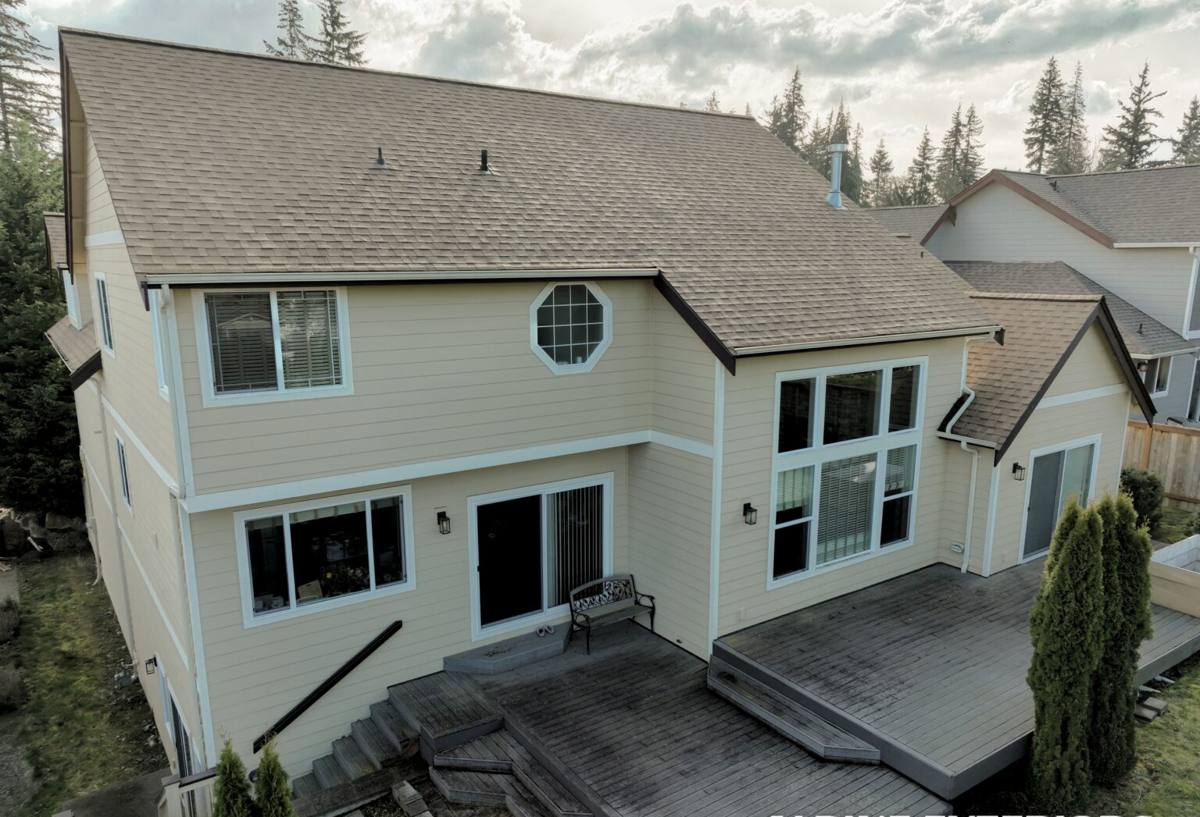
What "Energy-Efficient" Actually Means for This Area
The term gets used loosely in advertising, so it's worth being specific about what actually matters for a Marietta home.
Glass Package
Double-pane glass with a low-emissivity (low-E) coating and an argon or krypton gas fill between the panes is the baseline for this climate. The coating reflects radiant heat back into the room in winter and blocks solar heat gain in summer, while the gas fill slows heat transfer through the airspace itself. In a marine climate like ours, where temperature swings are moderate but damp cold is constant, the low-E coating does more day-to-day work than raw pane count.
Frame Material
Frame material affects both thermal performance and how the window holds up against salt air and constant moisture. We'll walk through the trade-offs in the comparison table below, but the short version is: whatever material you choose, the frame needs a finish and hardware rated for coastal exposure, not just a standard inland spec.
Spacer System
The spacer that separates the two panes of glass is a weak point on cheaper windows. Metal spacers conduct cold straight to the edge of the glass, which is why older double-pane windows often fog or frost along the perimeter first. A warm-edge (non-metal or thermally broken) spacer keeps that edge temperature closer to the center of the glass, which matters a lot during a Whatcom County cold snap.
Installation Detailing
None of the above matters if the window isn't sealed and flashed correctly into the wall. This is the step that gets rushed on lower-bid jobs and is the single biggest predictor of whether a window leaks in three years.
Signs Your Current Windows Are Working Against You
Homeowners in Marietta usually notice one of these before they call for an estimate:
- Visible fog or moisture trapped between the panes (a failed seal — this cannot be cleaned, only replaced)
- Cold air noticeable near the window even with it fully closed and locked
- Soft, discolored, or swollen wood at the sill or lower corners of the frame
- Moss or dark streaking on the exterior trim directly around the window
- Difficulty opening, closing, or locking a window that used to operate smoothly
- A noticeable jump in heating costs without a corresponding change in usage
- Condensation on the interior glass on cold mornings, even with normal household humidity
Any one of these is worth a look. Several together usually mean the window's seal and weatherstripping have both given out, which is common once original windows pass the fifteen- to twenty-year mark in this climate.
Frame Material Comparison for Coastal Whatcom County
| Frame Material | Performance in Salt Air & Rain | Maintenance | Typical Lifespan Here |
|---|---|---|---|
| Vinyl | Good — won't rust or corrode; UV-stable finishes hold up well | Low; occasional cleaning | 20-30 years |
| Fiberglass | Very good — dimensionally stable, resists warping from moisture cycling | Low | 30-40 years |
| Aluminum | Fair — needs a marine-grade finish and thermal break, or it conducts cold and can corrode over time | Moderate | Varies widely by finish quality |
| Wood / wood-clad | Requires diligent upkeep — exposed wood is vulnerable to the constant damp and moss growth typical here | High | Depends heavily on maintenance |
We don't push one material on every job. A shaded, moss-prone north wall calls for different priorities than a south-facing wall that gets more sun and drying time. What we won't do is install a frame material into a high-exposure spot without the right finish or detailing to handle it — that's a callback waiting to happen, and it's not a trade-off we ask homeowners to gamble on.
How We Approach a Marietta Window Project
1. On-Site Assessment
We look at each window opening individually, not just the house as a whole. Sun exposure, wall orientation relative to prevailing wind and rain, existing framing condition, and any signs of past water intrusion all factor into what we recommend for that specific opening.
2. Measurement and Product Selection
Openings are measured precisely — old construction is rarely perfectly square, and a window that's forced to fit an out-of-square opening won't seal correctly no matter how good the product is. We match glass package, frame material, and hardware to the exposure conditions we found in the assessment.
3. Removal Without Collateral Damage
Old windows and any deteriorated framing material around them are removed carefully. If we find rot or moisture damage in the rough opening — common on older homes here — we flag it before proceeding rather than sealing a problem behind a new window.
4. Flashing and Air Sealing
This is the step that determines whether the window performs for twenty years or leaks in three. Proper flashing directs any water that gets behind the siding back out, rather than into the wall cavity. Air sealing around the frame closes the gaps that cause drafts and energy loss, using materials rated for exterior moisture exposure — not just standard interior caulk.
5. Final Check and Cleanup
Every window is operated, checked for square, level, and plumb, and inspected for a consistent seal around the full perimeter before we consider the job done. Job site debris and old materials are hauled away.
What Drives Cost on a Window Project
| Factor | Why It Matters |
|---|---|
| Number and size of openings | More straightforward — cost scales with the amount of window being replaced |
| Frame material selected | Vinyl, fiberglass, and clad options carry different material costs |
| Existing frame condition | Rot or moisture damage found during removal adds repair scope before the new window goes in |
| Access and wall height | Second-story or hard-to-reach openings take more time and equipment |
| New construction vs. retrofit | Full-frame replacement (tearing out to the studs) costs more than an insert replacement into a sound existing frame |
We won't quote a number without seeing the openings — anyone who does is guessing. What we can say honestly: the biggest cost swings usually come from hidden frame damage discovered during removal, not from the window product itself. That's exactly why the assessment step matters, and why we'd rather find that damage during a walkthrough than after demo has started.
Why Local Experience in This Area Matters
Marietta's proximity to the bay means every exterior product on a home here is dealing with a different stress load than the same product would face twenty miles inland. Salt air accelerates corrosion on hardware and fasteners that aren't rated for it. Driving rain finds gaps in flashing that would never get tested in a drier climate. And the long moss season means anything that stays damp for extended stretches — trim, sills, low-quality caulk — will show it within a couple of seasons.
A crew that works Whatcom County regularly knows which details to get right the first time: how deep the flashing needs to lap, which sealants actually hold up to sustained moisture rather than just passing a quick inspection, and where on a given elevation to expect the worst exposure. That knowledge doesn't come from a spec sheet — it comes from seeing how windows in this specific climate actually fail, and building the fix around that.
Maintaining Your Investment After Installation
Energy-efficient windows still need basic upkeep in a climate like this one:
- Rinse salt residue off exterior glass and frames periodically, especially on wind-exposed elevations
- Keep weep holes (the small drainage openings at the bottom of the frame) clear of debris and moss so water can drain out properly
- Check and clean weatherstripping annually — grit and moss spores can work into the seal over time
- Trim back vegetation that shades a window and keeps it damp longer than it needs to be
- Address any caulking cracks at the trim promptly, before water gets behind it
None of this is heavy maintenance, but skipping it is how a good window's lifespan gets cut short in a coastal climate.
Ready to Talk Through Your Windows?
If your Marietta home has windows showing any of the signs above — or you're just tired of a cold draft every winter — we're happy to take a look and walk you through honest options for your specific openings and exposure. There's no pressure and no obligation. Use the form below to request a free estimate, and we'll go from there.