 Ferndale Exterior
 What Cordata's Climate Does to Exterior Siding
Homes in the Cordata area sit in a stretch of Whatcom County that gets hit with a specific combination of weather stress: marine, salt-laden air moving in off the water, long stretches of driving rain through fall and winter, and a moss season that can run most of the year in shaded, north-facing spots. None of these individually would wreck a wall system fast. Together, over years, they find every weak point in a siding installation — the seam that wasn't caulked right, the fastener that missed the stud, the bottom course that was never held off the ground.
Salt air is corrosive to exposed metal fasteners and trim, and it accelerates the breakdown of finishes that aren't built to shed it. Driving rain doesn't just wet a wall's surface — wind-driven moisture gets pushed sideways and upward, finding gaps that a calm-weather rain would never reach. And moss doesn't just look bad; a sustained moss mat holds moisture against a wall surface far longer than open air would, which is a problem for any siding material that isn't dimensionally stable when wet.
This is the environment we're installing into on every Cordata-area job, and it's why we don't treat siding as an interchangeable commodity. The product and the installation both have to be matched to what this specific climate does to a house.
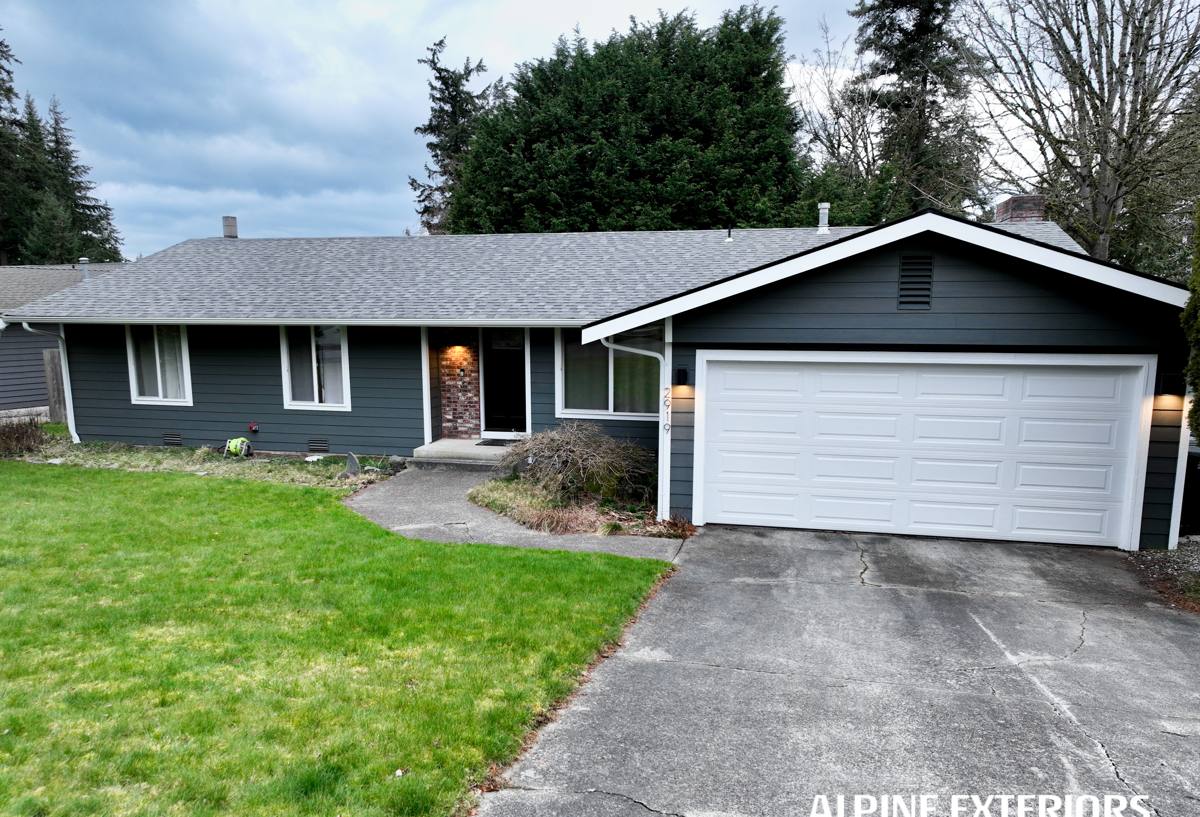
Why We Install Only James Hardie Fiber Cement
We don't install vinyl, LP SmartSide, primed spruce or cedar, or other fiber cement brands like Cemplank or Allura. That's a deliberate standard, not a lack of options. Fiber cement as a category — cement, sand, and cellulose fiber pressed and cured into a dimensionally stable board — handles wet marine climates better than wood-based or vinyl products because it doesn't expand, contract, or absorb moisture the way those materials do. Within fiber cement, James Hardie is the product we've settled on because of how the boards are engineered and finished, not because of marketing.
| Factor | What matters in this climate |
|---|---|
| Moisture stability | Fiber cement doesn't swell, rot, or delaminate the way wood-based siding can when repeatedly wetted by driving rain and shaded moss growth |
| Combustibility | Non-combustible material, which matters for insurance and wildfire-adjacent building codes even in a wet region |
| Factory finish | ColorPlus finish is baked on and warranted separately from the board, which holds color better against UV and salt exposure than field-applied paint |
| Climate engineering | Hardie's HZ product lines are formulated by moisture zone, which is directly relevant to a wet coastal county like Whatcom |
We're not going to tell homeowners that other products are junk — LP SmartSide has real fans and legitimate uses, and vinyl is cheap and low-maintenance in the right setting. Our position is narrower: for the moisture load and salt exposure a Cordata-area home deals with, and for the standard we want to stand behind years after we've left the job site, James Hardie's engineered fiber cement is what we're willing to install.
What a Correct Fiber Cement Installation Actually Involves
Drainage plane and rain screen gap
Fiber cement siding is not a waterproof membrane by itself — it's a cladding layer that has to work with a properly built wall behind it. A weather-resistive barrier, correctly lapped and taped at every penetration, sits behind the siding, and in a climate this wet we install with a rain screen gap so any water that gets past the cladding has somewhere to drain and dry instead of sitting against the sheathing.
Flashing at every transition
Windows, doors, deck ledgers, roof-to-wall intersections, and horizontal trim are where wind-driven rain finds its way in. Each of those transitions needs proper flashing, not just caulk. Caulk is a maintenance item that will eventually fail; flashing is the actual water management. We've reworked enough previously "finished" jobs to know that skipped flashing is the single most common cause of hidden rot behind siding that looks fine from the yard.
Fastening and clearances to manufacturer spec
James Hardie publishes specific fastening patterns, minimum clearances from grade, decks, and roof lines, and gapping requirements at butt joints. Those numbers aren't suggestions — they're what the warranty is actually based on, and they're what keeps a wall performing over 20-plus years instead of 8. Corrosion-resistant fasteners matter more here than in a drier inland climate, given the salt content in the air.
Choosing the Right HZ Line and ColorPlus Finish for This Location
James Hardie makes its siding in moisture-zone-specific HZ5 and HZ10 formulations, and Whatcom County's coastal exposure is exactly the kind of environment those distinctions exist for. We spec the product line based on the home's actual exposure — how much direct wind-driven rain a wall sees, how close it sits to salt air, how shaded and moss-prone the site is — rather than defaulting to whatever's cheapest to source.
ColorPlus finish is worth understanding on its own terms. It's a multi-coat, baked-on finish applied at the factory under controlled conditions, which produces more even, more durable color than field painting after installation — especially relevant where salt air and UV both work against a painted surface over time. It also carries its own finish warranty separate from the substrate warranty on the board itself. For homeowners who want the lowest-maintenance exterior possible, ColorPlus is almost always the right call over field-applied paint, particularly in a climate where repainting cycles get shortened by weather exposure.
Our Process, From First Estimate to Finished Job
- Walkthrough and assessment — we look at the existing siding, wall assembly, moisture history, and sun/shade exposure on each elevation before recommending a product line.
- Written scope and product spec — you get a clear breakdown of HZ line, trim package, and ColorPlus color before anything is ordered.
- Tear-off and wall inspection — old siding comes off and we check sheathing condition before closing the wall back up; this is where hidden rot from prior flashing failures gets caught.
- Weather barrier and rain screen install — done correctly the first time, since this layer is invisible once siding goes up.
- Flashing at all penetrations and transitions — windows, doors, roof lines, and any deck or utility penetrations.
- Fiber cement installation to manufacturer spec — fastening pattern, gapping, and clearances per James Hardie's published requirements.
- Final walkthrough — we go over the finished work with you before calling the job done.
Maintenance in a Moss-Prone, Salt-Air Climate
James Hardie fiber cement is genuinely low-maintenance compared to wood-based siding, but "low-maintenance" doesn't mean "no maintenance" in a climate like this one. A short annual routine keeps a correctly installed system performing the way it's designed to for decades.
- Rinse siding annually to clear salt residue and organic buildup, especially on shaded or north-facing walls where moss takes hold first
- Keep gutters clear so overflow doesn't run down and constantly wet a section of wall
- Trim back vegetation and tree cover that keeps a wall section shaded and damp longer than the rest of the house
- Inspect caulking at trim and penetrations yearly — caulk is a wear item even on a well-flashed wall
- Check that siding maintains its minimum clearance from grade, decking, and roof lines as landscaping or grading changes over time
- Address any small paint or finish chips promptly rather than letting exposed edges sit through a wet winter
Cost Factors for a Cordata-Area Siding Project
Every home is different, so we won't quote a number without seeing the house, but the variables that actually move the price on a fiber cement re-side are consistent enough to walk through in advance.
| Factor | Why it affects cost |
|---|---|
| Tear-off scope | Full removal of old siding and any needed sheathing repair adds labor beyond a straightforward re-side |
| Home size and wall complexity | More corners, dormers, and roof intersections mean more cutting, flashing, and trim detail |
| HZ line and product mix | HZ10 and specialty profiles (shingle-style accents, panel siding) cost more than standard lap siding |
| ColorPlus vs. primed-for-paint | ColorPlus carries a material premium but avoids a paint job and repaint cycles down the road |
| Trim and accessory package | Corner boards, window trim, and fascia detailing add material and labor but define the finished look |
| Access and site conditions | Multi-story walls, tight lot lines, or landscaping that complicates staging add time |
Why Hiring a Crew That Already Works This Area Matters
A siding contractor who works regularly in Whatcom County's coastal, wet environment has already seen what happens when flashing is skipped, when a rain screen gap is left out to save time, or when the wrong HZ line goes on a wall with heavy wind-driven rain exposure. That's not something you can fully substitute with a generic national install crew moving through on a regional contract. Local permitting familiarity, an honest read on how much sun or shade a specific lot actually gets through the year, and having to stand behind the work if a neighbor down the street calls with a problem five years later — all of that shapes how carefully a local crew installs the first time.
We install James Hardie fiber cement siding because we're comfortable putting our name behind it in this specific climate, on this specific type of job, for homeowners who are going to be looking at this siding — and living behind it — for the next several decades.
If you're weighing a siding replacement on a Cordata-area home, we're happy to walk the property, look at what's there now, and give you a straight assessment of what it would take to do it right. Use the form below to request a free, no-pressure estimate.