 Ferndale Exterior
 Marietta Sits Right Where Whatcom County's Weather Gets Serious
Marietta is a small, low-lying community tucked along the water just west of Ferndale, and that location matters more than most homeowners realize when it comes to siding. Homes here sit close to Bellingham Bay, which means near-constant exposure to salt-laden air, wind that carries moisture sideways instead of just down, and a shoreline microclimate that behaves differently than siding installed a few miles inland. Add in Whatcom County's long, gray wet season and you have a combination that punishes siding that isn't built and installed for it.
Salt air is corrosive to metal fasteners, flashing, and trim if the wrong materials or details are used. Driving rain — rain pushed horizontally by wind off the water — finds every gap, seam, and poorly lapped joint that would go unnoticed on a calmer, drier site. And the moss season here isn't a few weeks; between the shade from mature trees common in this area and months of damp, low-light conditions, moss and algae have a long runway to take hold on north-facing walls and anywhere airflow is limited. Siding installation in Marietta has to be planned around all three of these realities at once, not treated as a generic exterior upgrade.
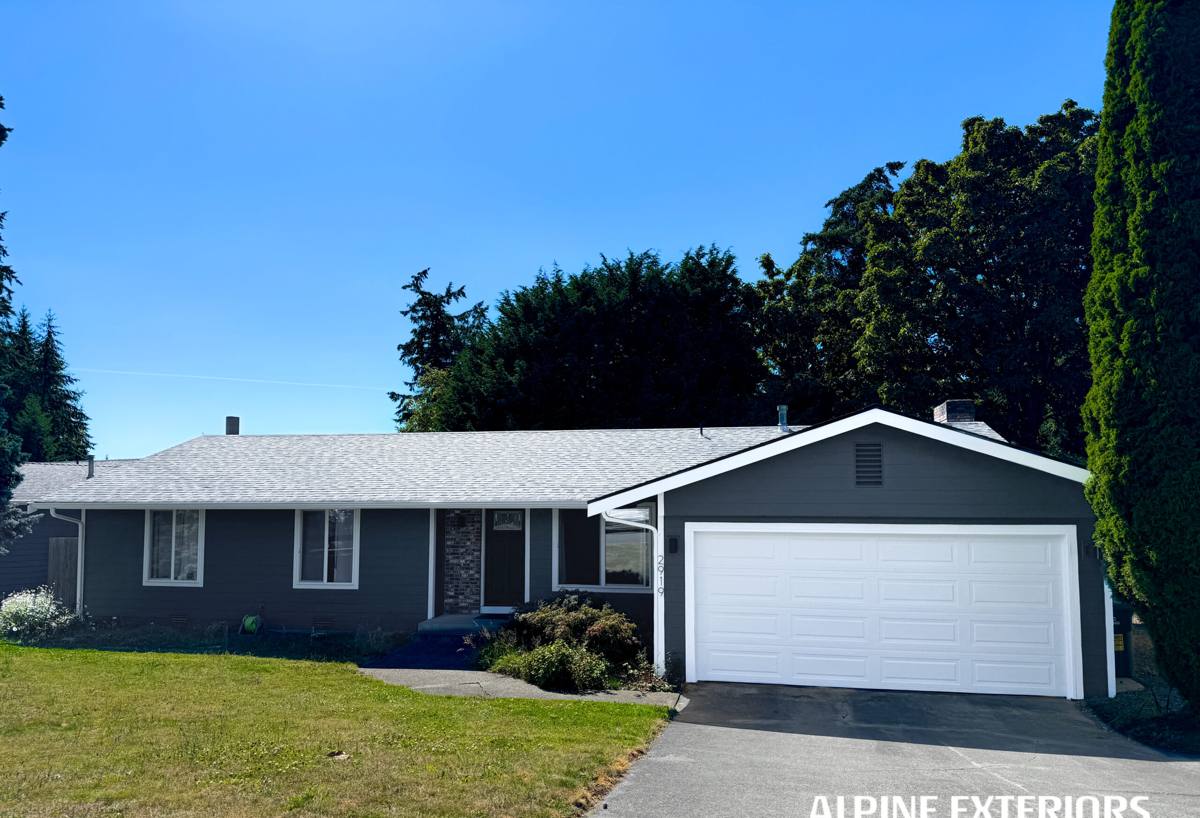
What "Correct" Siding Installation Actually Means Here
A lot of siding jobs look fine the day they're finished and start failing within a few wet seasons. The difference almost always comes down to the details that aren't visible once the siding is up. For a Marietta home, that means:
- A continuous, properly lapped weather-resistive barrier behind the siding — not just stapled house wrap with gaps at seams
- Correct flashing at every window, door, and horizontal trim transition, so water is directed out and down rather than trapped behind the cladding
- Proper fastener selection and placement — the wrong fastener in a salt-air environment corrodes, stains the siding, and eventually loosens
- Adequate ground clearance and drip edges so splashback and standing moisture near the foundation don't wick into the bottom courses
- Rainscreen or venting details where the wall assembly calls for them, to let incidental moisture dry out instead of sitting against the siding
None of this is exotic. It's standard best practice — but it only works if the crew installing it treats those steps as non-negotiable rather than optional, and that discipline is exactly where a lot of siding jobs in wet coastal climates go wrong.
Why We Only Install James Hardie Fiber Cement
We made a deliberate decision as a company: we install James Hardie fiber cement siding, and nothing else. Not vinyl, not LP SmartSide, not Cemplank or Allura, not primed spruce or cedar. That's not a marketing angle — it's because after years of working on homes in exactly the kind of climate Marietta sits in, Hardie is the one product system we're willing to stand behind long-term.
Fiber cement is non-combustible and dimensionally stable, meaning it doesn't expand, contract, warp, or cup the way wood-based products can when they cycle between soaked and dry through a Pacific Northwest winter. Hardie's ColorPlus factory-applied finish is baked on under controlled conditions, which gives it better fade and moisture resistance than field-applied paint — a real advantage in a spot where UV, salt, and rain all attack a finish at once. Hardie also engineers specific HZ5 product lines for harsher climate zones, which is relevant this close to open water. And the warranty is a real, transferable manufacturer warranty on the product itself, not just a contractor's promise.
We're not going to tell you every other product on the market is junk — vinyl, wood, and engineered wood siding all have legitimate use cases and honest trade-offs. But for a coastal Whatcom County home that has to shed driving rain, resist salt exposure, and hold up through a long moss season without constant upkeep, we've concluded fiber cement done right is the product worth putting our name on.
How Hardie Compares for a Marietta-Style Site
| Factor | James Hardie Fiber Cement | Vinyl Siding | Wood / LP-Style Engineered Wood |
|---|---|---|---|
| Salt air / coastal exposure | Engineered for harsh climates (HZ lines); factory finish resists fade and moisture damage | Can become brittle and discolor faster under UV and salt exposure over time | Vulnerable to moisture intrusion at cut edges and fastener points; needs vigilant sealing |
| Driving rain / wind-driven moisture | Rigid, holds tight lap lines when installed with correct flashing | Can flex and gap in high wind, opening paths for water intrusion | Swelling at edges if moisture gets past the coating |
| Moss and algae resistance | Factory finish resists organic growth better than field-applied coatings; doesn't feed fungal growth like wood | Resists rot but can trap moisture behind panels where moss/algae grow unseen | Wood-based substrate is more susceptible to moisture-driven fungal growth if the coating fails |
| Fire resistance | Non-combustible | Combustible, can melt/deform near heat sources | Combustible |
| Typical upkeep | Occasional wash-down; repaint only if not ColorPlus factory finish | Low maintenance but can crack/fade; hard to patch invisibly | Periodic recaulking, inspection, and repainting to protect the substrate |
This table isn't meant to declare every alternative product a bad choice everywhere — it's meant to show why, specifically for the conditions Marietta sees, fiber cement installed correctly comes out ahead on the things that actually fail first in this climate.
Our Process for a Marietta Siding Installation
Every job starts with an honest look at the existing wall assembly, not just the old siding. We check for hidden moisture damage, sheathing condition, and whether the current weather barrier and flashing details are salvageable or need to be redone. On a coastal site like this, we don't assume the substrate is fine just because the old siding looked okay from the street.
- Assessment and tear-off — remove old siding, inspect sheathing and framing for rot or moisture damage before anything new goes up
- Weather barrier installation — a continuous, correctly lapped moisture barrier, with any needed rainscreen detailing for wall assemblies that call for it
- Flashing at every penetration — windows, doors, hose bibs, light fixtures, and horizontal trim all get flashed to shed water outward
- James Hardie siding installation — installed to manufacturer specification, including fastener type, spacing, and clearances suited to a coastal exposure
- Trim, caulking, and finish detail — sealing only where Hardie's install guide calls for it, since over-caulking can trap moisture instead of shedding it
- Final walkthrough — we go over the finished exterior with the homeowner and explain what maintenance, if any, is actually needed going forward
Signs a Marietta Home May Need New Siding
Because this area's climate accelerates certain failure patterns, we tend to see specific warning signs come up on inspections here more than in drier parts of the county:
- Soft or spongy spots when you press on the siding, especially near the bottom courses or under windows
- Persistent moss or dark streaking on north- or west-facing walls that keeps returning after cleaning
- Visible gaps, warping, or cupping at panel seams and butt joints
- Peeling or bubbling paint that keeps coming back in the same spots year after year
- Rust staining running down from fasteners or metal trim
- A musty smell or visible staining on interior walls that share an exterior wall with problem siding
Any one of these on its own might just need a repair. Several together, especially on a home that's had the same siding for a couple of decades, usually means the wall assembly behind it needs a real look.
Why Local Installation Experience Matters
Siding manufacturers write installation specs for a huge range of climates, and following the letter of the instructions isn't the same as understanding how a wall assembly actually behaves a few blocks from tidal water. A crew that regularly works Ferndale and the surrounding Whatcom County communities knows which details to over-build for salt exposure, where wind-driven rain hits hardest on a given lot orientation, and which shaded, damp corners of a property are going to grow moss no matter what siding goes up. That judgment comes from doing the work here repeatedly, not from a manufacturer's general install guide.
It also means we're not guessing about permitting, local code requirements, or how a particular street's exposure to wind off the water should change our approach to flashing and clearances. That local familiarity is part of what a correct installation depends on — it's not a separate service, it's baked into how the work gets done.
Maintenance After Installation
James Hardie siding installed correctly is genuinely low-maintenance, but "low" doesn't mean "none" in a climate like this. A periodic rinse-down helps keep salt residue and organic growth from building up, particularly on shaded walls. Keeping gutters clear and vegetation trimmed back from the siding reduces the moisture and shade that moss needs to establish itself. Beyond that, an occasional visual check for caulking that's pulled away or trim that's showing wear is enough to catch small issues before they become bigger repairs.
If you're weighing a siding replacement for a Marietta property, we're happy to walk the exterior with you, point out what we're seeing, and explain exactly what a correct installation would involve for your home specifically. Reach out for a free, no-pressure estimate — there's no obligation, just a straight answer about what your siding needs.