 Ferndale Exterior
 Blaine's Coastal Climate Is Hard on Roofs
Blaine sits right on the water, tucked against Semiahmoo Bay and Drayton Harbor at the top of Whatcom County. That location gives homeowners some of the best views in the region — and some of the toughest conditions for a roof anywhere in the county. Between salt-laden air, wind-driven rain, and a moss season that can run most of the year, roofs here age differently than roofs even a few miles inland. A new roof installation in Blaine needs to be planned around those specifics, not treated as a generic reshingle job.
Salt Air and Corrosion
Homes close to the water deal with a slow, steady exposure to salt-laden moisture in the air. Over years, that accelerates corrosion on unprotected metal — nails, flashing, vent stacks, and fasteners that weren't rated for a marine-influenced environment. A roof that would hold up fine twenty miles inland can develop rust streaks, failing fasteners, or pitted flashing years earlier near the bay. Material choice and fastener selection matter more here than they do in a typical inland installation.
Driving Rain and Wind Off the Water
Blaine gets more wind-driven rain than sheltered inland areas. When rain comes in sideways instead of straight down, it finds every weak seam, every under-lapped shingle course, and every place where flashing was installed to code minimums instead of to a higher standard. Roofs in this area need more attention to the details that keep wind-driven water out — not just the visible shingle layer, but everything underneath it.
Moss, Shade, and a Long Wet Season
Like most of Whatcom County, Blaine has a long wet season and plenty of tree cover on wooded and semi-rural lots. Moss and algae get a real foothold on north-facing slopes and shaded sections of roof, and once established, moss holds moisture against the roofing material and works its way under shingle edges. A new roof is a chance to reset that clock and build in some resistance from day one.
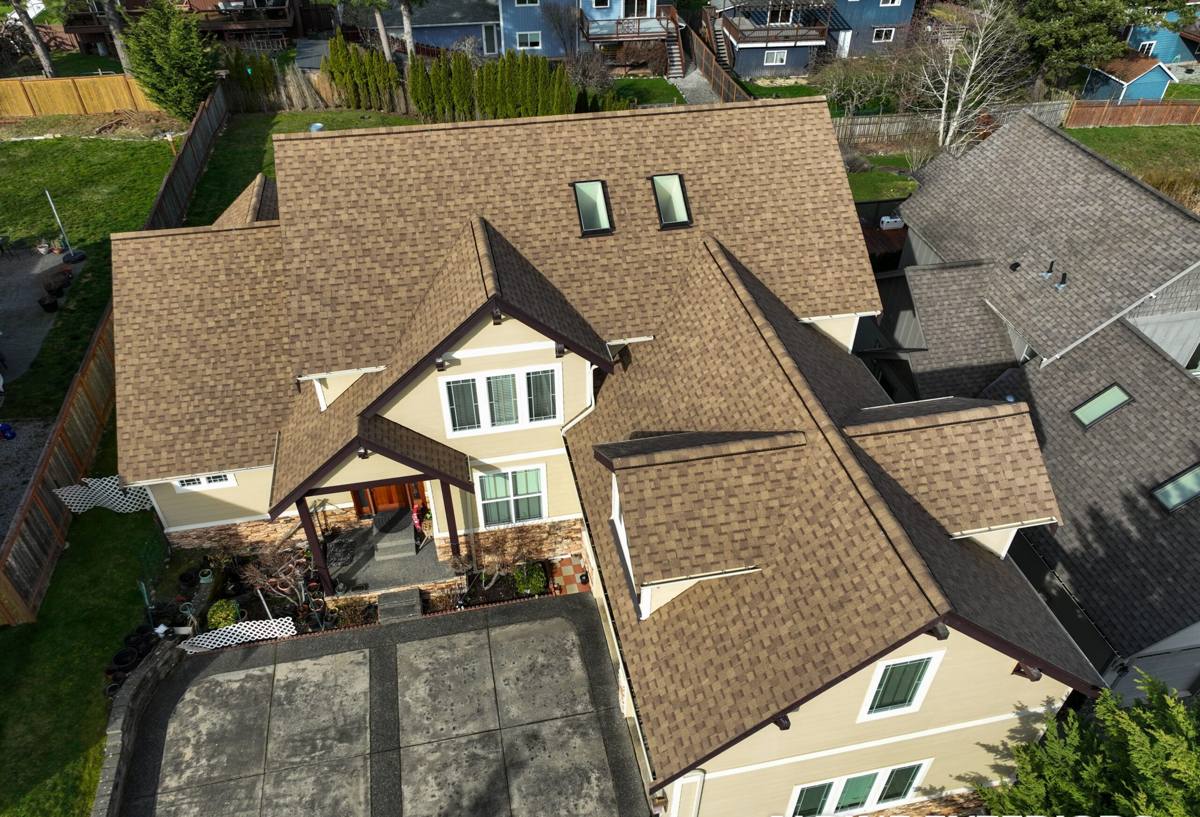
Signs Your Blaine Home Needs a New Roof, Not Another Repair
Not every roofing problem calls for full replacement. But there's a point where patching stops making financial sense and starts becoming money spent delaying an inevitable full install. Some of this is visible from the ground; some needs someone up on the roof and in the attic.
- Granule loss heavy enough that you can see bare, shiny patches on the shingle surface
- Shingles that are cupping, curling at the edges, or cracking across multiple slopes
- Soft spots in the roof deck when walked on, or visible sagging between rafters
- Recurring leaks in the same area even after repairs
- Moss or algae growth that comes back within a season or two of cleaning
- Flashing around chimneys, skylights, or vent stacks that's rusted, lifted, or improperly sealed
- Daylight or water staining visible in the attic along the roof deck or rafters
- A roof approaching or past the expected lifespan of its material
If you're seeing two or three of these at once, a straightforward repair usually isn't the right fix. We'll tell you honestly if a repair will hold for a few more years, or if you're better off putting that money toward a new roof instead.
What a Correct New Roof Installation Actually Involves
A new roof is more than stripping off old shingles and nailing down new ones. The parts nobody sees from the driveway are usually what determine whether the roof performs well for its full expected life, especially in a climate like Blaine's.
Tear-Off and Deck Inspection
We remove the existing roofing down to the deck rather than layering over it. That lets us actually see the plywood or plank sheathing underneath — soft, delaminated, or water-stained deck sections get replaced before anything new goes down. Installing new roofing over a compromised deck just hides a problem that will resurface later, usually as a leak.
Underlayment and Moisture Protection
Underlayment is the roof's backup layer if wind ever drives water past the shingles, which happens more often near the water than it does inland. In vulnerable areas — eaves, valleys, and low-slope transitions — we use self-adhered ice-and-water membrane rather than relying on standard felt or synthetic underlayment alone. This is one of the details that matters more in Blaine than it would in a drier, more sheltered part of the state.
Flashing Details
Flashing at chimneys, skylights, sidewalls, and valleys is where most roof leaks actually start, not in the open field of shingles. We install new flashing rather than reusing old pieces, and we choose materials that hold up to salt-air exposure rather than the cheapest option available. Step flashing, counter-flashing, and valley metal all get installed in the correct sequence with the underlayment and shingles — not caulked together as an afterthought.
Ventilation
A roof needs balanced intake and exhaust ventilation to manage heat and moisture in the attic. In a damp climate, poor ventilation traps moisture against the underside of the deck, which shortens the life of the roof from the inside and can encourage rot you won't see until it's advanced. We check existing ventilation as part of every new roof project and correct it when it's inadequate.
Choosing Roofing Materials for Blaine's Weather
Most Blaine homes end up choosing between a few practical options. Each has real trade-offs, and the right choice depends on your home's exposure, roof pitch, budget, and how long you plan to stay in the house.
| Material | Salt Air / Coastal Durability | Moss & Algae Resistance | Typical Lifespan | Relative Cost |
|---|---|---|---|---|
| Standard architectural asphalt shingle | Good with corrosion-resistant fasteners and flashing | Moderate; better with algae-resistant granules | 25–30 years | $ |
| Impact-rated (Class 4) asphalt shingle | Good, same fastener requirements apply | Moderate; usually paired with algae-resistant granules | 30+ years | $$ |
| Standing seam metal | Excellent with proper coating and fastener spec | Very good; sheds moss more easily due to slope and surface | 40–50+ years | $$$ |
Asphalt shingle roofing remains the most common choice in this area because it balances upfront cost with solid performance, especially in an algae-resistant formulation. Metal roofing costs more up front but sheds moss and biological growth more effectively because of its smooth, low-friction surface, and it holds up very well to coastal exposure when the coating and fasteners are specified correctly. We'll walk through the honest trade-offs for your specific roof rather than pushing whatever has the highest margin.
Our Local Installation Process
The steps below are roughly what a Blaine new roof install looks like from first call to final walkthrough.
- On-site inspection and honest assessment of whether repair or replacement is the right call
- Written estimate covering material options, scope of work, and a realistic timeline
- Scheduling around weather windows — we don't tear off a roof into an incoming storm system
- Tear-off, deck inspection, and any necessary deck repair before anything new is installed
- Installation of underlayment, ice-and-water membrane at vulnerable areas, and new flashing
- Shingle or metal panel installation to manufacturer specifications and proper fastening patterns
- Ventilation check and correction if intake or exhaust airflow is inadequate
- Full site cleanup and final walkthrough so you know exactly what was done and why
Why a Crew That Already Works in Blaine Matters
A roofing crew that works Blaine regularly already knows which details matter here: which slopes hold moss longest, how much wind exposure a given street sees off the water, and where salt-air corrosion tends to show up first on a roof. That local pattern recognition means fewer surprises during the job and a roof that's built for the conditions it will actually face, not generic conditions from a training manual. It also means we're not learning the area on your project — we're applying what we've already seen work on homes near yours.
Keeping Moss and Algae From Coming Back
A new roof is the best opportunity you'll have to get ahead of moss and algae, but the material alone isn't a permanent fix — some ongoing care keeps it from creeping back. Zinc or copper ridge strips can help suppress regrowth along the ridge line, where runoff carries trace metal ions down the slope. Beyond that, keeping nearby branches trimmed back to let light and airflow reach shaded slopes, and having the roof rinsed (never pressure-washed, which strips granules) every year or two, goes a long way. We're glad to point out which slopes on your specific roof are most at risk and explain simple upkeep — there's no obligation attached to that advice.
Permits and Local Code in Whatcom County
New roof installations in Blaine typically require a building permit through the applicable local jurisdiction, and the work needs to meet current Washington State building code for wind exposure, ventilation, and underlayment requirements. We handle the permit process as part of the job so you're not left navigating it alone, and we build to code as a floor, not a ceiling — meaning we often exceed the minimum requirement in areas like ice-and-water coverage and flashing quality, because code minimums are written for the whole state, not specifically for a bay-front climate.
If your roof is showing its age or you're just weighing options before it becomes an emergency, we're happy to take a look and give you a straightforward, no-pressure estimate. Use the form below to get started — there's no obligation, and we'll tell you honestly what your roof actually needs.