 Ferndale Exterior
 Siding Repair for Point Roberts Homes
Point Roberts is a strange piece of geography, and that shapes exterior work here as much as the weather does. It's an exclave of Whatcom County — American soil sitting on the tip of a peninsula that's cut off from the rest of Washington by land, reachable only by driving through Canada or by water and air. That isolation means fewer contractors bother learning the area at all, let alone learning what its specific exposure does to siding over time. We've been repairing siding on this peninsula for years, and we treat it as its own micro-climate rather than an afterthought tacked onto a Ferndale or Blaine service call.
This page is specifically about siding repair in Point Roberts — patching, resealing, board replacement, and diagnosing what's actually causing a problem — as distinct from a full re-side. Not every siding issue out here needs to become a bigger job, but a fair number of them do once you look behind the surface, and knowing the difference is most of what a good repair call comes down to.
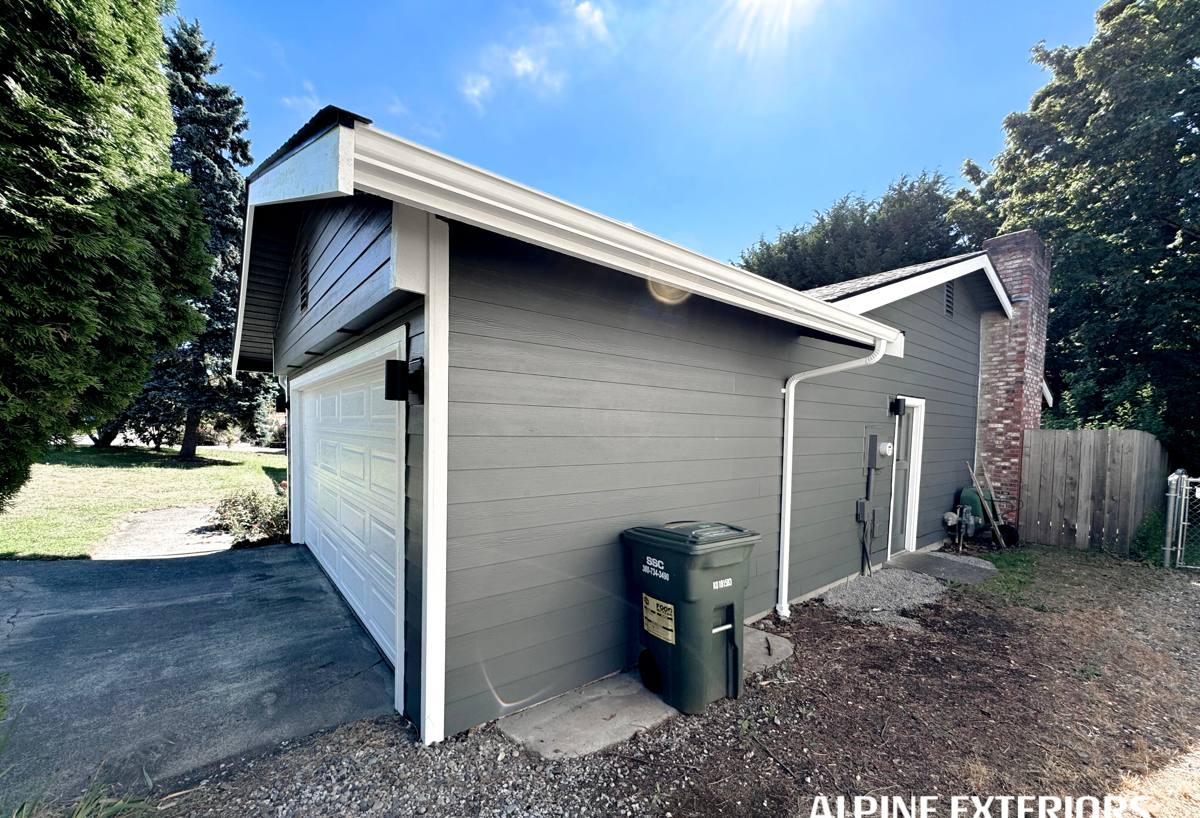
What Point Roberts' Exposure Does to Siding
Wind and Salt Air From Three Sides
Point Roberts sits on a peninsula with water on multiple sides — Boundary Bay to the east and the open water of the Strait of Georgia to the west. That's a different exposure than a typical inland Whatcom County lot. Homes here catch salt-laden marine air and wind more consistently than properties set back from the water, and that steady exposure accelerates corrosion in fasteners, flashing, and trim faster than a sheltered location would ever see.
Driving Rain That Doesn't Fall Straight Down
Being surrounded by open water means storms have a long fetch to build wind before they hit the peninsula, and that wind pushes rain sideways into laps, seams, and trim rather than letting it run straight off a wall. Siding details that are only built to shed rain falling straight down — a loose lap, an under-caulked corner, a flashing detail installed out of sequence — get tested here more often than they would a few miles inland.
A Moss Season That Barely Breaks
Mild temperatures and near-constant moisture keep moss and mildew active across most of the year on shaded and north-facing walls, which is true across Whatcom County but shows up early and lingers longer on a peninsula like this one. Moss isn't just cosmetic — it holds moisture directly against the siding surface, extending every wet cycle the material goes through and giving water more time to find its way into a seam or fastener hole that's already starting to fail.
Common Siding Repair Issues We See on Point Roberts Homes
The repair calls we run out here tend to fall into a fairly consistent set of patterns, and most of them trace back to the same combination of salt air, wind, and sustained moisture covered above.
- Cracked or shrunken caulk joints at trim, corners, and butt joints, letting water track behind the siding face
- Corroded fasteners that have backed out slightly or left rust streaks bleeding down the siding
- Cupped, swollen, or delaminating boards on wood-based or engineered wood siding, especially at cut edges
- Buckled or heat- and wind-distorted vinyl panels, particularly on wall sections that catch direct sun and wind together
- Isolated impact damage from wind-blown debris during winter storm systems
- Soft or slightly spongy sections that indicate moisture has already gotten past the surface
Repair or Replace? How We Make That Call
A repair only makes sense if it actually solves the underlying problem rather than covering it up. We look at both the extent of visible damage and what a moisture check tells us about what's happening behind the wall before recommending either path.
| What We Find | What We Typically Recommend | Why |
|---|---|---|
| Isolated crack or impact damage on otherwise sound Hardie siding | Patch or matched board replacement | The material underneath is intact, so a targeted fix holds without disturbing the rest of the wall |
| Failed caulk at several joints, no soft spots behind them | Targeted resealing and select board replacement | Catching joint failure early stops water from tracking further before it becomes a bigger repair |
| Soft sheathing or staining found once siding is pulled back | Section or wall-area replacement, not a surface patch | A cosmetic repair over trapped moisture just hides the problem until it spreads |
| Non-Hardie siding with widespread cupping, seam failure, or fading | Full re-side recommendation | Patching an aging system usually delays a larger cost rather than avoiding it |
We'll always tell you honestly which category your home falls into rather than defaulting to the more expensive answer. A lot of Point Roberts repair calls really are straightforward, isolated fixes — the goal is making sure that call is based on what we actually find, not a guess.
Why Repairs Here Go Back On With James Hardie Fiber Cement
We install and repair James Hardie fiber cement siding exclusively. We don't work with LP SmartSide, vinyl siding, Cemplank, Allura, primed spruce, or cedar. That's a professional standard we settled on after years of seeing how different materials actually hold up — or don't — in this kind of sustained coastal exposure, not a sales position.
- Non-combustible core: Fiber cement doesn't feed a fire the way wood-based siding can, which matters for household safety and can matter for insurance as well.
- Factory-applied ColorPlus finish: The color is baked on under controlled factory conditions rather than brushed on in the field, so it resists fading and chalking far longer than site-applied paint exposed to constant salt air.
- Climate-engineered HZ product lines: Hardie's HZ5 formulation is built for regions with heavy moisture exposure, which fits a Point Roberts property well.
- Dimensional stability: Fiber cement doesn't swell, cup, or warp with repeated wet-dry cycling the way engineered or solid wood siding can.
- Strong transferable warranty: Hardie backs the product with a solid warranty structure, provided the installation follows spec, which gives a homeowner real recourse rather than a marketing claim.
Matching a Repair Into Existing Hardie Siding
One of the trickier parts of repairing rather than replacing is color and profile matching, especially on an older home where the original ColorPlus color may have been updated or discontinued since installation. We check what's actually on the wall before ordering replacement boards, and where an exact factory match isn't available, we'll walk you through the honest options — a close match on a less visible elevation, a full wall-section replacement instead of a single board, or field-painting a small patch as a last resort, with the trade-offs of each laid out plainly.
What a Correct Repair Actually Involves
A repair that just caulks over a problem tends to fail again within a season or two out here. Doing it correctly means pulling enough of the surrounding siding to check for hidden moisture before closing anything back up, using the correct fastener type and spacing for the replacement boards, re-flashing any window, door, or penetration disturbed during the repair, and sealing joints with a product rated for sustained marine exposure rather than a generic caulk. Skipping any of those steps is exactly how a "quick fix" turns into a callback.
Why Logistics Matter for Exterior Work on Point Roberts
Point Roberts' isolation isn't just a geography trivia point — it's a real, practical factor in how exterior work gets done here. A crew driving out has to route through Canada and back into the U.S., which means factoring border crossing time into the schedule and making sure tools, materials, and trucks aren't tied up at the crossing on the day of a job. Materials need to be ordered and staged ahead of time, since a missing board or a forgotten fastener box isn't a quick supply-house run the way it would be on the mainland. A number of contractors simply won't take on jobs out here because of that friction, which narrows the field for homeowners and makes prior, hands-on experience with the crossing and the peninsula's specific exposure worth asking about directly when you're vetting who to hire.
Our Siding Repair Process
We start with an on-site assessment of the affected siding and the areas around it — not just the visible damage, but the joints, fasteners, and wall sections nearby that are exposed to the same conditions and may be a step or two behind on the same failure. From there we give you a clear, written scope that states plainly whether we're looking at a straightforward patch, a section replacement, or something bigger, along with a realistic timeline that accounts for the trip out and any material lead time. We handle flashing, fastener, and joint details as standard practice on every repair, not as an upsell, and we walk you through what we found and what we did once the work is finished.
Signs Your Point Roberts Home May Need Siding Repair
- Visible cracks, gaps, or shrinking caulk at trim, corners, or butt joints
- Rust streaking below fasteners or trim screws
- Cupping, swelling, or soft spots on wood-based or engineered wood siding
- Persistent moss or dark staining on shaded or north-facing walls that keeps returning after cleaning
- Buckled, warped, or loose vinyl panels, particularly on wind-exposed elevations
- Musty odors or interior staining near an exterior wall
Cost Factors for Siding Repair in Point Roberts
| Factor | What It Affects | Why It Matters Here |
|---|---|---|
| Extent of hidden moisture damage | Whether the job stays a surface patch or grows into sheathing repair | Salt air and wind-driven rain give moisture more chances to get behind the wall than a sheltered inland lot |
| Color and profile matching | Whether a single board, a section, or a full wall gets replaced | Older ColorPlus colors are sometimes discontinued, changing the practical repair options |
| Site access and trip logistics | Scheduling and material staging | Crossing through Canada to reach the peninsula means materials and tools need to be ready before the trip out |
| Occupancy status | Scheduling flexibility | Many properties on the peninsula are part-time or seasonal residences, which affects access and timing |
Exact costs depend on what we find once siding is opened up, which is why we give a real number after an on-site look rather than a phone estimate.
If you're seeing cracked caulk, rust streaks, soft siding, or persistent moss on a Point Roberts home, we're glad to take a look and give you an honest read on what it actually needs. Reach out using the form below for a free, no-pressure estimate.