 Ferndale Exterior
 Siding Repair in Bellingham: Built for This Climate, Not a Generic Fix
Bellingham sits close enough to the water that salt-laden air reaches home exteriors year-round, and close enough to the mountains that rain arrives sideways more often than people expect. Add the shaded, damp yards that many Whatcom County properties sit in, and you get a siding environment that's genuinely harder on materials than most of the country deals with. A siding repair here isn't just "patch the bad spot and move on." It has to account for what caused the damage in the first place, or the same failure shows up again in a year or two, usually worse.
We work on homes throughout the Bellingham area regularly, which means we're not guessing at how local siding ages — we're looking at it every week. That matters more than it sounds like it should, because siding damage in this climate rarely looks like a single obvious problem. It's usually a combination of moisture, organic growth, and material fatigue that's been building quietly behind the surface.
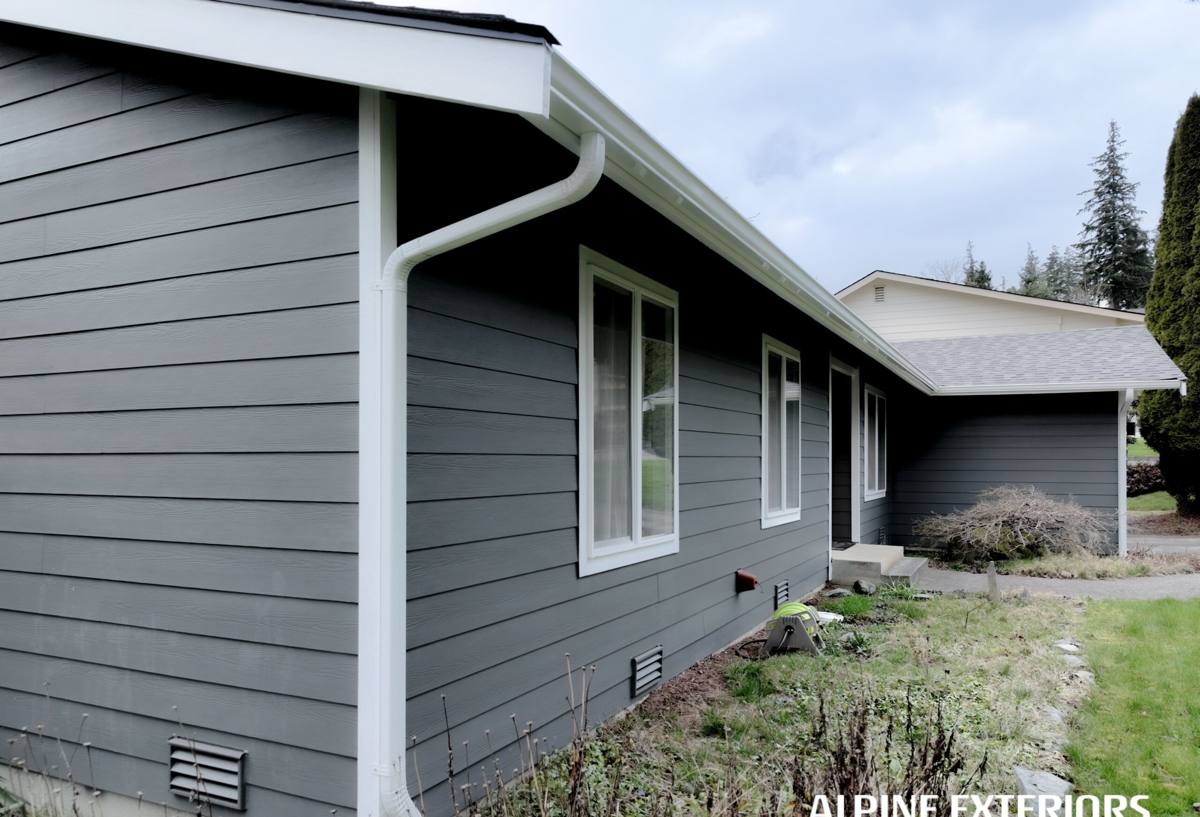
What's Really Going Wrong When Siding "Just Needs a Patch"
Moisture Intrusion vs. Cosmetic Damage
There's a real difference between siding that looks bad and siding that's failing structurally, and homeowners aren't expected to know which one they're looking at. Cosmetic damage — fading, minor surface cracking, a ding from a fallen branch — doesn't threaten the wall behind it. Moisture intrusion does. When water gets behind siding through a failed seam, a cracked board, or bad flashing, it doesn't dry out quickly in this climate. Bellingham's rain frequency and humidity mean trapped moisture has fewer chances to evaporate between storms than it would in a drier region, so small entry points turn into sheathing rot faster than homeowners expect.
Moss, Algae, and the Long Wet Season
Whatcom County's moss season runs long. On siding that stays shaded — north-facing walls, areas under trees, spots that don't get afternoon sun — moss and algae can take hold and stay established almost year-round. This isn't just a cosmetic nuisance. Moss holds moisture against the siding surface, which accelerates whatever degradation is already happening underneath, and on some materials it can work into seams and fastener points over time. A repair that just power-washes the surface without addressing why moss keeps coming back is a temporary fix at best.
Salt Air's Slow Effect on Fasteners and Trim
Even homes that aren't right on the water pick up salt-laden air moving in off Bellingham Bay. Over years, this accelerates corrosion on exposed fasteners, metal flashing, and trim components. A repair that reuses corroded fasteners or ignores a failing flashing detail is repairing the symptom, not the cause.
What a Correct Repair Involves
A repair done right starts with figuring out the actual source of the damage, not just the visible symptom. That means checking the area around the damaged section — not just the board itself — for softness, discoloration, or moisture in the sheathing behind it. If the underlying structure is compromised, patching the surface siding without addressing that is a short-term cosmetic fix that will fail again.
Correct repair work typically includes:
- Identifying whether the damage is isolated or a symptom of a broader moisture or flashing issue
- Removing and inspecting the affected siding and the sheathing or house wrap behind it
- Correcting any flashing, sealant, or drainage-plane issues that let moisture in
- Replacing damaged material with a matching product, not a mismatched patch
- Re-fastening and sealing to the same standard as new installation, not a shortcut version
Skipping any of these steps is how homeowners end up paying for the same repair twice.
Repair or Replace? How We Help Homeowners Decide
Not every damaged section needs a full siding replacement, and not every "small" repair should be treated as small. The right call depends on how widespread the underlying moisture issue is, how old the existing siding is, and what it's made of. Here's how we generally think through it on a site visit:
| Situation | Usually Repair | Usually Replace |
|---|---|---|
| Isolated impact damage (one board, no rot found behind it) | Yes | No |
| Localized rot found in one wall section during inspection | Yes, with sheathing repair | Not usually |
| Moisture damage found in multiple areas or repeat problem spots | No | Yes |
| Siding material is near or past its expected service life | No | Yes |
| Persistent moss/algae staining across large wall areas | Depends on cause | Often, if moisture-related |
We'll always tell you honestly which category your home falls into. There's no benefit to us talking a homeowner into a full replacement when a targeted repair will genuinely hold up — but we'll also tell you plainly when a patch is just delaying a bigger, more expensive problem.
Our Process for Bellingham-Area Repair Calls
Because we work in this area consistently, our repair process is built around what actually happens to siding here, not a generic checklist:
- On-site inspection — we look at the damaged area and the surrounding wall, not just the spot you called about
- Moisture and sheathing check — if there's any sign water has been getting behind the siding, we check how far it's traveled
- Honest scope discussion — we explain what we found, what's driving it, and what your real options are
- Matched repair or targeted replacement — using product that matches your existing siding as closely as possible
- Flashing and sealant correction — so the same failure point doesn't reopen next wet season
We don't push full replacement on every call, and we don't recommend a surface patch when we've found rot behind it. The goal is telling you what's true about your specific wall, not applying a one-size answer.
Why We Only Repair and Replace With James Hardie Fiber Cement
We install and repair with James Hardie fiber cement exclusively. We don't work with vinyl, LP SmartSide, Cemplank, Allura, or wood siding like primed spruce or cedar, and that's a deliberate standard, not a limitation we apologize for.
In a climate with this much sustained moisture exposure, the material behind a repair matters as much as the workmanship. Fiber cement is non-combustible and doesn't feed moisture into the wood-based rot cycle the way some alternative products can under prolonged wet exposure. James Hardie's ColorPlus factory finish also holds color and resists the fading that shows up faster on job-site-painted materials exposed to this much rain and UV cycling. Their HZ5 product line is engineered specifically for climates with significant moisture exposure, which describes Whatcom County well.
We're not claiming other products are unusable — plenty of them perform fine in the right conditions with the right maintenance. But when we're the ones standing behind the repair, we want to be repairing a material we trust to hold up here for decades, backed by a strong transferable warranty, not one that requires a maintenance routine most homeowners won't keep up with consistently enough for this climate.
Matching Repairs on Existing Siding
One practical challenge with any siding repair is color and profile matching, especially on homes with siding that's a few years old and has weathered or faded slightly. James Hardie's ColorPlus finish is more consistent and fade-resistant than field-applied paint, which makes matching more predictable than it is with painted wood or lower-grade products. Where an exact match isn't possible — for example, on older siding that's faded unevenly — we'll walk you through realistic options, including whether a full wall or elevation replacement makes more visual sense than a patch that will stand out.
What Affects the Cost of a Repair
Every repair is different, so we won't quote a number without seeing the home, but the main cost factors are consistent:
- How much siding needs to come off to assess and fix the underlying cause
- Whether sheathing or framing repair is needed behind the siding
- How much flashing or trim work is required to correct the actual moisture path
- Accessibility — height, roof lines, and obstructions around the damaged area
- How closely the replacement material needs to match existing siding
Isolated repairs with no hidden moisture damage are usually straightforward. Repairs that uncover rot or repeated moisture intrusion cost more because they require fixing the cause, not just the symptom — but that's the difference between a repair that lasts and one that doesn't.
Signs Worth Getting Checked Before They Get Worse
Whatcom County's wet season gives small problems a lot of time to become bigger ones. It's worth having these checked even if they seem minor:
- Soft or spongy spots when you press on the siding
- Persistent moss or dark staining that comes back after cleaning
- Visible cracking, gaps, or separation at seams and corners
- Peeling or bubbling paint on painted wood siding sections
- Water stains or discoloration on interior walls near exterior siding
- Siding that feels warped or no longer sits flat against the wall
If any of this sounds like what's happening on your home, we're happy to take a look. We offer free, no-pressure estimates for Bellingham-area homeowners — we'll tell you honestly whether you're looking at a simple repair or something bigger, and what it would take to fix it right.