 Ferndale Exterior
 Siding Replacement for Blaine Homes: Getting It Right the Second Time
Blaine sits at the northern edge of Whatcom County, close to Semiahmoo Bay and Drayton Harbor, in a spot where salt-laden marine air, wind-driven rain, and a moss season that runs most of the year all bear down on a house at once. A lot of the siding on Blaine homes today went up years ago under different conditions, different codes, or different budget priorities than a homeowner would choose now — and once it starts failing, replacement is a different job than a first-time install. The old material has to come off, whatever's been happening behind it has to be dealt with honestly, and the new system has to be built to hold up against a coastal climate that doesn't forgive shortcuts.
We work out of Whatcom County and treat Blaine as regular territory, not a once-a-year detour. For siding, we install James Hardie fiber cement exclusively — no vinyl, no LP SmartSide, no Cemplank, no Allura, no primed spruce or cedar. This page is specifically about full siding replacement for Blaine properties: what tends to be found once old siding comes off in this climate, how the process actually runs, and why the choice of both crew and material matters more on a coastal replacement job than it would somewhere drier and more sheltered.
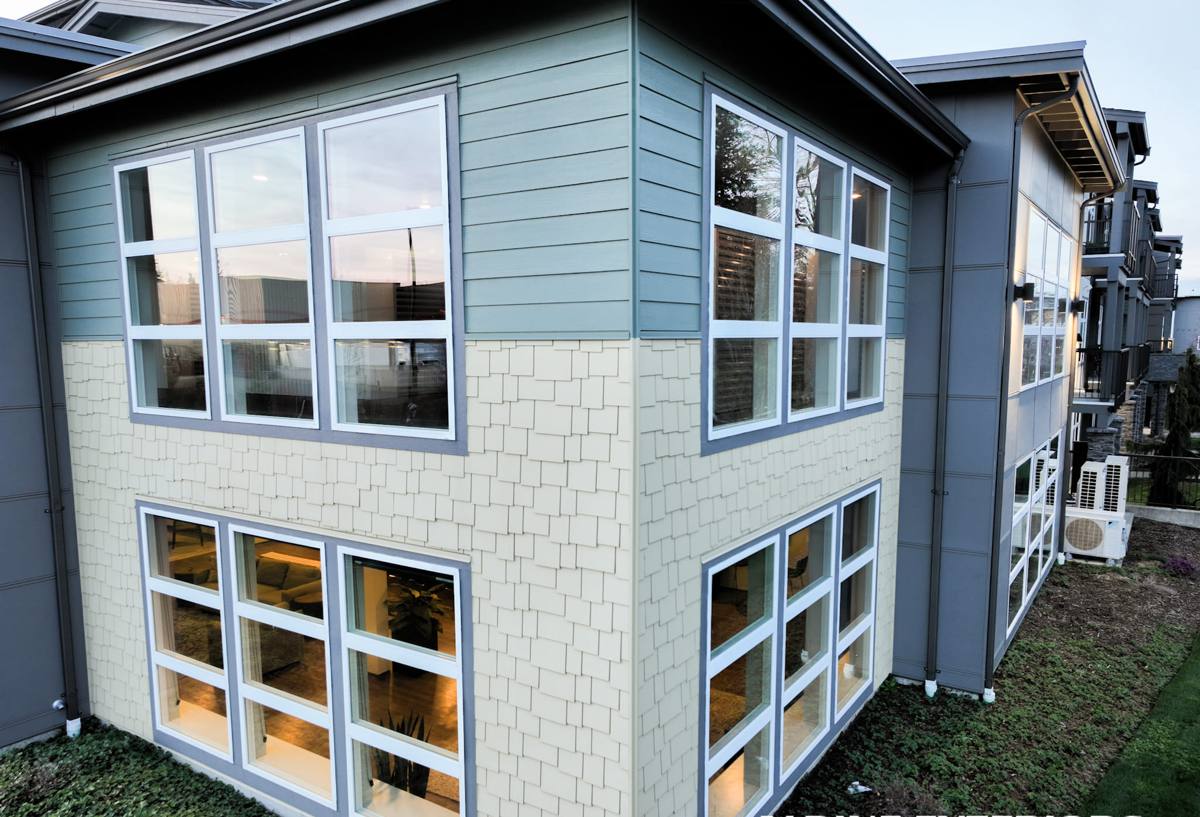
When Replacement Is the Right Call, Not Repair
Not every siding problem calls for a full tear-off. Isolated damage — a cracked board, a section that took an impact, a small area of failed caulking — can often be repaired without touching the rest of the wall. Full replacement becomes the right call once the damage is widespread, once the underlying moisture barrier is compromised across multiple areas, or once the material itself has reached the end of what it can offer regardless of upkeep.
- Soft or spongy siding in more than one location, not just a single isolated spot
- Moss or dark staining that returns quickly after cleaning, especially on shaded or north-facing walls
- Visible warping, cupping, or separation at seams across multiple courses
- Paint that won't hold anymore no matter how often it's redone
- Rot or staining showing up at trim, corners, or around window openings
- A house that's due for new windows or a rain screen retrofit anyway, making a bundled replacement more efficient than sequential repairs
If a Blaine home is showing two or three of these at once, that's usually a sign the siding system as a whole — not just the visible surface — has reached the point where patching delays the inevitable rather than solving it.
What We Typically Find Once Old Siding Comes Off in Blaine
Moisture Behind the Wall
Blaine's exposure to wind-driven rain off the water means moisture often finds its way behind older siding well before it becomes visible on the surface. By the time staining or softness shows up outside, the house wrap or sheathing underneath has frequently been damp for a while. A proper replacement means opening the wall up and dealing with what's actually there, not just covering it with a new layer.
Outdated or Missing Drainage
A lot of older siding in this region was installed directly against the sheathing, with no drainage gap behind it. That works fine in a dry climate. In a town this close to open water, it gives moisture nowhere to go once it gets past the outer surface, which is a major reason older installations fail well ahead of a properly built one.
Corroded Fasteners and Trim Hardware
Salt air accelerates corrosion on anything metal, and older homes were often built with fastener and flashing hardware that wasn't rated for that kind of sustained exposure. Rusted fasteners and degraded flashing are common finds on Blaine tear-offs, and they're one more reason a full replacement gives us a chance to correct problems a simple resurfacing would leave in place.
Damaged Sheathing
Where moisture has been getting in for a while, the wood sheathing underneath can be soft, delaminated, or rotted in patches. This isn't something we can know for certain until the old siding is off, which is part of why an honest replacement estimate includes room for what the crew finds mid-project, not just a fixed number based on square footage alone.
How the Replacement Process Works
Inspection and Tear-Off
We start by walking the property and inspecting the existing siding, trim, and any visible signs of moisture damage before a single board comes off. Once tear-off begins, we assess the sheathing and house wrap as we go, since that's the only reliable way to see what's actually behind the old material.
Substrate Repair
Any soft, rotted, or delaminated sheathing gets replaced before anything new goes up. Skipping this step is one of the more common shortcuts we see on past installs, and it's the single fastest way for a brand-new siding job to fail early regardless of how good the exterior material is.
Rain Screen and Drainage Plane
On a coastal property like a Blaine home, we build in a drainage gap behind the new siding rather than installing it flush against the wall. That gap lets any moisture that does get past the outer surface drain and evaporate instead of sitting against the sheathing, which matters more here than it would in a drier, more sheltered part of the county.
House Wrap and Flashing
New or repaired house wrap goes on with every seam and penetration properly lapped to shed water downward and outward. Window and door flashing gets integrated into the wall assembly as a whole, not treated as a separate detail bolted on afterward.
Hardie Installation to Spec
James Hardie siding goes up according to the manufacturer's fastener spacing, fastener type, and joint-sealing specifications. In a town that takes this much direct wind-driven rain, those details are the difference between a job that holds up for decades and one that starts letting moisture back in within a few wet seasons.
Trim, Paint, and Cleanup
Trim gets finished, ColorPlus-coated panels and trim are installed with the manufacturer's touch-up process where needed, and the site gets cleaned up, including proper disposal of the old siding material.
Why James Hardie for a Replacement Project
A full replacement is exactly the moment to install something better than what's coming off the wall, not just a same-for-same swap. We install Hardie fiber cement exclusively because of how it performs specifically in conditions like Blaine's:
- Non-combustible core: Fiber cement doesn't feed a fire the way wood-based siding products can.
- Factory-applied ColorPlus finish: Baked on under controlled conditions rather than brushed on site, so it holds color and resists chalking better against constant salt air and moisture.
- Climate-engineered HZ product lines: Hardie's HZ5 formulation is built for regions with sustained moisture and freeze-thaw cycling, which fits coastal Whatcom County.
- Dimensional stability: It won't swell, cup, or warp the way engineered wood siding can after repeated wet-weather exposure.
- Strong transferable warranty: Backed by Hardie when the installation follows their spec, which matters for resale value on a home that's had a full exterior replacement.
We don't install LP SmartSide, vinyl, Cemplank, Allura, primed spruce, or cedar. Each has its market and its fans. But on a full replacement — where we're already committed to the labor of a tear-off — we'd rather put up one system we fully stand behind than a cheaper option that quietly resets the maintenance clock in five or ten years instead of twenty or thirty.
Cost Factors for a Blaine Siding Replacement
| Factor | What Drives It | Blaine-Specific Consideration |
|---|---|---|
| Tear-off and disposal | Home size, number of siding layers already on the wall | Older coastal homes sometimes have siding installed over prior siding |
| Substrate repair | Extent of rot or moisture damage found once old siding is off | More common on walls facing prevailing wind-driven rain off the water |
| Drainage and house wrap | Whether a rain screen gap needs to be added, not just replaced | Higher priority given sustained salt air and moisture exposure |
| Trim and detail complexity | Number of windows, corners, and roofline transitions | Every added seam is another place moisture can find a way in |
| Material and finish | Hardie plank profile, HZ line, and ColorPlus color selection | HZ5 formulation suited to coastal, high-moisture conditions |
These are general drivers, not a quote. We won't know the real scope of a Blaine replacement — especially the substrate condition — until the old siding is off the wall, which is why we're upfront that a walk-through and, in some cases, a partial tear-off preview gives a far more honest number than a phone estimate ever could.
Timing a Replacement Around Blaine's Weather
Whatcom County's wettest, windiest stretch generally runs from late fall through winter, and Blaine's exposed coastal position makes that stretch harder on an open wall mid-replacement than it is further inland. Spring and summer tend to offer the driest, most stable conditions for tear-off and installation, which matters because house wrap, flashing, and fiber cement all perform best when they go on and cure under dry conditions rather than between storm systems. That said, a home with active moisture intrusion shouldn't wait for the ideal season just to look better on a calendar — the damage keeps compounding while it waits.
Why a Crew That Already Works Blaine Matters for a Replacement
A full siding replacement means the wall is open and exposed for stretches of the project, and a crew that already works this stretch of coastline knows how to sequence tear-off and cover-up around Blaine's weather rather than getting caught by it. That local familiarity also shows up in smaller ways: knowing which walls in this town tend to hide the most substrate damage, which fastener and flashing choices are worth the extra time near open water, and how disposal and scheduling logistics work for a coastal property rather than an inland one. A crew that treats Blaine as a regular part of its territory builds a replacement to match conditions here, instead of applying a generic approach and hoping it holds.
If your Blaine home needs a full siding replacement, or you're not sure yet whether repair or replacement is the right call, we're glad to take a look. Reach out using the form below for a free, no-pressure estimate — we'll walk the property, tell you honestly what we find, and lay out the real options before any work begins.