 Ferndale Exterior
 Windows Built for What Sudden Valley Actually Deals With
Sudden Valley homes sit in a part of Whatcom County where the weather doesn't do "mild" for very long. You get stretches of salt-laden air moving in off the water, weeks of driving rain that hits siding and window frames sideways instead of straight down, and a moss and algae season that seems to start earlier and last longer every year. None of that is exotic weather. It's just persistent, and persistent is what wears out a window that wasn't built or installed with this specific climate in mind.
Custom windows aren't about luxury add-ons. In this context, "custom" mostly means sized and detailed correctly for your specific openings, flashed and sealed for a wet climate, and glazed with the right glass package for a home that gets a mix of grey, damp days and strong low-angle winter sun. We install custom windows across Ferndale and the surrounding Whatcom County communities, and Sudden Valley properties tend to share a specific set of problems worth understanding before you buy anything.
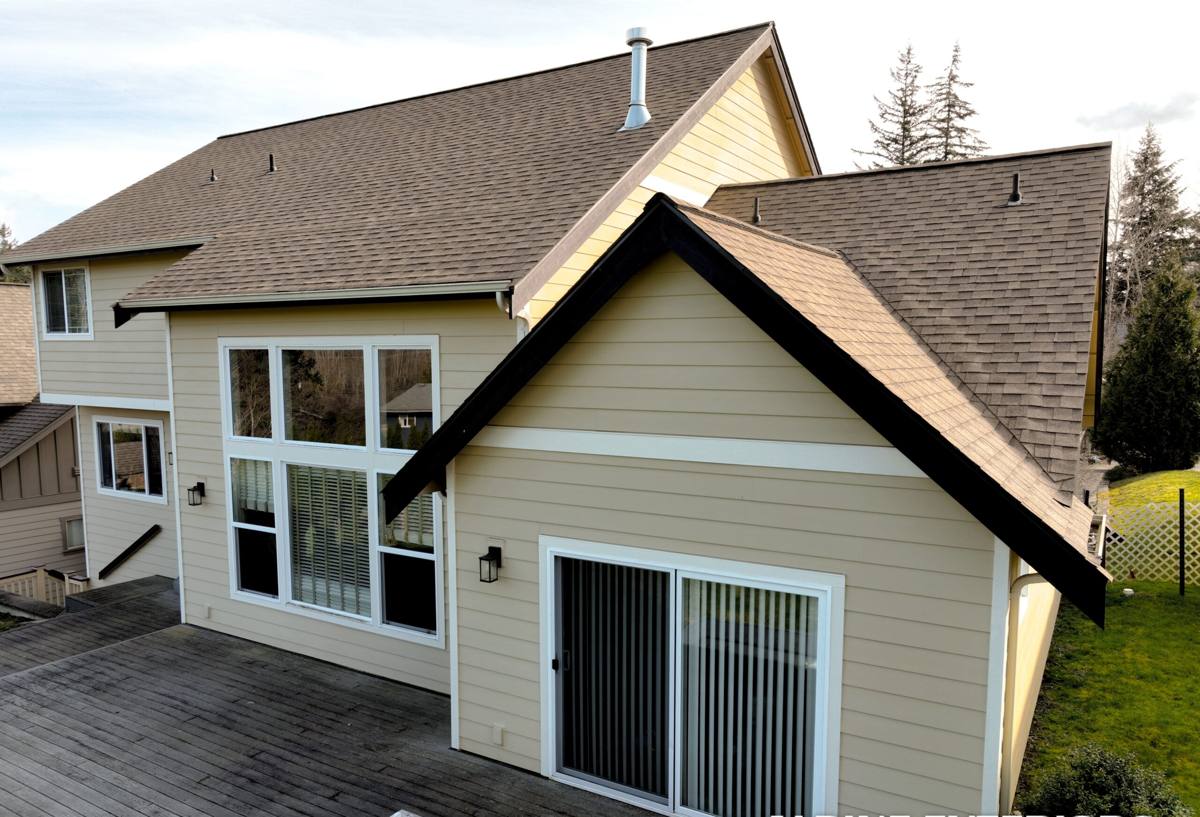
How Local Weather Breaks Down a Window Over Time
Every window failure we see out here traces back to the same handful of causes. Understanding them helps you ask better questions when you're comparing bids.
Salt Air and Metal Fatigue
Salt-carrying air corrodes exposed fasteners, weep hardware, and lower-grade aluminum components faster than inland climates ever would. Cheap hardware pits and seizes within a few seasons. Good custom windows spec corrosion-resistant fasteners and hardware from the start, not as an upgrade.
Driving Rain and Wind-Driven Water
Rain that comes in sideways doesn't just test the window unit — it tests the flashing, the sill pan, and the sealant joint around the rough opening. A window can be excellent and still leak if the install detail around it is wrong. This is the single biggest cause of the "water stain under the window" calls we get.
Moss, Algae, and Constant Dampness
Shaded exposures and long damp stretches let moss and green algae creep onto sills, trim, and lower sash rails. Left alone, that growth holds moisture against the frame and finish, which accelerates wood rot, paint failure, and seal breakdown on frames that aren't built to shed water quickly.
Condensation From Temperature Swings
Cool, humid Whatcom County air meeting a warm interior creates condensation on and around window glass, especially with older single-pane or poorly sealed double-pane units. Persistent condensation on the frame or between panes is usually a sign the seal or glass package has already failed.
What "Correct" Actually Looks Like for a Sudden Valley Install
A properly done custom window job isn't just picking a style you like. It involves several details that matter more here than they would in a drier climate:
- Accurate field measurement of each opening — older homes settle unevenly, so openings are rarely perfectly square
- A sloped sill pan or sill pan flashing that actively directs water back outside, not just a bead of caulk
- Proper head flashing integrated with the house wrap or building paper, lapped correctly so water sheds down and out
- Low-expansion, weather-rated sealant at the exterior joint, applied in the right sequence relative to the flashing
- Corrosion-resistant screws, hinges, and cranks appropriate for a salt-influenced climate
- Glass and gas-fill spec matched to the home's exposure — full sun, shaded, or lake-adjacent
Skip any one of these and you can end up with a good window doing a bad job, because the water management around it was treated as an afterthought.
Material and Glass Options That Hold Up Locally
We install a range of materials, and the right one depends on the home's style, budget, and exposure. Here's how the common options actually perform under Whatcom County conditions rather than in a showroom.
| Material | How It Handles Salt Air & Rain | Maintenance | Best Fit |
|---|---|---|---|
| Vinyl | Good — won't corrode or rot, handles moisture well | Low — occasional cleaning | Budget-conscious replacements, most home styles |
| Fiberglass | Excellent — very stable in wet/dry cycling, resists warping | Low | Larger openings, homes wanting long-term dimensional stability |
| Wood-clad | Good exterior protection if the cladding and seals are sound | Moderate — interior wood still needs periodic attention | Traditional or higher-end aesthetics |
| Bare Aluminum | Poor in salt air unless marine-grade and well-maintained | Higher — prone to corrosion and condensation | Generally not our first recommendation in this climate |
For glass, we typically recommend a dual-pane, low-E coated unit with an argon gas fill for standard Sudden Valley exposures — it manages condensation and heat loss well without being overkill. Homes with more direct wind and rain exposure sometimes benefit from a heavier-duty weatherstripping package or a slightly higher-performance glass spec. We'll walk through which makes sense for your specific elevation rather than defaulting to the most expensive option.
A Note on Product Choices
We're selective about the window lines and glass packages we install. Some lower-cost systems use hardware or seal designs that don't hold up well to sustained wind-driven rain and salt exposure — not because the product is "bad" in every climate, but because it's a poor match for this one. We'd rather steer you toward a system with a maintenance profile and warranty structure suited to where you actually live than sell you something that looks fine on a spec sheet.
Our Process, Start to Finish
- On-site assessment. We look at each opening, note drainage paths, sun exposure, and any existing rot, moss buildup, or flashing issues before we talk products.
- Honest recommendation. Based on that walk-through, we recommend materials and glass suited to that specific elevation — not a one-size-fits-all package.
- Precise measurement and ordering. Custom windows are built to your actual openings, which is why field measurements matter more than catalog sizes.
- Removal and inspection. When we pull the old unit, we check the framing and sheathing underneath for hidden moisture damage before anything new goes in.
- Correct flashing and sealing. This is where most of the long-term performance is decided — sill pans, flashing laps, and sealant applied in the right order.
- Final adjustment and walkthrough. We check operation, seal integrity, and finish work, and walk you through basic care before we leave.
Signs Your Current Windows Need Attention
A lot of Sudden Valley homeowners live with failing windows longer than necessary because the signs show up gradually. Watch for:
- Visible moss or green growth building up on sills or lower frames
- Fogging or moisture trapped between panes of a double-pane window
- Soft or discolored wood trim around the window opening
- Drafts you can feel with a hand near the frame on a windy day
- Windows that stick, won't latch fully, or have warped out of square
- Paint or finish peeling specifically around window edges, even if the rest of the trim looks fine
- A noticeable jump in heating costs during wet, windy months
Any one of these on its own isn't an emergency. A few of them together, especially around the same window, usually means water is getting past the seal or flashing and it's worth having someone look before it reaches the framing.
What Affects the Cost
Custom window pricing varies by opening size, material, glass package, and how much flashing or framing repair is needed once the old unit comes out. Rather than quote a number that won't mean much without seeing your home, here's what actually moves the price:
| Factor | Why It Matters |
|---|---|
| Material (vinyl vs. fiberglass vs. wood-clad) | Base unit cost and expected lifespan differ significantly |
| Glass package | Low-E coatings, gas fill, and impact-rated glass all add cost but affect comfort and durability |
| Opening condition | Rot or damaged framing found during removal adds labor and material |
| Window size and style | Larger units, casements, and specialty shapes cost more than standard double-hungs |
| Number of openings done at once | Batching multiple windows in one visit is typically more efficient than one-offs |
We give itemized, written estimates so you can see exactly what you're paying for — not a lump sum with no explanation.
Why It Matters to Hire a Crew That Already Works This Area
Sudden Valley's exposure to salt air, wind-driven rain, and long damp seasons isn't identical to every neighborhood in Whatcom County — a home a few miles inland or on a more sheltered lot can weather very differently. A crew that's done window work across Ferndale and the surrounding communities has already seen how local homes of different ages and construction styles respond to this climate, which flashing details actually hold up, and which shortcuts show up as callbacks two winters later. That local pattern recognition is hard to replace with a generic install checklist.
We're not interested in oversized promises or pressure tactics. We'll tell you plainly if a window doesn't need replacing yet, or if a repair to the flashing and sealant would solve the problem for less than a full replacement.
Maintaining Your New Windows in This Climate
A correctly installed custom window still benefits from basic seasonal care in a climate like this:
- Rinse sills and lower sashes periodically to keep moss and algae from taking hold
- Check exterior caulk lines once a year for cracking or separation
- Keep gutters and downspouts clear so runoff isn't sheeting directly onto window heads
- Wipe down tracks and weatherstripping so debris doesn't hold moisture against the seal
- Address any soft trim or paint failure early, before it spreads to the frame
None of this is heavy maintenance — it's the same kind of upkeep that keeps any exterior component performing well through a wet Pacific Northwest year.
If your Sudden Valley home has windows showing wear, drafts, or moss buildup, we're happy to take a look and give you a straightforward, no-pressure estimate. Use the form below to get started.