 Ferndale Exterior
 Siding That Has to Work Around Sudden Valley, Not Just Look Good
Sudden Valley homes deal with a specific combination of punishment: wind-driven rain off the water, a marine air pattern that carries salt-tinged moisture inland across Whatcom County, and tree cover dense enough that entire wall sections rarely see direct sun for weeks at a time. That last part matters more than most homeowners realize. Shade plus dampness is exactly what moss, algae, and mildew need to take hold, and it's why siding that performs fine in a drier, sunnier part of the state can struggle here. We install fiber cement siding in this area because it's built to hold up under those exact conditions — not because it's the trendiest option, but because it's the one that keeps doing its job year after year without babysitting.
This page is specific to fiber cement siding installed on Sudden Valley properties. If you're comparing materials generally or want a broader look at siding options for Ferndale and Whatcom County, that's a separate conversation — here we're focused on what this one product does in this one place, and what a correct installation looks like.
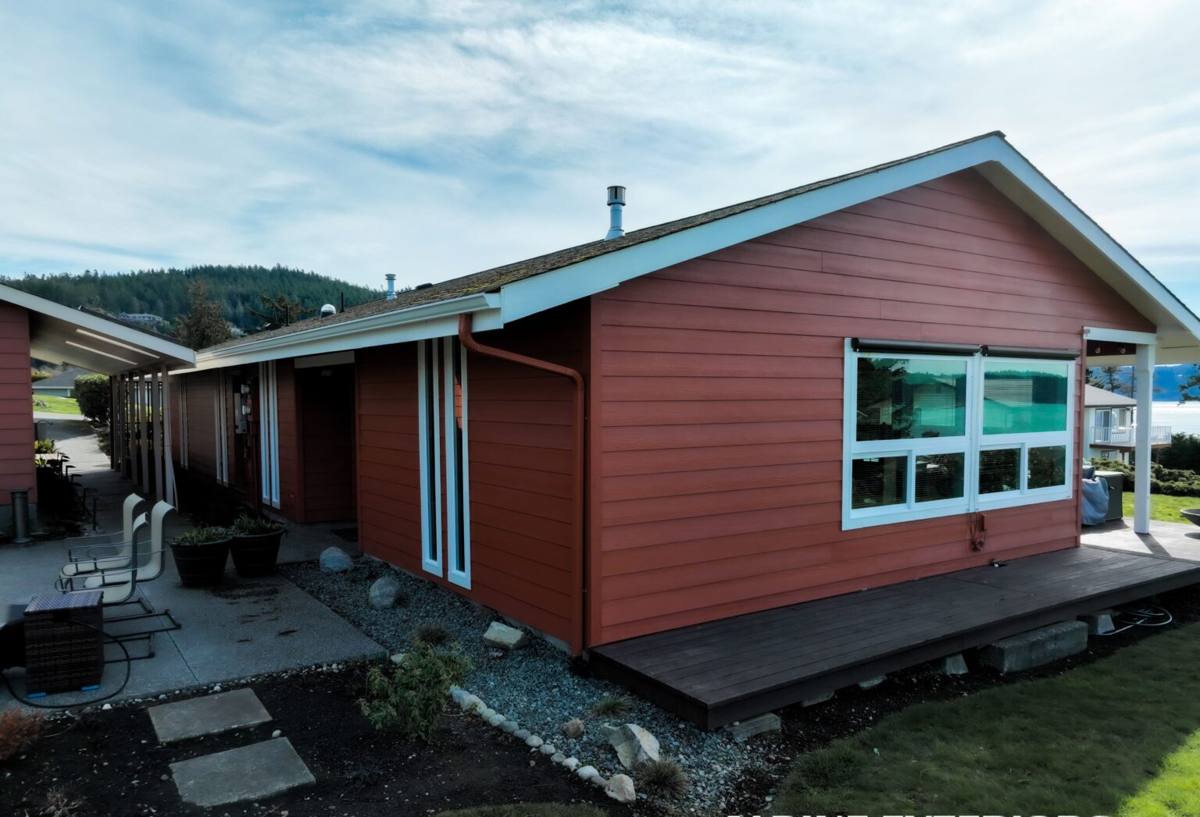
What Sudden Valley's Climate Actually Demands From Siding
Driving Rain and Wind Exposure
Storms moving through this part of Washington don't just drop rain straight down — wind pushes it sideways into wall assemblies, seams, and trim joints. Siding that isn't detailed correctly at the laps, corners, and penetrations will eventually let water track behind it, and once moisture gets trapped against sheathing, the damage happens where you can't see it until it's expensive.
Salt-Influenced Marine Air
Whatcom County sits close enough to the Sound that marine air moves through regularly, carrying trace salt and moisture that accelerates corrosion on fasteners, trim flashing, and lower-grade cladding materials. Over years, that exposure is part of why some siding products chalk, pit, or corrode faster here than they would inland.
Shade and Moss Season
Sudden Valley's tree canopy is a selling point for the neighborhood and a genuine challenge for exterior materials. Shaded, damp wall sections stay wet longer after every rain event, and that extended dry-out time is what feeds moss and algae growth on north-facing and heavily shaded elevations. A siding product's surface texture and paint system both affect how much of a foothold that growth can get.
Why We Install Only James Hardie Fiber Cement Here
We don't offer vinyl, LP SmartSide, Cemplank, Allura, or primed wood siding — not because those products don't have their place somewhere, but because we've made a professional decision to standardize on one system we can stand behind on every job we do in this climate. James Hardie fiber cement is non-combustible, dimensionally stable in swinging moisture conditions, and finished with a factory-applied ColorPlus coating engineered to resist the fading and moisture intrusion that plague field-painted or thinner-clad products in wet, shaded environments like Sudden Valley.
Hardie also produces climate-specific HZ product lines, meaning the boards themselves are engineered differently for high-humidity, high-moisture regions versus hot, dry ones. That's a meaningful difference from one-size-fits-all products, and it's part of why we consider it the right long-term investment for homes in this county rather than a compromise.
- Non-combustible core — fiber cement doesn't feed a fire the way wood-based or foam-backed products can
- Factory ColorPlus finish — baked-on color and moisture protection, not a field-applied coat that ages unevenly
- HZ5 engineering — Hardie's product formulation for the Pacific Northwest's wetter, cooler climate zone
- Transferable warranty — coverage that follows the house through a sale, which matters in a desirable neighborhood like Sudden Valley
What a Correct Fiber Cement Installation Actually Involves
Fiber cement is only as good as the installation behind it. The board itself is durable, but water management, fastening, and clearances are what determine whether that durability shows up ten or twenty years down the road. On every Sudden Valley project we treat these details as non-negotiable:
- A continuous weather-resistive barrier and correctly lapped, sealed house wrap behind every course
- Rigid flashing at windows, doors, and every roof-to-wall intersection, integrated with the wrap — not just caulked over the top
- Proper starter strip at the base course so the first row sits and drains the way the rest of the field does
- Manufacturer-specified fastener spacing, penetration depth, and placement — over-driven or under-driven nails are one of the most common causes of early Hardie failures
- Minimum clearance from grade, decks, patios, and roof lines so the board isn't sitting in standing moisture
- Factory-mitered or properly caulked joints at corners and trim, sized for the product's expansion and contraction
None of this is unusual or proprietary — it's simply what Hardie's own installation instructions call for. The problem is that skipping steps doesn't show up on day one. It shows up in year six or seven as staining, soft trim, or a callback that costs far more than doing it right the first time would have.
How We Approach Your Project
- On-site assessment — we walk the exposures that matter most in Sudden Valley: shaded north walls, low-clearance areas near grade or decks, and anywhere existing siding shows moss or trapped moisture
- Tear-off and substrate check — old siding comes off and we inspect sheathing before anything new goes up; hidden rot gets addressed, not covered
- Water management first — house wrap, flashing, and drainage details go in before a single piece of siding is hung
- Installation to spec — correct fastening, clearances, and joint treatment on every elevation, including the shaded sides that get skipped when crews are moving fast
- Trim, caulking, and cleanup — finished detailing and a job site left the way we found it
Fiber Cement vs. Other Siding Options in This Climate
Homeowners comparing quotes in Sudden Valley often see very different materials proposed at very different price points. Here's how they generally compare under the specific conditions this neighborhood deals with:
| Material | Moisture & Moss Performance | Maintenance | Typical Lifespan |
|---|---|---|---|
| James Hardie Fiber Cement | Engineered for wet climates (HZ5); factory finish resists moss foothold | Occasional wash; no repainting for years | 30+ years to spec |
| Vinyl | Sheds water but can trap moisture behind it; can warp or crack in temperature swings | Low, but limited repair options once damaged | 20-30 years, variable |
| Cedar / Primed Wood | Absorbs moisture, feeds moss and rot in shaded, damp areas without diligent upkeep | Regular repainting/staining and sealing | 15-25 years with maintenance |
| LP SmartSide (engineered wood) | Treated to resist moisture but still wood-based; edge and cut-end sealing is critical | Field-applied finish needs monitoring | 20-30 years, installation-dependent |
This isn't a claim that other products are unusable — plenty of homes around the region wear them fine. It's why, after weighing moisture behavior, maintenance burden, and long-term performance in a shaded, wet, marine-influenced neighborhood like Sudden Valley, we chose to install one product and install it correctly rather than offer several and let price alone decide.
What Drives Cost on a Sudden Valley Fiber Cement Project
Every quote should be broken down by more than square footage. The factors that actually move the number on a Sudden Valley home include:
| Cost Factor | Why It Matters Here |
|---|---|
| Existing siding removal & substrate repair | Shaded walls with a history of moisture often need sheathing repair before new siding goes on |
| Home access & lot grade | Wooded, sloped lots common in Sudden Valley can affect scaffolding and material staging |
| Trim & detail complexity | Dormers, multiple rooflines, and deck intersections all add flashing and cut work |
| Board profile & color | Lap width and ColorPlus color selection affect material cost, not labor difficulty |
| Number of shaded/high-moisture elevations | These get extra attention on water management, which adds install time but prevents callbacks |
Why It Matters That We Already Work in This Neighborhood
A crew that's worked Sudden Valley before already knows which elevations tend to stay wet longest, how tree cover on a given lot affects drying time, and what the access and staging challenges typically look like on these properties. That's not a marketing point — it's the difference between a crew guessing at water management details versus one that's already seen how this specific neighborhood's conditions play out over a full wet season. It also means we're positioned to stand behind the work: Hardie's transferable warranty means little if the installer isn't around or isn't familiar enough with the area's demands to diagnose a problem correctly if one ever comes up.
Keeping Moss and Moisture From Becoming a Problem
Even correctly installed fiber cement benefits from basic upkeep in a shaded, damp neighborhood like this one. A short seasonal routine goes a long way:
- Rinse shaded and north-facing walls once or twice a year to keep early moss growth from establishing
- Keep gutters clear so overflow isn't running down wall sections repeatedly
- Trim back branches and foliage that keep specific wall areas shaded and damp longer than necessary
- Check caulking at trim and penetrations every few years and recaulk before gaps open up
- Watch for any staining or soft spots near grade, decks, or roof intersections and address them early
None of this is heavy maintenance — it's the kind of occasional attention that keeps a correctly installed system performing the way it's designed to for decades.
Get a Straight Answer for Your Home
If you're weighing a siding replacement in Sudden Valley, we're glad to walk your property, point out what your specific exposures and shade patterns mean for the job, and give you a clear, no-pressure estimate for a correctly installed James Hardie fiber cement system. There's a form below — reach out and we'll get you scheduled.