 Ferndale Exterior
 Window Installation for Sandy Point Homes
Sandy Point sits right on the water along Ferndale's stretch of Whatcom County coastline, and that open exposure to the Strait of Georgia changes what window installation actually needs to hold up to compared to a more sheltered inland property. Homes here range from older beach cottages, some originally built as seasonal getaways and later converted for year-round living, to newer construction with larger windows oriented to make the most of the water view. Whatever the vintage, a window on a Sandy Point home is doing more work than the same product would a few miles inland — it's the seam between a conditioned interior and a marine environment that doesn't let up much through the year.
Ferndale Exterior Company installs windows across Whatcom County, and Sandy Point is one of the areas we work in regularly enough to know how its specific exposure differs from the rest of our service area. Salt air, driving rain, and a long moss season all take their toll here, and a window installation that doesn't account for that combination tends to show problems faster than it would somewhere calmer.
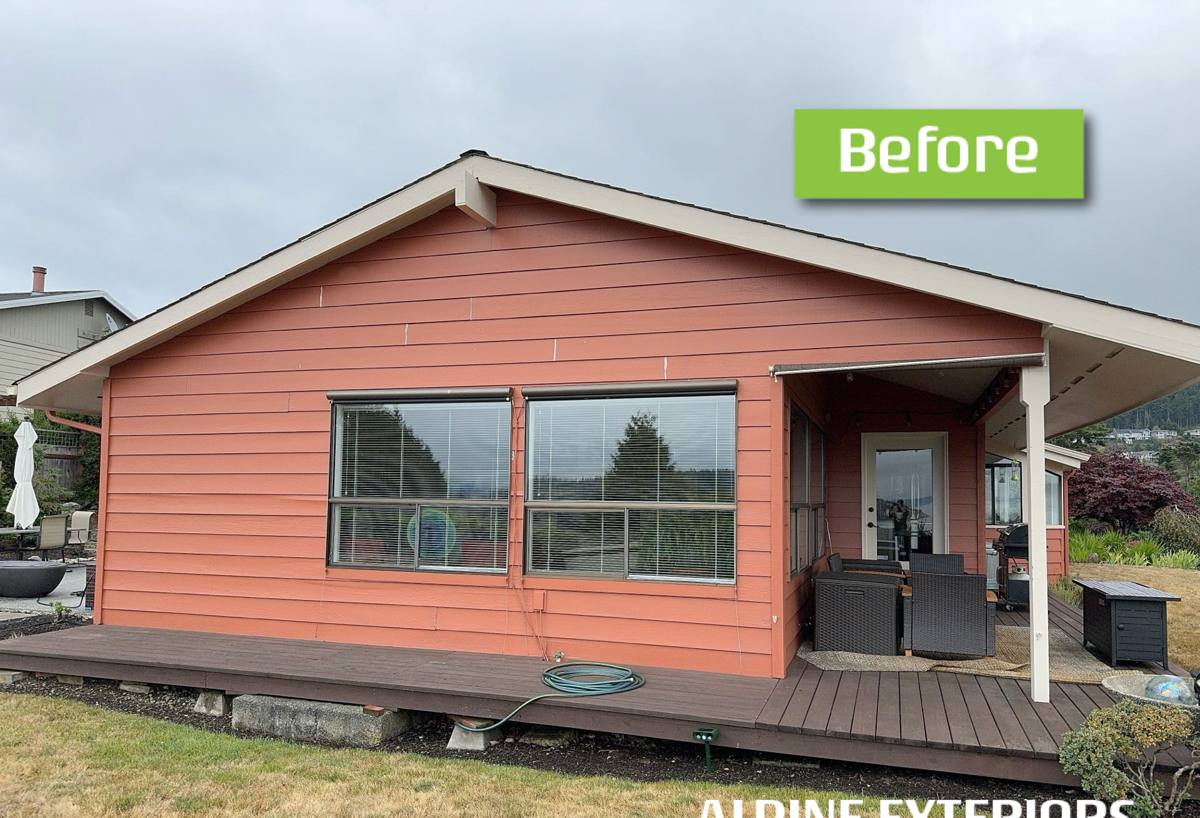
What This Stretch of Coastline Does to Windows
Salt Air and Hardware Corrosion
Being directly on open water means Sandy Point homes take a steadier, more concentrated dose of salt-laden air than properties set back from the shoreline. That accelerates corrosion on window hardware, screen frames, and lower-grade fasteners, particularly on windows facing the water and prevailing wind. It's usually the small components — hinges, cranks, latch hardware — that show pitting or start sticking first, well before the frame or glass itself shows any wear.
Wind-Driven Rain and Flashing
Storms coming off the water push rain sideways into window openings rather than letting it fall straight down and run off. That sideways load tests flashing and sealant details far more than it tests the window product itself. A sill pan that isn't pitched correctly, or head flashing that isn't lapped and tied into the housewrap above it, will let water in on a waterfront lot long before it would cause a problem on a sheltered inland wall.
A Long Moss and Mildew Season
Persistent dampness and mild temperatures give moss and mildew a long season across this part of the county, and shaded or north-facing window sills hold that moisture longer than sun-exposed ones do. On wood-framed or wood-sill windows, sustained moisture like that eventually leads to soft, rotting wood at the corners and sill — usually well before anyone notices from the outside.
Sun and Glare on Water-Facing Windows
The flip side of a water view is direct, largely unobstructed sun exposure on west- and south-facing glass, with no tree cover or neighboring structures to break it up the way an inland lot often has. That sun load accelerates seal failure on aging insulated glass units and UV degradation on lower-grade vinyl and sealants faster than a shaded elevation would see.
Frame Materials for a Waterfront Property
There isn't one right frame material for every home, but a property that sits directly on open water narrows the field faster than an inland lot would. We'll walk through the real trade-offs for your home's specific orientation and budget rather than defaulting to whatever's easiest to install.
| Frame Material | Moisture & Salt Air Behavior | Typical Maintenance | Realistic Fit for Sandy Point |
|---|---|---|---|
| Vinyl | Won't rot; quality of welds and hardware finish matters more here than inland | Low; periodic hardware and weep-hole cleaning | Good budget option on sheltered elevations |
| Fiberglass | Dimensionally stable, resists both moisture and salt-driven corrosion well | Low | Strong fit for direct water-facing walls |
| Wood, painted or clad | Attractive but vulnerable at joints and sills without diligent upkeep | High; regular finish maintenance required | Best limited to sheltered or interior-facing openings |
| Aluminum | Prone to corrosion and cold transfer unless well-finished and maintained | Moderate to high near salt air | Generally not our first recommendation here |
On a property with this much direct water exposure, we lean toward fiberglass or a quality vinyl on weather-facing elevations, and reserve wood-framed units, if a homeowner wants that look, for sheltered sides of the house where the maintenance burden is more manageable.
Full-Frame Replacement vs. Insert Replacement
A lot of Sandy Point homes fall into one of two categories: older cottages with original wood-framed windows that have taken decades of direct salt and rain exposure, or newer builds where the existing windows are still sound but a homeowner wants to upgrade performance or add view area. Those two situations usually call for different approaches. Insert replacement — fitting a new window into the existing frame — works well when the surrounding frame is still structurally sound and properly flashed. Full-frame replacement, which removes the window down to the rough opening and rebuilds the flashing from scratch, is the honest answer when there's already moisture damage at the sill or jambs, which is common on older waterfront cottages that have never had the flashing corrected. We'll tell you which one your home actually needs rather than defaulting to the faster, cheaper option and sealing a moisture problem up behind new glass.
What Correct Installation Looks Like at This Exposure
Most window problems we find on Sandy Point homes aren't failures of the window product — they're shortcuts in the flashing and sealing sequence that don't show up until the next storm season. On a direct waterfront lot, none of these steps are optional:
- A properly pitched sill pan that sheds water outward instead of letting it collect under the frame
- Head flashing integrated with the housewrap above the opening, lapped correctly for water to shed down and out
- Jamb flashing tied into the surrounding wall assembly, not relying on caulk to bridge the gap
- Weep holes and drainage paths left open and functional after installation, not sealed shut by paint or sealant
- Corrosion-resistant fasteners and hardware rated for sustained salt air exposure
- Air sealing and insulation around the frame that doesn't trap moisture against the framing
None of these steps add meaningfully to the cost of a job. Skipping any one of them is what turns a window that should perform for decades into one that's leaking behind the wall within a few wet seasons on a lot this exposed.
Signs a Sandy Point Home Needs Window Attention
- Fogging or condensation trapped between panes, usually meaning a failed seal on an insulated glass unit
- Noticeable drafts or a cold spot near a closed window, especially on water-facing walls
- Soft, discolored, or spongy trim and sill material
- Hardware that's stiff, pitted, or difficult to operate compared to how it used to work
- Peeling paint or a bubbling finish around wood-framed windows
- Visible gaps, cracked caulk, or daylight around the frame when checked from inside
- Interior water staining on the wall or ceiling near a window opening
Any of these is worth a professional look before another storm season sets in. Caught early, most point to a repair or resealing job rather than a full replacement.
Our Installation Process
- On-site assessment — we look at each window's exposure, orientation, and current condition, and check the surrounding frame and sill for existing moisture damage
- Honest recommendation — insert replacement, full-frame replacement, or repair, explained with the reasoning behind it
- Material selection — frame material and glass options matched to each elevation's actual sun and water exposure, not a single default for the whole house
- Removal and opening prep — the old unit comes out carefully, and any hidden rot or flashing failure gets addressed before the new window goes in
- Installation and flashing — the new unit is set, shimmed, and flashed in a sequence built for direct waterfront exposure
- Trim and finish — exterior trim integrated cleanly with the surrounding siding
Cost Factors for Window Installation in Sandy Point
| Factor | What It Affects | Why It Matters Here |
|---|---|---|
| Insert vs. full-frame | Labor scope and flashing work | Older waterfront cottages more often have hidden sill or jamb damage that calls for a full rebuild |
| Frame material | Upfront cost and long-term maintenance | Fiberglass and quality vinyl cost more upfront but hold up better against salt air than lower-grade alternatives |
| Number and size of openings | Total labor and material cost | Larger view-oriented windows common on water-facing walls cost more to flash and install correctly |
| Existing damage | Repair costs before new windows go in | Sustained moisture exposure can rot sheathing and framing behind older window openings |
| Site access | Labor time and equipment staging | Some Sandy Point properties have tighter beachfront access than a typical in-town lot |
We won't quote a number without seeing the actual windows and openings in person, since exposure and existing condition vary a lot even between neighboring properties on the same stretch of shoreline.
Why a Local Crew That Works Sandy Point Matters
Manufacturer installation guidance is written for average conditions, and a direct waterfront lot in Sandy Point rarely matches that description. A crew that installs windows on this stretch of coastline regularly knows which flashing details are non-negotiable here even when they'd be optional a few miles inland, which elevations take the worst of the wind-driven rain, and which hardware finishes actually hold up against sustained salt exposure instead of just looking good on a spec sheet. That experience is what keeps a window performing cleanly through years of Whatcom County storms rather than showing drafts and soft trim after just a few seasons.
If your Sandy Point home has windows that are fogging, drafty, corroding, or just reaching the end of their service life, we're glad to take a look and give you a straightforward read on what it actually needs. Reach out using the form below to schedule a free, no-pressure estimate.