 Ferndale Exterior
 Roofing Built for Bellingham's Weather, Not Just Any Weather
Bellingham sits close enough to the water that salt air is a real factor in how a roof ages, and far enough into the Pacific Northwest rain belt that moisture exposure is a year-round concern rather than a seasonal one. Add in Whatcom County's long, damp shoulder seasons and the shade cover common in many established Bellingham neighborhoods, and you get a climate that is genuinely harder on a roof than most manufacturers' national warranty language assumes. An asphalt shingle roof that's correctly specified and installed for this environment behaves very differently over 15-20 years than one that was installed the same way you'd install it in a dry inland climate.
This page is about one thing: asphalt shingle roofing done right for Bellingham homes. Not a generic overview of shingles, and not a sales pitch for one brand over another — just what actually matters here, why it matters, and what a correct installation looks like.
What Bellingham's Climate Actually Does to a Roof
Three conditions drive almost every asphalt shingle problem we see on homes in and around Bellingham:
Driving rain and wind-driven moisture
Storms off the Strait of Georgia and Bellingham Bay don't just drop rain straight down — wind pushes it sideways, up under shingle tabs, and into any gap in flashing or underlayment that a calmer climate could get away with ignoring. This is why underlayment choice and flashing detail work matter more here than in most parts of the country.
Moss and algae growth
Cool, damp, shaded conditions for much of the year are exactly what moss and algae need to take hold on a roof. Once moss establishes itself, it lifts shingle edges, holds moisture against the roof deck, and accelerates granule loss — all of which shorten the roof's usable life well before the shingles themselves would otherwise wear out.
Salt air near the water
Homes closer to the bay deal with airborne salt that can accelerate corrosion on exposed metal — flashing, fasteners, vents, and drip edge. A roof with the wrong fastener or flashing material in a salt-exposed location will show problems at those metal points long before the shingle field does.
What a Correct Asphalt Shingle Roof Involves Here
A shingle roof is a system, not just a layer of shingles nailed to plywood. For Bellingham, every layer of that system needs to be chosen with the climate above in mind:
- Roof deck condition — any soft, delaminated, or water-stained sheathing gets replaced before anything new goes down. Installing new shingles over a compromised deck just hides a problem that will resurface.
- Ice and water shield at vulnerable points — eaves, valleys, and roof-to-wall transitions get self-adhering waterproof membrane, not just felt, because these are the spots where wind-driven rain and ice damming (on the colder, higher-elevation edges of the county) cause the most damage.
- Synthetic underlayment across the field — a durable, water-resistant underlayment as the roof's backup layer, since no shingle roof is 100% watertight under sustained wind-driven rain.
- Balanced attic ventilation — intake at the eaves and exhaust at the ridge, sized correctly for the attic volume. Without it, trapped moisture condenses on the underside of the deck and shortens the life of the roof from the inside out.
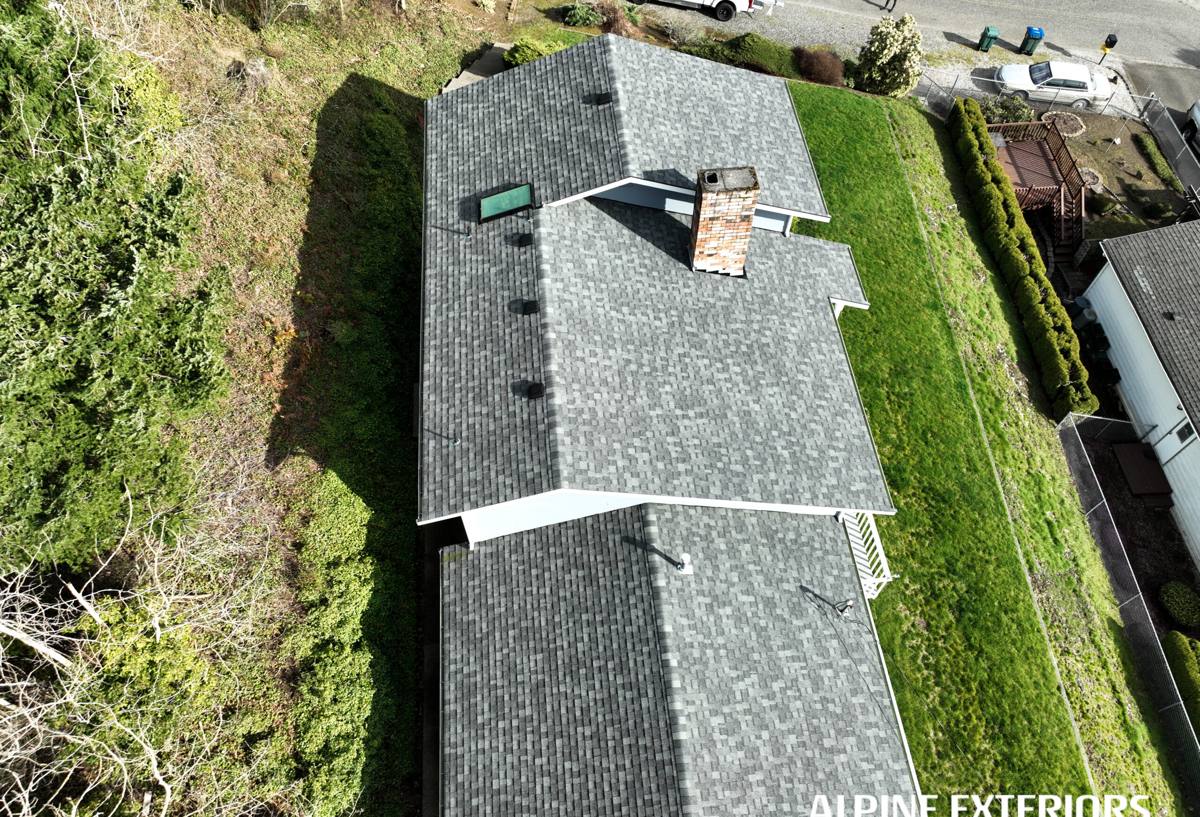
- Correctly lapped, corrosion-resistant flashing — around chimneys, skylights, and wall intersections, using metal suited for a marine-influenced climate rather than the cheapest available option.
- Manufacturer-spec nailing pattern — proper nail count, placement, and depth, since under-nailed or over-driven shingles are one of the most common causes of premature wind and water failure.
Skipping any one of these doesn't show up on day one. It shows up in year four or five, as a leak, a soft spot, or granules collecting in the gutters faster than they should.
Choosing the Right Shingle for a Bellingham Roof
Asphalt shingles come in a few basic tiers, and the right one depends on your roof's exposure, budget, and how long you plan to stay in the home. We'll talk through the tradeoffs honestly rather than steering everyone toward the most expensive option.
| Shingle Type | Typical Lifespan | Wind Rating | Best For |
|---|---|---|---|
| 3-Tab | 15-20 years | Lower | Budget-conscious projects, secondary structures |
| Architectural / Dimensional | 25-30 years | Higher, better in driving rain | Most Bellingham homes — the standard recommendation |
| Premium / Designer | 30+ years | Highest available in asphalt | Exposed or high-visibility roofs, homeowners planning to stay long-term |
For most homes in the Bellingham area, we recommend architectural (dimensional) shingles. They handle wind-driven rain noticeably better than 3-tab shingles because of their heavier, layered construction, and the added thickness also gives them more resistance to the granule loss that moss and algae exposure accelerates. Algae-resistant (AR) shingle lines are also worth the modest upcharge here — they contain copper or zinc granules that slow algae growth, which matters more in a climate like ours than in drier regions.
Our Installation Process
The steps don't change much from job to job, but the details within each step are where quality is won or lost:
- Roof inspection and estimate — we assess the deck, ventilation, flashing points, and any moss or moisture damage before quoting, so the estimate reflects the actual roof rather than a generic square-footage number.
- Tear-off and deck inspection — full removal of old roofing material, with the deck inspected and any damaged sheathing replaced.
- Underlayment and waterproofing — ice and water shield at eaves, valleys, and penetrations, synthetic underlayment across the rest of the field.
- Flashing and ventilation work — new flashing at chimneys, walls, and skylights; intake and exhaust ventilation corrected or upgraded as needed.
- Shingle installation — installed to manufacturer nailing specifications, with attention to proper exposure and alignment for both weather performance and appearance.
- Cleanup and final walkthrough — magnetic sweep for stray nails, debris removal, and a walkthrough so you understand what was done and what to watch for going forward.
Repair or Replace? How to Tell
Not every roofing problem in Bellingham means a full replacement. Some signs point to a targeted repair; others mean the roof's usable life is genuinely up.
Usually a repair
Isolated shingle damage from a storm, a single flashing leak, moss buildup on an otherwise sound roof, or a localized soft spot from one failed section — these are typically fixable without touching the whole roof.
Usually time to replace
Widespread granule loss, shingles that are curling or cracking across large areas, multiple leak points, a deck with widespread moisture damage, or a roof that's already near or past its expected lifespan given its age and exposure — at that point, repairs become a short-term patch on a system that's failing as a whole.
If you're not sure which category your roof falls into, an honest inspection is the fastest way to find out — and it's worth getting before a small problem becomes a deck-replacement problem.
Living With an Asphalt Shingle Roof in This Climate
A correctly installed roof still needs some ongoing attention here. A few habits go a long way toward getting the full lifespan out of your investment:
- Have moss growth removed before it spreads across the roof field, not after — early moss brushes off, established moss lifts shingles.
- Keep gutters clear so water isn't backing up under the eaves during heavy rain.
- Trim back overhanging branches where practical to reduce shade and debris buildup, both of which encourage moss.
- Have the roof looked at after any major windstorm, even if nothing looks obviously wrong from the ground.
- Schedule a periodic inspection every few years so small issues get caught while they're still small.
Why It Matters to Hire a Crew That Already Works in Bellingham
Roofing crews who mostly work in drier climates don't always think in terms of wind-driven rain resistance, moss-resistant shingle lines, or salt-air-rated fasteners, because they don't have to. A crew based in Whatcom County and working Bellingham roofs regularly makes those calls automatically, because they've seen what happens when they're skipped. That local, repeated exposure to this specific climate is the difference between a roof that looks fine at handoff and one that's still performing well a decade in.
We're a Ferndale-based crew, and Bellingham is part of our regular service area — not a stretch job we take occasionally. That means we know what this climate does to a roof over time, and we build accordingly.
Get a Free, No-Pressure Estimate
If you're dealing with an aging roof, storm damage, moss buildup, or you're just trying to plan ahead for a replacement, we're happy to take a look and give you an honest assessment — no pressure, no obligation. Use the form below to request a free estimate for your Bellingham home.