 Ferndale Exterior
 Energy Efficiency Means Something Different Right on the Water
Birch Bay sits on one of the more exposed stretches of coastline in Whatcom County, and that exposure changes what "energy-efficient windows" actually needs to mean for a house out here. Inland, energy efficiency is mostly about glass performance — how much heat a window lets in or holds back. On the water, that's only half the equation. Salt-laden marine air, near-constant wind, and driving rain add a second variable: how well the window and its installation resist the physical wear that slowly degrades a seal, a gasket, or a frame joint over the years. A window can carry a great efficiency rating on paper and still underperform within a decade if it wasn't built or installed with this exposure in mind.
We work on windows across Whatcom County, but Birch Bay homes get a specific kind of attention because of where they sit. The same wind that makes the waterfront desirable also drives infiltration — cold air finding its way in around a frame — at a rate a sheltered, inland home rarely deals with. And the moss and mildew season that runs through much of the year here isn't just a cosmetic nuisance; persistent dampness around a window opening is often the first sign that air, and with it energy, is moving through a gap that shouldn't exist.
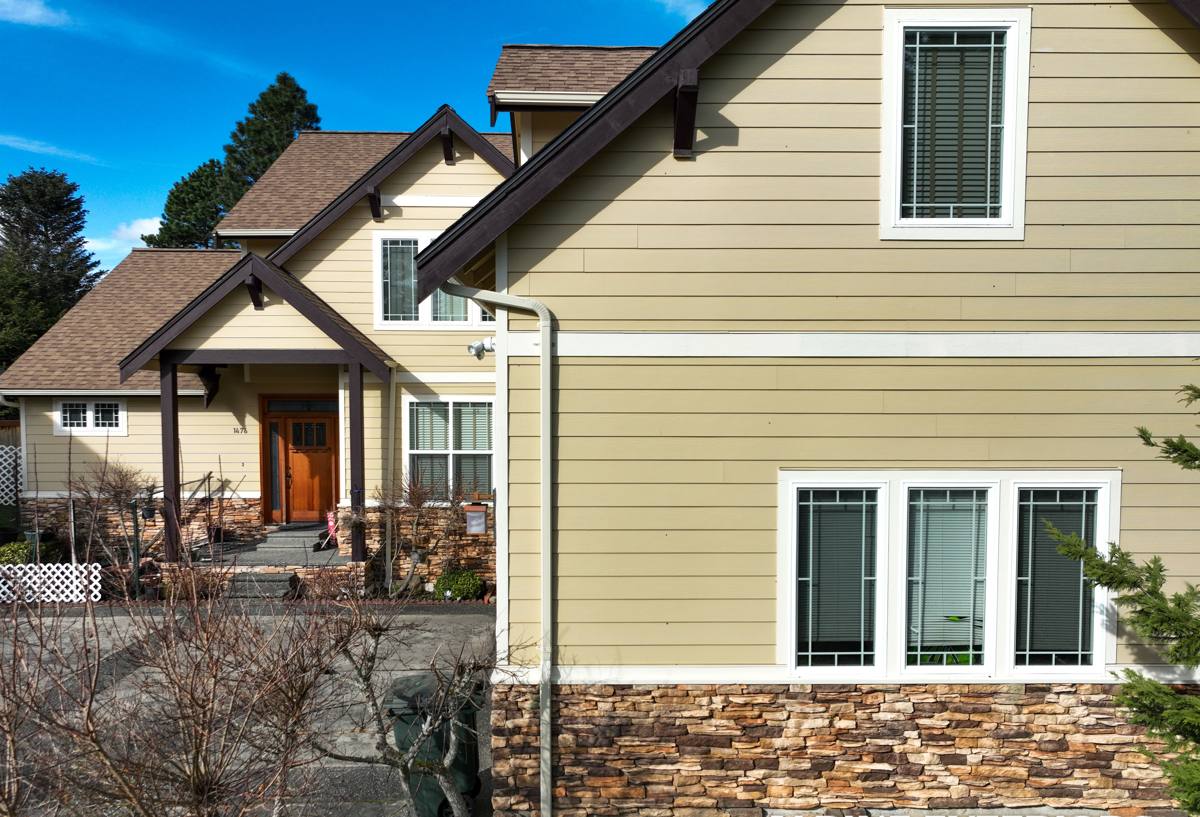
What "Energy-Efficient" Actually Measures
Efficiency claims on a window label break down into a handful of specific numbers, and it's worth understanding what each one tells you before comparing options.
U-Factor
U-factor measures how much heat a window loses through the glass and frame — lower is better. In a marine climate like this one, where winters are mild but damp and heating runs steadily rather than in short cold snaps, a low U-factor keeps a consistent, comfortable indoor temperature without the furnace running constantly to make up for heat sneaking out through the glass.
Solar Heat Gain Coefficient (SHGC)
SHGC measures how much solar heat passes through the glass. In the Pacific Northwest, where overcast days are common but summer afternoon sun can still overheat a south- or west-facing room, the right SHGC balances letting in useful winter warmth against not overheating a sunroom or west-facing living space in July.
Low-E Coatings and Gas Fills
Low-emissivity coatings are a microscopically thin layer that reflects heat back into the room in winter and back outside in summer, while argon or krypton gas fill between panes slows heat transfer compared to plain air. These aren't optional upgrades on a quality window anymore — they're standard on most efficient double- and triple-pane units, and they do more to improve real-world performance than most homeowners realize.
Spacer Systems
The spacer holds the panes of glass apart at the correct distance and seals the gap between them. Older aluminum spacers conduct heat and cold straight through, creating a cold line right at the edge of the glass — that's often where condensation shows up first. Warm-edge spacer technology, using materials that don't conduct as readily, cuts down on both that heat loss and the condensation that follows it, which matters in a climate with Birch Bay's humidity levels.
Frame Material: Where Coastal Exposure Changes the Calculation
Glass technology gets most of the attention, but frame material has just as much influence on long-term efficiency in a coastal setting, because the frame is what has to survive the salt air and moisture cycle year after year without warping, corroding, or losing its seal.
| Frame Material | Efficiency Behavior | Coastal Durability |
|---|---|---|
| Vinyl | Good insulator, multi-chamber designs improve performance further | Handles salt air and moisture well; no corrosion risk, minimal upkeep |
| Fiberglass | Excellent insulator, dimensionally stable across temperature swings | Very strong coastal performance; resists warping and doesn't corrode |
| Wood | Naturally insulating core | Vulnerable to sustained moisture and rot without diligent maintenance and finish upkeep |
| Wood-clad | Good insulating core with a protective exterior shell | Performs well if the exterior cladding is fully intact; any breach exposes the wood beneath |
| Aluminum | Conducts heat and cold readily unless thermally broken | Corrosion-resistant, but a poor insulator that undercuts efficiency gains from the glass |
For most Birch Bay replacements, we lead with vinyl or fiberglass frames on weather-facing walls, since both hold their seal and dimensional accuracy over time without the ongoing maintenance a wood exterior finish demands in this kind of salt and moisture exposure. A wood-clad interior can still make sense when the interior look matters to you and the exterior cladding is properly detailed — that's a conversation worth having against your specific house, not a rule we apply blindly.
Why Older Windows Underperform Faster Here
A single-pane or early dual-pane window that might still be doing an adequate job in a drier, calmer climate tends to fail sooner in Birch Bay for reasons that have as much to do with installation and hardware as with the glass itself.
- Weatherstripping breaks down faster under repeated salt air and moisture exposure, opening small gaps that let conditioned air escape
- Failed seals fog between panes once the gas fill has leaked out and moist air has worked its way into the gap — at that point the insulating value of that unit is largely gone
- Hardware and fasteners corrode faster near the water, which can let a sash sit slightly out of alignment and stop sealing tightly
- Wood components absorb moisture during the long wet season, swelling and shrinking in ways that open gaps around the frame over time
None of that shows up as a dramatic failure. It shows up as a slightly drafty room, a heating bill that creeps up year over year, or a window that's harder to latch than it used to be — small signs that are easy to write off individually but that usually point back to the same underlying cause.
Installation Is Where an Efficient Window Either Delivers or Doesn't
A window's published U-factor and SHGC are lab numbers, tested on a properly installed unit. Get the installation wrong and none of that rating matters, because the energy loss shifts from the glass to the gaps around it.
Air Sealing at the Rough Opening
The space between the window frame and the rough opening needs to be properly insulated and air-sealed, not just stuffed with fiberglass batting, which doesn't stop air movement on its own. A gap here is a direct path for conditioned air to leave and outside air to enter, regardless of how good the window itself is.
Flashing Sequenced for Wind-Driven Rain
Because rain here often comes in sideways rather than straight down, flashing has to be layered correctly — each piece lapping over the one below it — so water sheds outward instead of finding its way behind the siding. Flashing failures don't usually show up as an immediate leak; they show up as hidden moisture that eventually degrades the insulation and framing around the window, which then affects how well that window performs.
Shimming and Square
A window that isn't shimmed level and square won't close and seal evenly along all four sides, even if it's a top-tier energy-rated unit. That uneven seal is exactly the kind of small gap that lets air move and erases part of the efficiency you paid for.
Signs Your Birch Bay Home Is Losing Energy Through Its Windows
- Noticeable drafts near the window frame, especially during windy weather off the water
- Condensation forming between the panes rather than just on the interior surface
- Difficulty latching or locking a window that used to close easily
- Visible gaps, cracked caulk, or deteriorating weatherstripping around the frame
- A heating bill that's climbed noticeably without a clear reason
- Cold spots near windows that are noticeable even when the rest of the room feels comfortable
- Soft or discolored trim around a window, which often points to moisture getting in around the frame
Our Process for an Energy-Efficient Window Project
- On-site assessment — we look at each window's current condition, check for drafts, fogging, and signs of moisture at the frame, and note anything specific to that wall's exposure to wind and rain
- Honest recommendation — which openings genuinely need replacement now, which can wait, and what glass and frame combination fits that specific wall's sun and wind exposure
- Written scope and timeline — a clear plan before any work begins, with no surprises about what's included
- Removal and opening inspection — the old unit comes out carefully, and we check the framing and existing flashing for hidden moisture damage before anything new goes in
- Installation, shimming, and flashing — set level and square, sealed at the rough opening, and flashed in a sequence built to shed wind-driven rain rather than a generic straight-down assumption
- Final check and walkthrough — confirming every unit operates and seals correctly before we consider the job finished
What Actually Drives the Cost
Energy-efficient window pricing varies more than people expect, and it's driven by a handful of concrete factors rather than a flat per-window rate.
| Factor | How It Affects Cost |
|---|---|
| Frame material | Vinyl is typically the most budget-friendly; fiberglass and wood-clad options cost more upfront but bring different durability and appearance trade-offs |
| Glass package | Double-pane with Low-E and argon costs less than triple-pane; triple-pane adds efficiency and sound dampening at a higher price point |
| Window size and count | Larger openings and full-house replacements bring some efficiency of scale versus a single-window job |
| Condition of the existing opening | Hidden rot or flashing damage found during removal adds repair work before the new window can go in correctly |
| Wall exposure | Weather-facing walls sometimes warrant a higher-spec frame or more careful flashing detail than a sheltered elevation |
We won't quote a number without seeing the actual windows and openings in person, since the condition behind the trim matters as much as the size of the glass. What we can tell you upfront is which of these factors are likely to apply to your specific home once we've walked the exterior.
Why a Crew That Already Works Birch Bay Matters
Manufacturer installation guidance is written around average conditions in a moderate climate, and Birch Bay doesn't fit that description. A crew that has installed and serviced windows on this specific stretch of coastline knows which details in that guidance are worth extra time here — the flashing lap on a wind-facing wall, the sealant type that holds up against salt exposure, the spacer and frame combination that resists condensation through a long damp season — and which corners genuinely can't be cut, even when they'd be low-risk somewhere calmer and drier.
That local experience shows up less in the sales conversation and more in the details nobody sees once the trim is back on: how the rough opening was sealed, how the flashing was lapped, whether the shims were set true. Those choices are what decide whether a window is still sealing tightly and holding its efficiency rating in fifteen years, or drafting and fogging in five.
A Few Questions Worth Asking Before You Hire
- Ask what U-factor and SHGC ratings they'd recommend for your specific walls, and why
- Ask how they handle air sealing at the rough opening, not just installing the window itself
- Ask how flashing is sequenced for a wind-driven rain exposure like Birch Bay's
- Confirm current Washington contractor licensing and insurance
- Get a written scope of work and a clear breakdown of what's covered under warranty — the glass unit and the installation labor are often covered separately
If your Birch Bay home has windows that feel drafty, fog between the panes, or are just getting harder to close the way they used to, it's worth having someone look at them in person before you start comparing brands or prices. We offer free, no-pressure estimates for energy-efficient window projects in Birch Bay and the surrounding area — use the form below to get a time on the schedule.