 Ferndale Exterior
 A deck built for Blaine and Ferndale has to earn its keep in a climate that doesn't let up. This stretch of Whatcom County sits close enough to Semiahmoo Bay and the Strait of Georgia that salt-laden air reaches yards well inland, and the region's long wet season means any deck here spends months at a time damp, shaded, and exposed to wind-driven rain. A deck that looks good on installation day but wasn't built with those conditions in mind will show its age fast — soft spots, black streaks, loose fasteners, and a slick, mossy surface by year three or four. Building correctly for this specific area from the start is what keeps a deck solid and safe for decades instead of needing early rework.
What Blaine and Ferndale Homes Actually Need From a Deck
Every deck faces some version of sun, rain, and temperature swings. What makes Blaine and Ferndale different is the combination and duration of exposure. Homes closer to the water deal with salt air that accelerates corrosion on fasteners and hardware, even on decks that never get direct sea spray. Homes further inland, tucked under fir and cedar canopy, deal less with salt and more with shade — which means slower drying times, more moss and algae growth, and surfaces that stay damp far longer after a storm passes.
Both situations point to the same conclusion: material and hardware choices matter more here than in a drier climate, and the build details that control moisture — drainage, airflow, fastener quality — aren't optional extras. They're the difference between a deck that needs a pressure wash and a re-stain every couple of years versus one that needs boards replaced.
Salt Air and Hardware
Standard steel fasteners and connectors corrode faster in coastal air, even at a distance from the water. Corroding hardware doesn't just look bad — it weakens structural connections over time, and by the time rust is visible on a deck screw or joist hanger, the metal underneath has often already lost strength. We spec stainless steel or coated fasteners rated for coastal/marine exposure on every deck we build in this area, not just the ones with a direct water view.
Moss, Algae, and Shade
Whatcom County's moss season isn't a minor cosmetic issue. Moss and algae hold moisture against wood and composite surfaces, and on stairs or ramps they turn a deck into a fall hazard. Decking material, board spacing, and how much airflow the substructure gets all affect how fast moss takes hold and how hard it is to keep off.
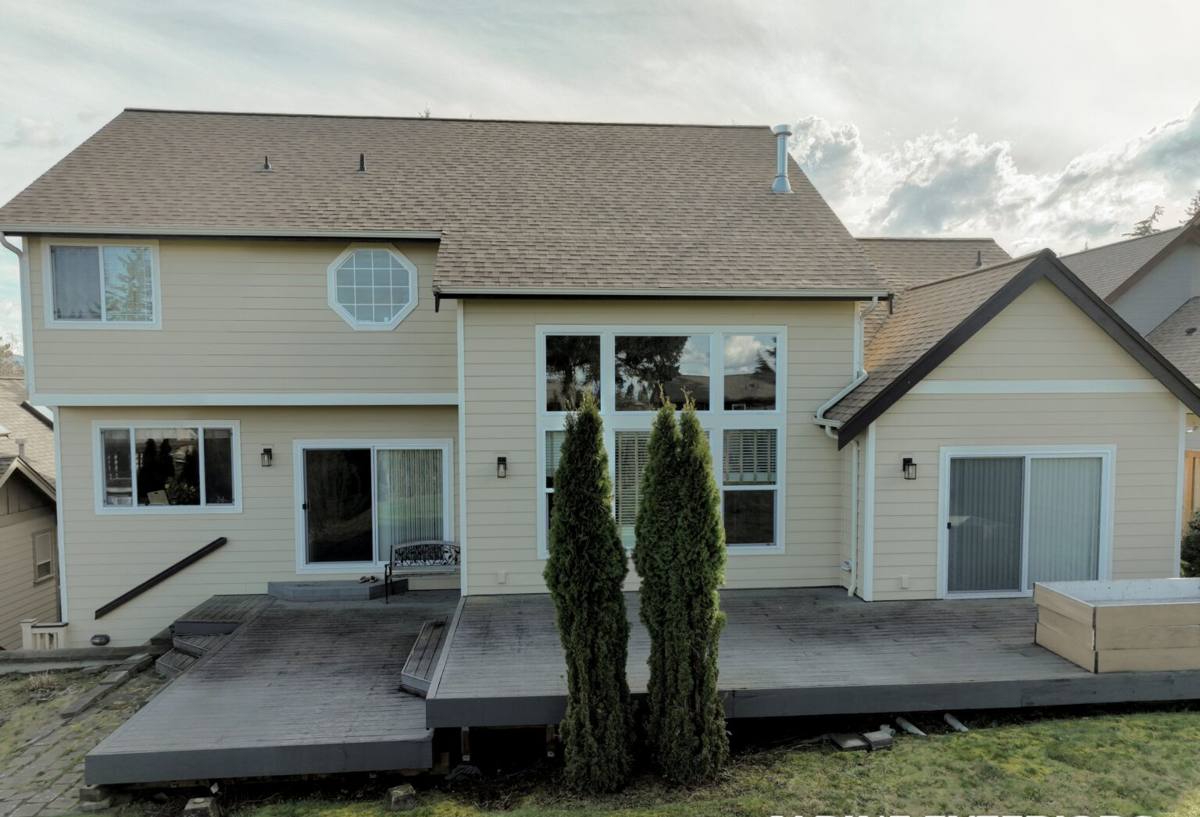
Choosing the Right Decking Material
There's no single "best" decking material — the right choice depends on how much sun and shade your specific lot gets, how much maintenance you want to do, and your budget. Here's how the common options actually perform in Blaine and Ferndale conditions.
| Material | Moisture/Moss Behavior | Maintenance | Typical Lifespan Here |
|---|---|---|---|
| Pressure-treated fir/hem-fir | Absorbs water, needs sealing to resist moss and cupping | Annual cleaning, re-seal every 2-3 years | 15-20 years with upkeep |
| Cedar | Naturally rot-resistant but still needs sealing in shaded, wet spots | Cleaning and re-oiling every 1-2 years | 20-25 years with upkeep |
| Capped composite | Won't absorb water or rot, but moss/algae can still grow on the surface film | Periodic washing, no sealing/staining | 25-30+ years |
| Uncapped composite (older style) | Can absorb moisture at cut ends and swell over time | Moderate — more cleaning than capped composite | 15-20 years |
For heavily shaded lots — common under the fir and cedar cover found around Ferndale — capped composite generally holds up with the least fuss, since it doesn't feed moss the way raw wood fibers can. For open, sunnier yards, quality cedar or well-maintained pressure-treated wood remains a solid, more budget-friendly option, as long as the owner keeps up with cleaning and sealing.
What a Correctly Built Deck Includes
The visible decking is maybe a third of what determines how long a deck lasts here. The parts you don't see — framing, fasteners, drainage, and ledger attachment — do most of the work of keeping water from becoming a long-term problem.
- Proper ledger flashing where the deck attaches to the house, so water is directed away from the band joist and siding instead of tracking behind it
- Joist tape or flashing on top of framing lumber to keep fasteners from sitting in a puddle every time it rains
- Adequate substructure airflow and ground clearance so the underside of the deck can actually dry out between storms
- Corrosion-resistant structural hardware — joist hangers, post bases, and screws rated for the exposure this area sees
- Consistent board spacing that lets water drain through rather than pool on the surface
- Footings set to local frost depth and soil conditions, not just poured to a generic minimum
- Guardrails and stair connections built to current code, with hardware sized for the actual loads involved
Skipping any one of these doesn't usually cause an immediate problem — it shows up two, five, or ten years later as rot at the ledger, a spongy stair stringer, or rust stains bleeding through the decking. Building it right the first time costs less than tearing into a failed deck later.
Design Considerations Specific to This Area
Sun, Shade, and Layout
Because tree cover and lot orientation vary block to block in Ferndale and Blaine, we look at how much direct sun a proposed deck location actually gets before recommending material and finish. A north-facing deck tucked under trees needs different moisture management than a south-facing deck that dries out fast between rains.
Wind Exposure Near the Water
Properties closer to Semiahmoo Bay or open water can see stronger, more consistent wind than more sheltered inland lots. That affects railing design, how furniture and structures like pergolas are anchored, and sometimes the layout of the deck itself to work with prevailing wind rather than against it.
Drainage on Sloped Lots
A lot of the terrain around here isn't flat. On sloped lots, where the deck's footings and drainage tie into the surrounding grade matters — done wrong, a deck can end up directing runoff toward the house foundation instead of away from it.
Our Process for a Blaine or Ferndale Deck Project
- On-site assessment. We look at sun/shade exposure, drainage, soil, and how close the property is to salt air influence, then talk through material options that actually fit the site.
- Design and honest pricing. You get a clear layout and a straightforward quote — no vague allowances that turn into surprise add-ons later.
- Permitting. Deck permits and inspections are handled through the applicable local jurisdiction; we manage that process so you don't have to chase it down.
- Build. Footings, framing, flashing, and hardware go in first and get it right before a single deck board is installed.
- Final walkthrough. We go over the finished deck with you, including basic care and cleaning guidance suited to your specific material and site conditions.
Maintenance That Actually Matters Here
Maintenance needs differ by material, but a few habits make a real difference for any deck in this climate:
- Sweep leaves and debris off the surface regularly, especially in fall, so damp organic matter doesn't sit on the boards
- Rinse or lightly scrub off early moss growth before it establishes — it's far easier to remove when it's new
- Keep gutters and downspouts clear so runoff isn't dumping extra water onto or near the deck
- Check railing and stair connections once a year for looseness, which can be an early sign of hardware corrosion
- Re-seal or re-oil wood decking on the schedule appropriate to that material — don't wait until it's visibly gray and dry
Why Local Build Experience Matters
A deck design that works fine in a dry inland climate can fail early here simply because it wasn't built with this area's rain volume, humidity, and moss pressure in mind. Crews who work Whatcom County regularly already know which fastener grades hold up, which material choices fight moss instead of feeding it, and how to detail flashing and drainage for a climate that stays wet for months at a stretch. That local pattern recognition is hard to substitute for, and it's usually the difference between a deck that needs attention every year and one that just quietly does its job.
If you're planning a new deck or replacing one that's showing its age, we're happy to take a look and put together a free, no-pressure estimate for your Blaine or Ferndale property — just fill out the form below.