 Ferndale Exterior
 Roof Replacement in Blaine: What a Local Crew Knows
Blaine sits right on Semiahmoo Bay and Drayton Harbor, at the northern edge of Whatcom County near the Canadian border, and that location puts real, sustained stress on a roof that homes further inland don't deal with in the same way. Salt-tinged air drifts in off the water almost year-round. Storms don't just fall straight down here — wind pushes rain sideways and forces it up under shingle edges and flashing details that were never designed to handle water moving in that direction. And a long, damp moss season settles onto shaded and north-facing roof planes and doesn't fully let go until well into the warmer months. A roof replacement done for Blaine has to account for all three of those things at once, not just swap old shingles for new ones.
We're based in Ferndale, a short drive south of Blaine, and we work roofs in this stretch of Whatcom County regularly — not as an occasional out-of-territory job. This page covers what Blaine's climate actually demands from a roof replacement, what a correct job involves from tear-off to final inspection, and why hiring a crew that already works this specific area, rather than one commuting in from further away, makes a practical difference on a job this size.
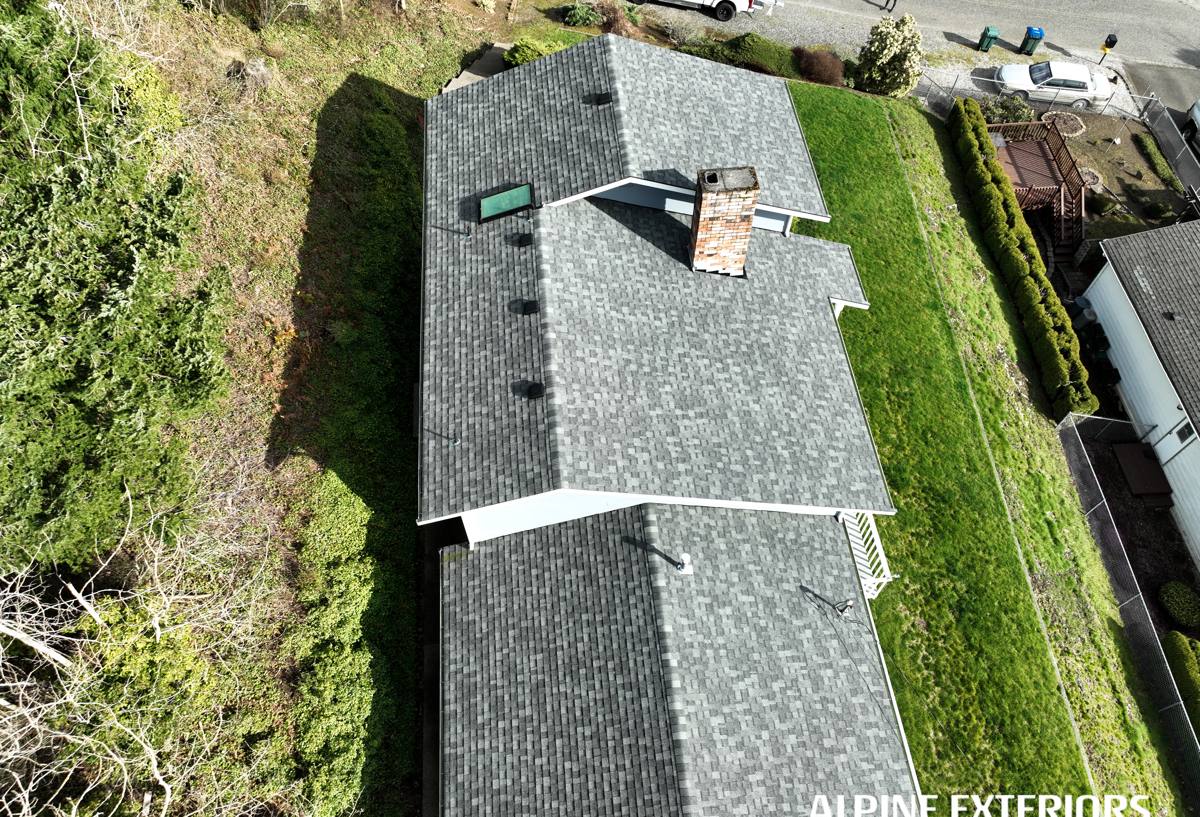
What Blaine's Climate Does to a Roof
Salt Air Off the Bay and Harbor
Homes near Semiahmoo Bay and Drayton Harbor take a steadier dose of salt-laden air than towns set further inland, and a roof has nowhere to hide from it — it's the most exposed surface on the house, day and night, in every season. Salt speeds up corrosion in exposed metal: nails, flashing, drip edge, and any fastener that isn't rated for the exposure. A fastener that's corroding loses holding strength well before it looks obviously bad from the ground, and corroded flashing metal is one of the most common sources of a leak that shows up years after a roof goes on, not right away.
Driving Rain and Wind
Storms coming off the water in Blaine tend to arrive with real wind behind them, and that wind pushes rain sideways into places a roof built for calm, straight-down rainfall was never designed to shed. Wind-driven rain gets forced under shingle tabs, up under flashing laps, and into valleys and roof-to-wall transitions that a lighter storm would never reach. A roof that performs fine on a still day can still let water in the moment wind gets involved, and in Blaine, wind is involved fairly often.
A Moss Season That Runs Most of the Year
Mild temperatures and near-constant moisture give moss and algae a long growing season here, and roof surfaces that stay shaded or face north are usually the first to show it. Moss doesn't just look bad — it holds moisture against the shingle surface and can work its way under tabs over time, and on an older roof it's often a sign that granule loss and surface wear are already underway underneath it.
Signs a Blaine Roof Needs Replacement, Not Just a Repair
Not every roofing problem calls for a full replacement, and an honest contractor should tell you when a repair is genuinely enough. But certain signs point toward a roof that's past the point where patching individual problems makes sense:
- Granules collecting heavily in the gutters, which signals the shingle surface has worn thinner than it should be at this stage of its life
- Curling, cracking, or lifted shingle edges across multiple areas of the roof rather than one isolated spot
- Repeated leaks in different locations after previous repairs, rather than one leak that gets fixed and stays fixed
- Visible sagging along the roofline, which usually points to deck-level moisture damage underneath the shingles
- Heavy, persistent moss or dark algae staining across shaded or north-facing roof planes
- A roof that's simply reached the end of its material's realistic service life, even if it isn't actively leaking yet
If a roof is showing two or three of these at once, a targeted repair is usually just delaying a replacement that's already due, and often at a higher total cost than doing the job right the first time.
What a Correct Roof Replacement Involves
A roof replacement isn't just stripping off old shingles and laying down new ones. Done right, it's a layered system, and each layer is doing a specific job against the exact conditions Blaine's climate creates.
Tear-Off and Deck Inspection
A full tear-off down to the plywood or OSB decking is the only way to find rot, soft spots, or hidden moisture damage that's been developing quietly under the old shingles — damage that often isn't visible from inside the attic until it's already advanced. Installing new shingles directly over an old layer skips this step and seals whatever problems already exist underneath a fresh surface, which is exactly the kind of shortcut that shows up as a bigger repair a few years later.
Underlayment
Synthetic or self-adhered underlayment gives the roof deck a real secondary water barrier, which matters directly in a place where wind-driven rain routinely gets forced under shingle edges instead of running straight off. Ice-and-water shield membrane at eaves, valleys, and other high-risk transitions adds another layer of protection at the exact spots where water is most likely to find a way in.
Flashing at Valleys, Chimneys, and Walls
Most roof leaks in this region don't start out in the open field of shingles — they start at flashing. Valleys where two roof planes meet, chimney and skylight penetrations, and the places where a roofline meets a wall all need flashing that's properly lapped, integrated with the underlayment, and built as part of the water-shedding system rather than caulked over as an afterthought once the shingles are already down.
Fastening and Ventilation
Nail placement, count, and pattern need to follow manufacturer specification so shingles stay locked down under wind load instead of lifting at the edges over time, which matters more on exposed lots near the water than on tightly sheltered ones. Balanced intake and exhaust ventilation keeps the underside of the roof deck dry, which extends shingle life and reduces the moisture that feeds moss growth from below. A roof can look fine from the street and still be shortening its own lifespan because of poor attic airflow nobody's checked.
Choosing Roofing Materials for Blaine's Exposure
Most Blaine homes are well served by asphalt shingles, but the grade and specification matter more here than they would in a drier, more sheltered town. Metal roofing is a reasonable option for some homes and budgets too, particularly where wind exposure or roof pitch make it a better fit.
| Roofing Option | Handling Salt Air & Wind-Driven Rain | Moss Resistance | Typical Lifespan |
|---|---|---|---|
| 3-Tab Asphalt Shingles | Fair — lower wind rating, thinner profile | Poor without algae-resistant granules | 15-20 years |
| Architectural Shingles | Good — heavier build, stronger wind rating | Fair to good with algae-resistant granules | 25-30 years |
| Premium/Designer Shingles | Very good — heaviest shingle-line construction | Good, especially on treated lines | 30+ years |
| Standing Seam Metal | Excellent — sheds wind-driven rain well, corrosion-resistant coatings available | Very good — smooth surface resists moss | 40-50+ years |
For most Blaine homes, architectural shingles with algae-resistant granules strike the right balance between upfront cost and long-term performance given the wind exposure and moss season here. Whether metal roofing or a premium shingle tier makes more sense usually comes down to roof pitch, how much of the roof stays shaded, and how long you plan to stay in the home.
Cost Factors Worth Understanding
Two bids for the same Blaine roof can come in thousands of dollars apart, and the gap is almost always real scope, not one contractor simply padding the number. Understanding what actually drives cost makes it much easier to compare estimates that look nothing alike on paper.
| Factor | What It Affects |
|---|---|
| Tear-off vs. layover | Whether hidden deck damage gets found and repaired before new roofing goes down |
| Underlayment grade | How well the roof resists wind-driven rain getting under shingle or panel edges |
| Material and wind rating | Expected lifespan and performance under Blaine's open, wind-exposed conditions |
| Flashing scope | How thoroughly valleys, chimneys, and wall transitions are addressed |
| Ventilation upgrades | Long-term moisture control and how long the roofing material actually lasts |
| Roof pitch, size, and access | Labor time, staging, and safety requirements on the job |
A written estimate that breaks these components out line by line tells you far more than a single lump-sum number. It's worth asking any contractor to walk you through exactly what's included before comparing two prices side by side.
How Our Process Works
We run the same process on every Blaine roof replacement, because a job this size on your home deserves clear steps and communication, not surprises partway through.
- In-person inspection: We walk the roof and attic ourselves rather than estimating from a photo, and document what we actually find.
- Written estimate: You get a clear, itemized bid covering tear-off, underlayment, flashing, ventilation, material selection, and cleanup, not one vague line item.
- Scheduling around weather: We build reasonable flexibility into the timeline, since wet-season delays are a normal part of working near the water in this region.
- Tear-off and deck repair: Old roofing comes off completely, and any deck damage we find gets addressed before anything new goes down.
- Underlayment, flashing, and material installation: Each layer goes on to manufacturer specification, with extra attention at valleys, penetrations, and wall transitions.
- Final walkthrough and cleanup: We review the finished roof with you in person and do a full site and magnetic nail sweep before we consider the job done.
Why It Matters That We're a Ferndale Crew Who Already Works Blaine
Being based in Ferndale rather than a company that occasionally drives up from somewhere much further south changes a few things in practice, not just in a sales pitch. It means we're already familiar with Blaine's specific exposure to Semiahmoo Bay and Drayton Harbor, the wind patterns that come with it, and which roofing specifications actually hold up here versus which ones are a corner cut that shows up in a few years. It also means scheduling, follow-up questions, and warranty service aren't dependent on a crew traveling in from out of the area — we're close by and working this part of Whatcom County on an ongoing basis.
That local familiarity shows up in the small judgment calls too: which flashing detail is worth the extra time on a wind-exposed lot near the water, how much moss resistance actually pays off on a shaded north slope, and being straightforward about what a roof here realistically needs to last versus what's just an upsell.
A Practical Checklist Before You Choose a Roofer
- Do they perform a full tear-off with deck inspection, not just a layover?
- Does the estimate specify underlayment type and shingle or panel product, not just "new roof"?
- Is flashing work at valleys, chimneys, and walls explicitly written into the bid?
- Do they carry current Washington contractor licensing, liability insurance, and workers' compensation?
- Can they point to recent, real work in or near Blaine, not just somewhere else in the region?
- Does the bid clearly separate manufacturer material warranty from the contractor's own workmanship warranty?
If you're weighing a roof replacement on your Blaine home, we're glad to come take a look and give you an honest read on where things stand, no pressure and no obligation. Use the form below to request a free estimate.