 Ferndale Exterior
 Custer's Climate Asks More of Siding Than Most Products Can Give
Custer sits in a stretch of rural Whatcom County where weather comes off the water and doesn't let up for months at a time. Homes here deal with a combination that's hard on exterior materials: salt-laden air drifting in off the coast, driving rain that hits siding sideways instead of straight down, and a long, damp moss season that keeps north-facing walls and shaded siding wet for weeks on end. Add in the wind that moves across open farmland and tree lines with little to slow it down, and you've got conditions that will find every weak point in a siding system within a few years, not a few decades.
This is exactly the kind of environment James Hardie fiber cement siding was engineered for. It's also exactly the kind of environment where a rushed or generic installation shows its flaws early — trapped moisture, swelling, streaking, and premature paint failure are common complaints we hear about siding that wasn't matched to the climate or installed with real attention to water management.
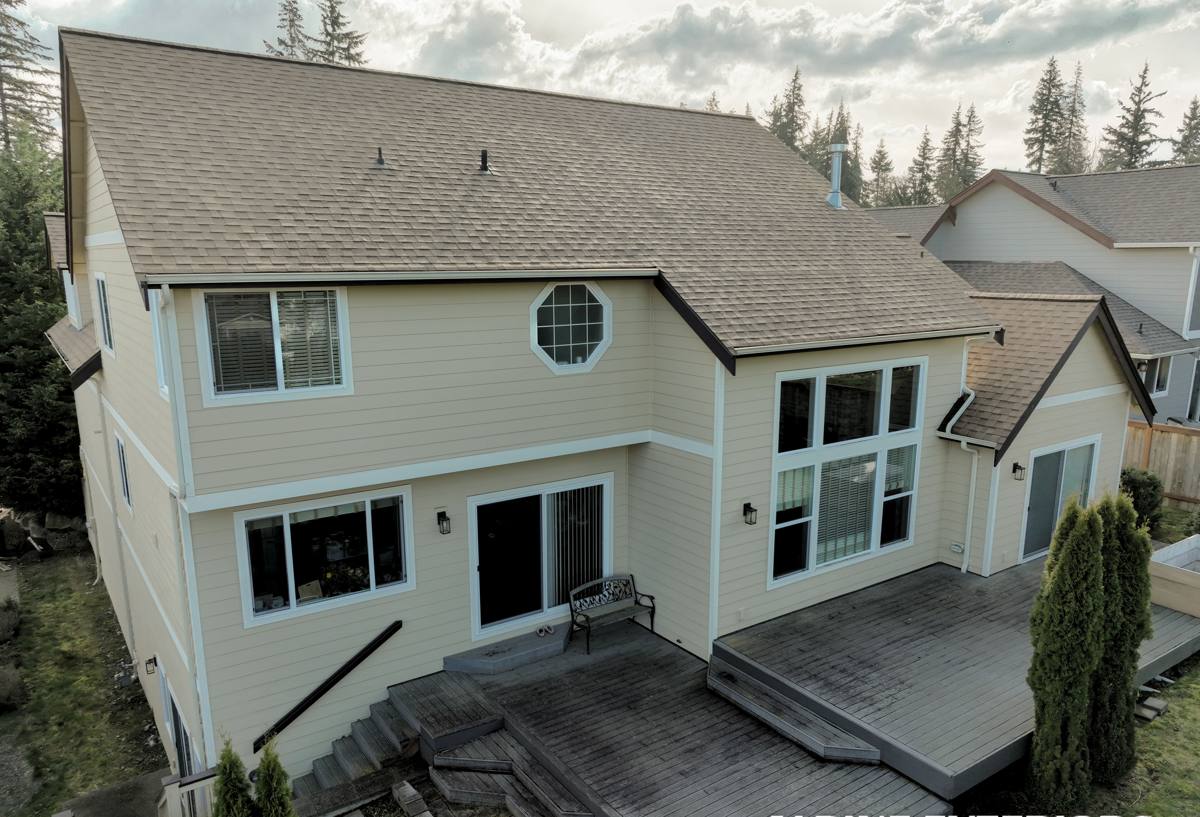
Why Fiber Cement Handles Salt Air and Rain Better Than the Alternatives
Salt air is corrosive and it's persistent — it doesn't just affect metal fasteners and flashing, it accelerates the breakdown of paint films and can drive moisture absorption in porous or wood-based materials. James Hardie's fiber cement is a cement, sand, and cellulose fiber composite. It doesn't absorb water the way wood-based products do, it doesn't rot, and it's dimensionally stable, so it doesn't swell and shrink with every wet-dry cycle the way engineered wood siding can. That stability matters more in Custer than in a drier inland climate, because the wet season here is long and the dry season is short — siding doesn't get much of a break to fully dry out between storms.
James Hardie also builds region-specific product lines (HZ5 for wetter climates like ours) engineered around moisture and freeze-thaw performance rather than a one-size-fits-all formula. That's part of why we standardized on this product instead of mixing and matching brands: consistency in how the material performs against the exact conditions Whatcom County throws at it.
What Moss Season Does to the Wrong Siding
Extended moss and algae growth isn't just cosmetic. On wood-based or improperly sealed products, sustained organic growth holds moisture against the surface, which accelerates rot and coating failure. Fiber cement doesn't feed mold and mildew growth the way wood fiber does, and Hardie's factory-applied ColorPlus finish is formulated to resist streaking and fading better than field-applied paint. Regular rinsing still matters — no siding is maintenance-free — but you're not fighting the material itself.
The Right James Hardie Products for a Custer Home
Not every Hardie product fits every house, and matching the right line to a home's exposure is part of doing this correctly, not an upsell.
- HardiePlank lap siding — the standard for most Custer homes; available in smooth or cedar-textured finishes, installed in traditional lap courses that shed water efficiently.
- HardiePanel vertical siding — often used on gables, shop buildings, or accent sections; pairs well with the barn-style and rural architecture common in this area.
- HardieTrim boards — for corners, window and door casing, and fascia; keeps trim from becoming the weak point once the field siding is upgraded.
- ColorPlus factory finish — baked-on color with a stronger warranty against fading and peeling than field-painted siding, which matters when a home faces years of salt air and UV exposure with no easy repaint schedule.
What a Correct Installation Actually Involves
James Hardie siding performs to spec only when the installation behind it is right. Most siding failures we're called out to inspect aren't a materials problem — they're a water-management problem hiding behind siding that looks fine from the curb.
The details that determine whether siding lasts
- Proper water-resistive barrier installed and lapped correctly before any siding goes up
- Correct flashing at every window, door, and roof-to-wall transition — the single most common failure point on homes we re-side
- Manufacturer-specified fastener type, spacing, and penetration depth (under- or over-driven nails are a leading cause of premature panel movement)
- Proper clearance between siding and grade, decks, patios, and roof lines to prevent wicking and splash-back moisture
- Correctly caulked and sealed joints, sized and installed per Hardie's published fastening and clearance specs
- Ventilation behind the siding plane where the wall assembly calls for it
Skipping any one of these doesn't show up on day one. It shows up in year three or four, as staining, soft trim, or paint failure at the joints — often just as a homeowner assumes their new siding should be performing at its best.
James Hardie Compared to Other Siding Choices for This Climate
| Factor | James Hardie Fiber Cement | Vinyl | Wood / Engineered Wood |
|---|---|---|---|
| Moisture resistance | Does not absorb water or rot | Doesn't rot, but can trap moisture behind it if installed poorly | Vulnerable to swelling and rot without diligent maintenance |
| Performance in driving rain / wind | Rigid, holds seal well | Can flex, crack, or blow off in high wind | Seams and joints are ongoing maintenance points |
| Salt air / coastal exposure | Engineered climate-specific lines (HZ5) | Can become brittle and discolored over time | Salt accelerates coating breakdown and decay |
| Fire resistance | Non-combustible | Combustible, can melt/deform near heat | Combustible |
| Finish longevity | Factory ColorPlus finish, strong fade warranty | Color molded in, but fades and chalks over time | Requires repainting/staining on a recurring cycle |
Our Process for a Custer Siding Project
We approach every Custer home the same methodical way, because the climate here doesn't forgive shortcuts.
1. On-site assessment
We walk the exterior, check existing siding and trim for hidden moisture damage, and look at exposure — which walls take the worst of the wind and rain, where moss and algae are already established, and where past water intrusion may have already done damage that needs addressing before new siding goes up.
2. Prep and repair
Any rot, damaged sheathing, or failed flashing gets addressed first. New siding over unresolved moisture problems just hides the issue — it doesn't fix it.
3. Water-resistive barrier and flashing
This is the layer that does the real work of keeping a Custer home dry. We install and lap it correctly, and detail flashing at every penetration before a single piece of siding is hung.
4. Installation to Hardie's fastening specification
Correct nailing pattern, correct clearances, correct joint treatment — installed to the manufacturer's published specs so the product warranty stays intact.
5. Trim, caulking, and final inspection
Trim boards, caulking, and touch-up finish work close out the job, followed by a final walk-through.
Why Hiring a Crew That Already Works Custer Matters
Siding crews that mostly work in cities or newer developments don't always have a feel for what rural Whatcom County properties need. Homes and outbuildings in and around Custer often sit on larger lots with more wall exposure to wind and weather, longer driveways that mean more dust and debris settling near the base of the siding, and mature tree cover that keeps some walls shaded and damp far longer than others. A crew that regularly works this area already knows to plan around those exposure differences instead of treating every wall the same way.
Local experience also means knowing which details matter most in this specific climate — where extra flashing attention pays off, which orientations need closer moss and algae monitoring, and how to sequence a project around Whatcom County's wet season instead of fighting it.
Maintenance and Longevity After Installation
James Hardie siding is low-maintenance, not no-maintenance. A yearly rinse to keep moss, pollen, and salt residue from building up, along with a visual check of caulking and trim joints, is typically all it takes to keep the siding performing the way it's designed to. Because the color is baked into a factory finish rather than field-applied, you're not on a repainting schedule the way you would be with wood siding — but catching a failed joint or damaged trim board early is still the difference between a five-minute fix and a bigger repair down the road.
Get a Straight Answer for Your Custer Home
Every property here faces its own mix of wind, shade, and exposure, and that affects how a siding project should be planned and installed. If you'd like an honest look at what your home needs, reach out for a free, no-pressure estimate — we'll walk the exterior with you and tell you straight what we see.