 Ferndale Exterior
 Building Decks for Custer's Coastal Conditions
Custer sits close enough to the water and open farmland that decks here take a different kind of beating than decks built twenty miles inland. Between the salt-laden air blowing off Birch Bay and the Strait, the long stretches of driving rain that define a Whatcom County winter, and a moss season that can run eight months out of the year, a deck built to a generic spec sheet starts showing problems fast — soft spots in the decking, corroding fasteners, slick green film on the walking surface, and railing posts that loosen before their time. A deck built correctly for this specific area holds up to all of it without turning into a maintenance project every spring.
We build and repair decks throughout the Ferndale area, and Custer's mix of coastal exposure and rural tree cover is one of the more demanding combinations we work in. This page covers what that actually means for material choice, framing, hardware, and drainage — not generic deck-building advice, but what we've learned building decks that need to survive this particular climate.
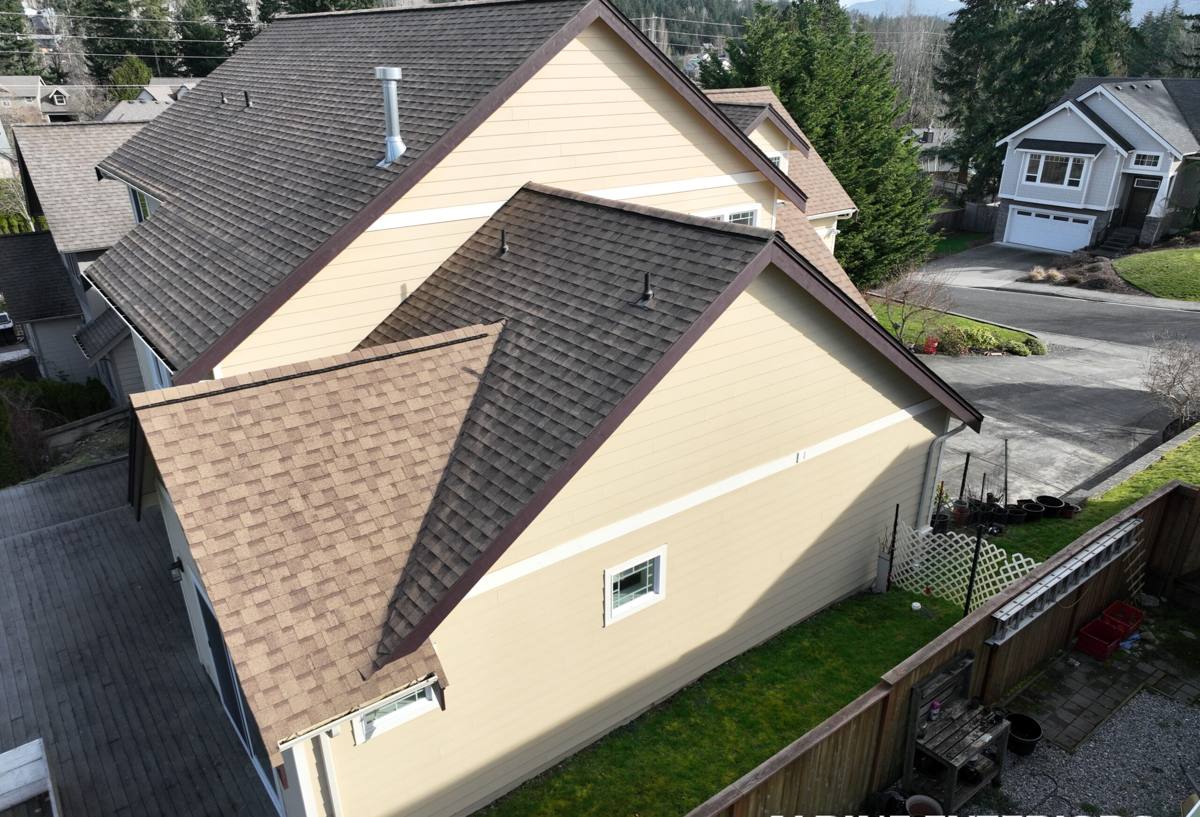
What Custer's Climate Actually Does to a Deck
Three things drive almost every deck problem we see out this way:
Salt Air
Proximity to the Strait of Georgia and Birch Bay means airborne salt is a real factor for exposed metal. Standard hardware — the kind fine for a deck fifty miles inland — corrodes noticeably faster here. Fastener heads streak, joist hangers weaken at the bend points, and cheap coated screws lose their protective layer within a few seasons.
Sustained, Driving Rain
Whatcom County doesn't just get rain, it gets rain that comes in sideways for days at a time. That matters for how water sheds off a deck, how ledger boards are flashed against the house, and whether water can get trapped between boards or behind rim joists where it can't dry out.
Moss and Shade
Custer has enough tree cover and cloud-heavy stretches that moss growth on horizontal surfaces is a near-constant fight. Moss holds moisture against the decking surface, which accelerates rot in wood and can stain and degrade even some composite products if it's never cleaned off. A deck with poor airflow underneath or tight board spacing gives moss exactly the damp, shaded environment it wants.
Choosing Decking Material for This Climate
There's no single "right" material for every Custer property — it depends on budget, how much upkeep you're willing to do, and how exposed the deck is to sun, shade, and salt air. Here's how the common options actually perform out here.
| Material | Salt Air Resistance | Moss/Moisture Behavior | Upkeep |
|---|---|---|---|
| Pressure-treated wood | Good if hardware is corrosion-rated | Needs regular cleaning and re-sealing or moss takes hold fast | Highest — annual cleaning, periodic staining/sealing |
| Cedar | Naturally decent, but fasteners still need to be corrosion-resistant | Still needs cleaning; cedar grays and can stain from trapped moisture | High — regular sealing to hold color and resist rot |
| Capped composite | Excellent — the cap resists salt exposure well | Won't rot, but moss/algae can still grow on the surface film and needs washing | Low — occasional washing, no sealing or staining |
| PVC decking | Excellent — fully synthetic, no wood fibers to break down | Same surface-cleaning need as composite, but zero moisture absorption | Lowest — wash occasionally, no structural moisture risk |
We install all of these depending on what the homeowner wants, but for a Custer property with real salt exposure or heavy shade, we're upfront that composite or PVC will save a lot of maintenance headaches over the life of the deck. If you want the look of real wood and are willing to keep up with sealing, we'll build it to hold up — we just make sure you know what the upkeep commitment looks like going in.
Framing and Structure: Where Deck Failures Actually Start
Most deck problems we get called out to fix aren't decking-surface problems — they're framing problems that took a few years to show up. In this climate, the details that matter most are:
- Ledger board flashing: the connection where the deck attaches to the house has to be flashed to shed water away from the wall framing, not just caulked and hoped for.
- Joist hangers and structural hardware: we use corrosion-resistant, coated hardware rated for exterior and coastal-adjacent use — not the cheapest box of hangers at the yard.
- Gaps and airflow: proper spacing between boards and adequate clearance underneath the deck lets air move and water evaporate instead of sitting and feeding rot or moss.
- Footing depth: footings need to be set below frost depth and bear on solid, undisturbed soil — this matters even in a region with relatively mild winters, because saturated ground behaves differently than dry ground.
A deck that looks fine on the surface but was framed with mismatched hardware or poor flashing will show its age within a handful of winters — soft ledger connections, sagging joists, or a railing post that's gone spongy at the base.
Fasteners and Hardware: The Detail Most Contractors Skip
This is the single biggest difference between a deck that lasts and one that doesn't in a salt-air environment. Standard galvanized fasteners are built for general exterior use, not sustained salt exposure. We spec stainless steel or heavy-duty coated fasteners rated for coastal and treated-lumber compatibility on every deck we build near the water, including structural screws, joist hangers, post bases, and railing hardware. It costs more up front than using whatever's on the shelf, but it's the difference between hardware that's still tight in fifteen years and hardware that's streaking and loosening in five.
Drainage and Moss Prevention Built Into the Design
You can't eliminate moss risk in a shaded, wet climate, but you can design a deck that fights it instead of feeding it. That means:
- Correct board spacing so water drains through instead of pooling on the surface
- A slight slope away from the house on the decking surface itself
- Adequate clearance underneath for airflow, especially on lower decks close to grade
- Keeping planters, rugs, and furniture feet off direct contact with the boards where moisture gets trapped
- Choosing a surface texture that doesn't hold standing water in the grain pattern
None of this eliminates the need to clean the deck occasionally — moss is part of living here — but it dramatically cuts down how often and how aggressively you have to do it.
Our Process for a Custom Deck Build
Every property is different, but the process we follow is consistent:
- On-site walkthrough: we look at sun exposure, shade, tree cover, drainage patterns, and how the deck will connect to your house before we talk materials.
- Design and material selection: we go over the tradeoffs between wood, composite, and PVC honestly, based on your budget and how much maintenance you actually want to do.
- Permitting: deck permits in Whatcom County depend on size, height, and attachment to the structure — we handle the permit process so you're not chasing paperwork.
- Framing built to coastal standards: corrosion-resistant hardware, correctly flashed ledger connections, and footings set to proper depth.
- Decking, railing, and finish work: installed with the spacing and slope details that keep water and moss from taking hold.
- Final walkthrough: we go over basic care specific to your material choice so you know what upkeep actually looks like year to year.
Maintenance Checklist for a Long-Lasting Deck in Custer
Whatever material you choose, a little seasonal attention goes a long way in this climate:
- Sweep debris and standing leaves off the surface regularly, especially in fall
- Wash the deck surface at least once or twice a year to clear moss and algae before it takes hold
- Check railing posts and stair connections annually for looseness
- Inspect fastener heads for rust streaking — an early sign hardware needs attention
- Keep gutters and downspouts near the deck clear so water isn't dumping directly onto or under it
- Re-seal or re-stain wood decking on the schedule the product actually requires, not "whenever it looks bad"
Why a Crew That Already Works Custer Matters
A contractor who mostly builds decks in drier, inland climates will often spec the same materials and hardware they'd use anywhere else — and that deck will age fine for a few years before the salt air and moss catch up to it. Building here means already knowing which fasteners hold up, how to flash a ledger board against sustained sideways rain, and how to design in the airflow and drainage that keep moss from taking over. That's not something you learn from a spec sheet — it's something you learn from building and maintaining decks in this exact climate, on this exact stretch of coastline.
If you're planning a new deck or replacing one that's showing its age, we're happy to take a look and put together a free, no-pressure estimate — just fill out the form below.