 Ferndale Exterior
 Building Decks for a Point Roberts Property
Point Roberts sits on its own point of land, surrounded on three sides by water, which means every deck out there gets more weather exposure than a typical Whatcom County backyard. Salt-laden air off the water, wind that doesn't have much to break it before it hits your siding and railings, and a rainy season that runs long even by Pacific Northwest standards — all of it adds up to conditions that are harder on outdoor wood and hardware than most manufacturers' warranty language assumes. A deck built to a generic spec sheet, without accounting for that, tends to show corrosion, cupping, and moss buildup years before it should.
We're based in Ferndale and have done deck work throughout Whatcom County, including out on Point Roberts. That matters more than it might seem — we'll get into why later in this page — but the short version is that building well for this specific spot takes more than swapping in "coastal" fasteners and calling it done.
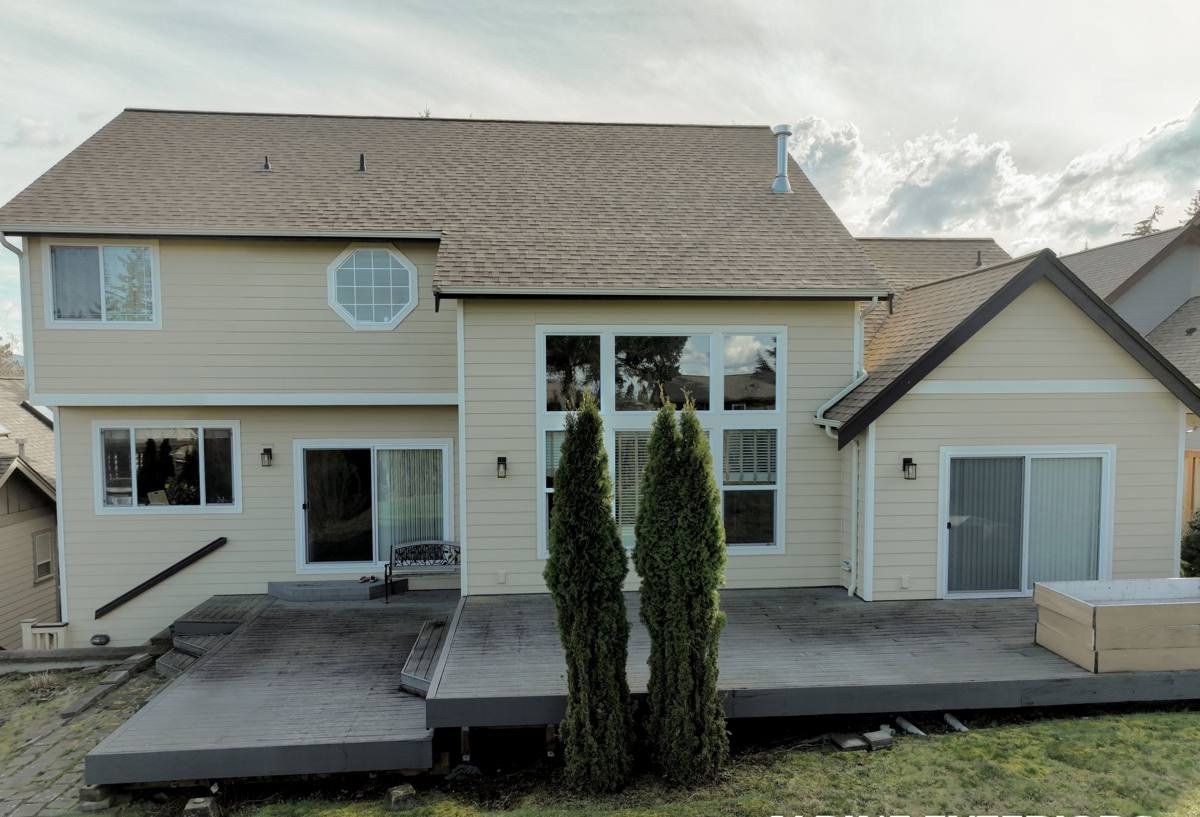
What Point Roberts' Climate Actually Does to a Deck
Salt Air and Corrosion
Being surrounded by saltwater on multiple sides means airborne salt settles on everything outdoors, including deck hardware. Standard galvanized screws and joist hangers can start showing rust streaks and pitting well before a comparable inland deck would. Over time that corrosion weakens the connection points that hold your deck together — the ledger board attachment, joist hangers, and structural screws — long before the decking boards themselves look worn out.
Driving Rain and Moisture Intrusion
Wind-driven rain doesn't just fall straight down here; it gets pushed sideways into ledger connections, under railing posts, and into any gap where flashing was skipped or done half-heartedly. Water that gets behind a ledger board or pools under decking is the single most common cause of the rot and structural failures we get called out to fix, and it's almost always a problem that traces back to how the deck was built, not how old it is.
Moss and the Long Wet Season
Whatcom County's damp season stretches for a good chunk of the year, and a spot as exposed to moisture as Point Roberts grows moss readily on any horizontal surface that stays shaded or doesn't drain well. Moss holds moisture against the decking surface, which accelerates wood decay and makes composite and wood decking alike slicker and more slippery underfoot. Deck orientation, gaps between boards, and how well water actually gets off the surface all affect how much of a moss problem you'll have.
What a Deck Built for This Climate Needs
- Stainless steel or heavy-duty coated fasteners and structural connectors rated for coastal or high-corrosion exposure — not standard galvanized hardware
- Proper ledger board flashing that directs water away from the house, with a moisture barrier between the ledger and siding
- Adequate board spacing and a slight slope built into the frame so water actually sheds instead of pooling
- Joist tape or comparable protection over the framing to slow moisture absorption into the structural lumber
- Footings set to proper frost depth per Whatcom County code, not just "deep enough to look right"
- Railing systems with corrosion-resistant hardware, since railings take the brunt of wind-driven rain and salt exposure
- A decking material choice that matches how much sun, shade, and moss exposure the specific spot on the property actually gets
Choosing a Decking Material for Point Roberts
There's no single right answer here — it depends on your budget, how much maintenance you're willing to do, and how exposed the deck's location is. Here's how the common options actually compare under salt air and heavy moss pressure, based on what we see holding up out there.
| Material | Salt Air / Corrosion Behavior | Moss & Moisture Behavior | Maintenance |
|---|---|---|---|
| Pressure-treated lumber | Good if paired with stainless or coated fasteners; lumber itself resists rot chemically | Needs regular cleaning and resealing or moss gets a foothold fast | Highest — annual cleaning, periodic sealing |
| Cedar | Naturally decent rot resistance; hardware corrosion is still the weak point | Moss grows readily on cedar if it stays shaded or damp | High — regular cleaning, oiling to hold color and protect the surface |
| Composite decking | Doesn't corrode itself; connection hardware still needs to be corrosion-rated | Resists rot but moss and algae can still grow on the surface film if it's not cleaned | Low — periodic washing, no sealing needed |
| PVC/capped decking | Fully inert to salt exposure | Most moss-resistant surface, but still needs occasional washing in shaded spots | Lowest — occasional washing |
We'll walk through these trade-offs honestly during your estimate. Composite and PVC cost more upfront but ask less of you over the deck's life, which matters more in a high-exposure spot like Point Roberts than it would somewhere more sheltered. Wood decking isn't a bad choice — it just needs an owner who'll keep up with cleaning and sealing on a real schedule, not just when it starts looking bad.
What a Correct Deck Build Involves
Planning and Permitting
Deck work in unincorporated Whatcom County, which includes Point Roberts, goes through the county's permitting process. We handle the permit application and inspections as part of the job, and we design the deck to meet current code on footing depth, railing height, guard spacing, and structural spans — not just to pass a quick look.
Framing That Accounts for Exposure
We size joists and beams for the actual load and span, use corrosion-rated hardware throughout, and flash every point where the deck meets the house. This is the stage where corner-cutting doesn't show up for a few years — and then shows up all at once as a soft spot near the ledger or a railing post that's gone spongy.
Surface and Drainage
Board spacing, direction, and any gaps at the perimeter are set up to move water off the deck instead of holding it. Where a deck sits low to the ground or is partially shaded, we talk through options like additional gapping or material choice to keep moss pressure manageable.
Railings and Guards
Any deck more than a modest height off grade needs a code-compliant guard system — generally 42 inches high with baluster spacing that won't pass a 4-inch sphere. We build these to hold up under wind load, not just to meet the letter of the code on installation day.
Our Process for a Point Roberts Deck Project
- On-site visit to assess the location, sun/shade exposure, existing structure (for replacements), and access
- Written estimate covering material options, structural scope, and permit requirements
- Permit submission and approval through Whatcom County before any work starts
- Demolition of the old deck if applicable, with attention to what's underneath — ledger condition, existing rot, soil drainage
- Framing, flashing, and footing work, inspected at the appropriate stages
- Decking, railing, and finish work
- Final walkthrough and county inspection sign-off
Why a Crew That Already Works Point Roberts Matters
Point Roberts is a bit of an outlier logistically — it's separated from the rest of Whatcom County by water and Canadian territory, so getting crews and materials there means planning around the border crossing rather than just driving down the road. A contractor who hasn't worked out there before will often underestimate how that affects scheduling, delivery timing, and even which subcontractors are willing to take the trip. We've built that into how we plan and price Point Roberts jobs, so a quoted timeline is one we can actually hold to.
There's also a practical side to local familiarity: we've seen how decks in that specific environment age, which framing and fastening choices hold up, and which shortcuts show up as problems a few years down the line. That's the kind of thing you only really learn by doing the work there, not by reading a spec sheet.
Signs Your Existing Point Roberts Deck Needs Attention
- Rust streaking around screws, joist hangers, or railing posts
- Soft, spongy, or discolored decking near the house or around posts
- Persistent moss or algae film that comes back within weeks of cleaning
- Railings that flex or feel loose when leaned on
- Gaps or separation at the ledger board where the deck meets the house
- Standing water on the surface after rain instead of it draining off
Any of these are worth having looked at before they turn into a full rebuild. Sometimes it's a repair — replacing hardware, re-flashing a ledger, swapping a few boards — and sometimes the frame underneath has enough going on that a rebuild is the more honest recommendation. We'll tell you which one it is.
Get a Free Estimate
If you're planning a new deck or need an honest look at one that's showing its age, we're happy to come out to Point Roberts, walk the site, and put together a straightforward estimate — no pressure, no upsell. Use the form below to get started.