 Ferndale Exterior
 Why Decks in the Fairhaven Area Wear Out Faster Than Homeowners Expect
If you own a home in the Fairhaven area near Ferndale, you already know the wood on your property doesn't get an easy life. Whatcom County sits close enough to the water that salt-laden air reaches decks, railings, and fasteners year-round, not just during storms. Add in months of driving rain and a moss season that can stretch from fall through spring, and you have a climate that's genuinely hard on outdoor structures — harder than most manufacturers' warranty language assumes.
A deck that would last two decades in a dry inland climate can start showing real structural problems in half that time here if it wasn't built with local conditions in mind. That's not a knock on the original builder necessarily — it's just what happens when a deck is framed and fastened the same way you'd frame one in Spokane or Sacramento.
Salt Air and Metal Fasteners
Airborne salt accelerates corrosion in screws, joist hangers, bolts, and structural connectors. On decks near Bellingham Bay and the surrounding coastline, we regularly find galvanized hardware that's rusted through at the head or shank well before the wood around it has failed. Once a fastener corrodes, it loses grip strength — and a deck is only as strong as its weakest connection. This is one of the most common hidden causes of deck failure we see, and it's almost always invisible until a board or railing moves underfoot.
Moss, Shade, and Moisture Retention
Many Fairhaven-area lots have mature tree cover, which is great for shade and privacy but keeps deck surfaces damp longer after rain. Combined with our long wet season, that moisture sits in board gaps, around post bases, and under railings — exactly where moss and rot get started. Moss isn't just cosmetic; it holds water against the wood surface and can make boards slick and unsafe well before they look structurally bad.
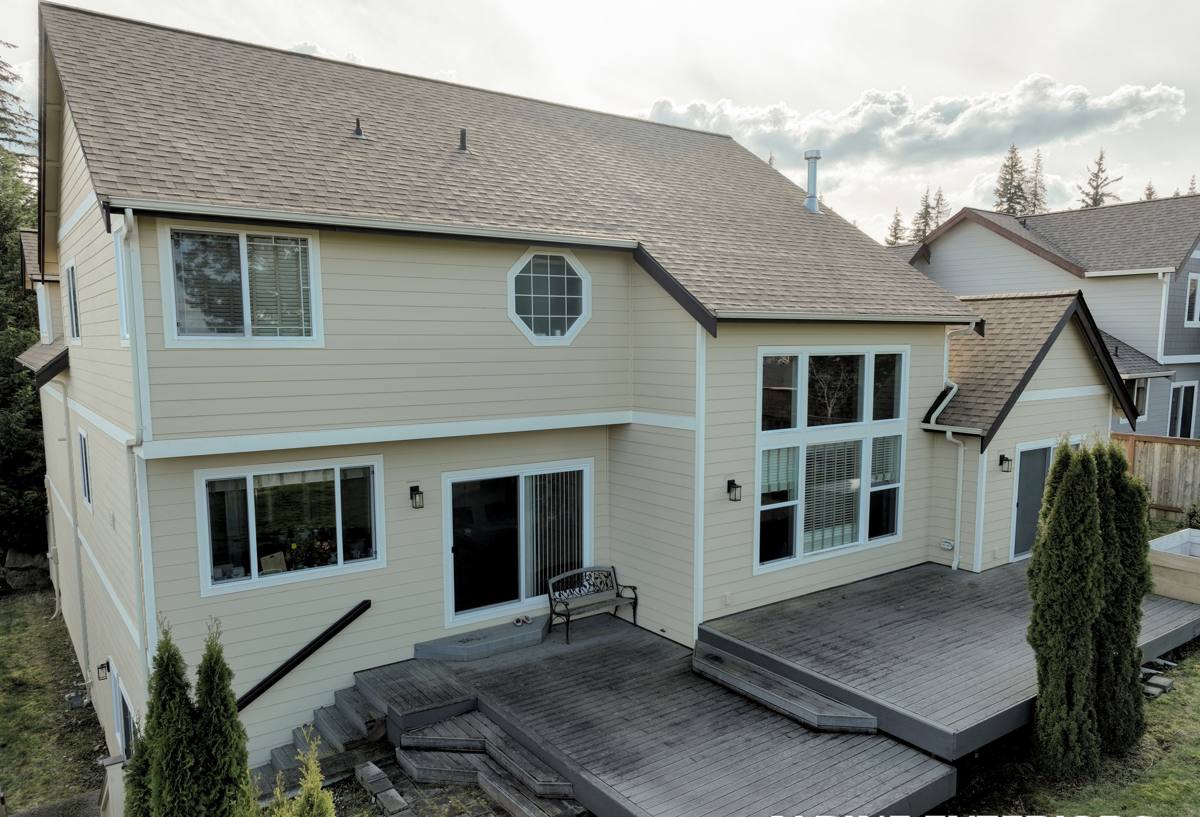
Signs a Fairhaven Deck Needs Replacement, Not Just Repair
Not every tired-looking deck needs to be torn out. But there's a point where patching individual boards is just delaying a bigger cost, or worse, leaving a safety issue in place. Here's what we look for when we're deciding whether repair is still the honest recommendation:
- Soft or spongy spots in the decking surface, especially near the house or at board ends
- Visible rust streaks below joist hangers, ledger bolts, or railing posts
- Ledger board separating from the house, or gaps where flashing should be sealing that joint
- Posts that wobble at the base, which usually means the footing or post connection has failed
- Persistent moss or algae that returns within weeks of cleaning, indicating the wood is staying wet too long
- Railings that flex noticeably when leaned on — a code and safety issue, not a cosmetic one
- Structural framing (joists, beams) that's original to a deck 20+ years old, even if the surface boards were replaced at some point
If a deck is showing two or more of these, replacement is usually the more honest answer than another round of board swaps.
What a Correct Deck Replacement Involves Here
A deck rebuild done right for this climate isn't just about swapping old boards for new ones. The parts you don't see are what determine whether the deck holds up through the next ten or twenty wet seasons.
Framing and Ledger Board Attachment
The ledger board — where the deck attaches to the house — is the single most common point of failure on decks in wet climates if it's not flashed correctly. We install proper flashing that directs water away from the house structure rather than letting it wick into the rim joist. This is a detail that's easy to skip and impossible to inspect once the deck boards are down, which is exactly why it matters who's doing the work.
Footings and Post Bases
Post bases that sit directly on or near grade stay wetter longer in our climate. We set posts on bases that keep the wood end grain elevated off the concrete and out of standing water, which significantly slows rot at the point where most deck posts eventually fail.
Fasteners and Hardware Rated for Coastal Exposure
Given how much salt air affects hardware in this area, we don't treat fastener selection as an afterthought. Stainless steel or coated fasteners rated for coastal/marine exposure cost more upfront than standard galvanized hardware, but the difference in corrosion resistance is significant over the life of the deck — and replacing corroded structural hardware later means tearing into finished decking to get at it.
Decking Material Comparison for a Salt Air, High-Moisture Climate
Material choice matters as much as construction quality. Each option below has real trade-offs for a Fairhaven-area property — there's no single "best" answer, just the right fit for your budget, maintenance appetite, and how the deck will be used.
| Material | Moisture & Moss Behavior | Maintenance | Relative Cost |
|---|---|---|---|
| Pressure-treated wood | Absorbs moisture; needs sealing to resist moss and rot in shaded, wet areas | Annual cleaning, periodic re-sealing/staining | Lowest upfront |
| Cedar | Naturally rot-resistant but still needs upkeep in constant damp conditions | Regular sealing to maintain appearance and resistance | Mid-range |
| Composite decking | Doesn't absorb water like wood, but surface moss/algae can still grow if boards stay shaded and damp — needs occasional washing | Low; no staining or sealing | Higher upfront |
| PVC/capped decking | Best moisture resistance of the common options; minimal water absorption | Lowest; occasional cleaning only | Highest upfront |
For heavily shaded, tree-covered lots that hold moisture the longest, we're often steering homeowners toward composite or capped boards specifically because the maintenance burden of keeping wood moss-free in those conditions is real and ongoing. For sunnier, more open sites, a well-maintained wood deck can still be the right, more affordable call.
Our Process, From Estimate to Finished Deck
- On-site assessment: We look at the existing structure (if there is one), the ledger connection, drainage around the site, and how much sun or shade the deck gets — that shade/moisture pattern drives a lot of our material recommendations.
- Honest scope and estimate: We tell you plainly whether full replacement is warranted or if a smaller repair genuinely solves the problem. We'd rather give you the accurate answer than the bigger job.
- Permitting: Deck work in Ferndale and unincorporated Whatcom County often requires a permit depending on size, height, and attachment to the home. We handle that process rather than leaving it on you.
- Demo and structural rebuild: Old decking, framing, and any compromised posts or ledger connections come out. Flashing, hardware, and footings go in to current standards, not just a like-for-like swap.
- Decking, railing, and finish work: Installed to manufacturer spec for whichever material you chose, with fastener spacing and gapping set appropriately for our wet climate's board movement.
- Final walkthrough: We go over the finished deck with you, including what maintenance (if any) the material requires going forward.
Permits and Code Considerations in Ferndale and Whatcom County
Deck replacements that involve new footings, structural changes, or decks over a certain height above grade typically need to meet current building code and pass inspection — even if you're replacing something that was there before. Codes around guardrail height, baluster spacing, and structural attachment have tightened over the years, so a deck built decades ago may not meet today's requirements even in its original footprint. We build to current code and pull the appropriate permits so you're not left with an inspection problem down the line, whether that's for your own peace of mind or for a future home sale.
Why a Crew That Already Works the Fairhaven Area Matters
Deck-building fundamentals don't change from town to town, but the details that make a deck last do change based on local conditions. A crew that regularly works properties in and around Fairhaven and Ferndale has already seen which hardware corrodes fastest here, which lots hold moisture the longest, and where ledger flashing tends to get skipped by builders working from an out-of-area playbook. That's not a marketing point — it's the difference between a deck that needs real attention in eight years and one that's still solid in twenty.
We're not a national franchise cycling through crews. We live and work in this region, and a deck we build for you is one we'll stand behind if you call us back in a few years with a question about it.
Get a Straight Answer About Your Deck
If your deck is showing rust stains, soft spots, moss that keeps coming back, or a railing that doesn't feel as solid as it should, it's worth having someone look at it before those small signs turn into a bigger repair. We offer free, no-pressure estimates for deck replacement in Fairhaven and the surrounding Ferndale area — use the form below and we'll walk the site with you and give you an honest read on what it actually needs.