 Ferndale Exterior
 Why Roofs Near Fairhaven Wear Differently
A roof in the Fairhaven area doesn't age the same way a roof does forty miles inland. Sitting close to the water in Whatcom County means homes here deal with a combination most contractors elsewhere never have to plan for: salt-laden air, wind-driven rain that gets pushed sideways under standard flashing details, and a moss season that can run eight months out of the year on shaded, north-facing slopes. None of these factors alone is unusual. Together, over enough winters, they shorten the useful life of a roofing system and make "just patch it" a more expensive decision than it looks like at first.
Salt air is corrosive to exposed metal fasteners, flashing, and vent housings well before most homeowners notice a leak. Driving rain finds the weak points in nailing patterns and underlayment laps that would never get tested in a drier climate. And moss doesn't just look bad — it holds moisture against the roof surface, lifts shingle edges, and works its way under flashing over time. A roof replacement in this area has to be specified with all three in mind, not just swapped like-for-like with whatever was installed last time.
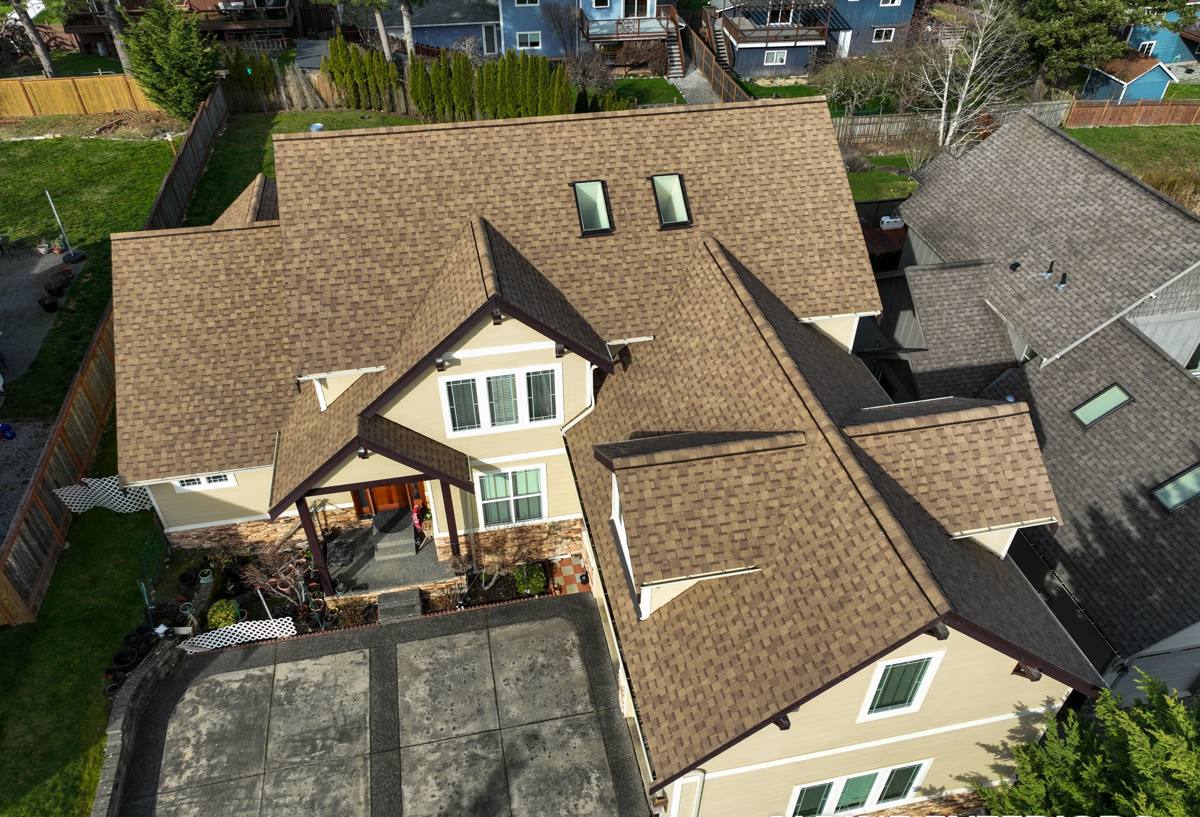
Signs a Fairhaven Roof Needs Replacement, Not Another Repair
Repair makes sense when the damage is isolated and the roof underneath is still sound. Replacement becomes the honest recommendation once the underlying materials — decking, underlayment, flashing — are failing broadly rather than in one spot. In this climate, that line gets crossed sooner than homeowners expect, because moisture damage spreads quietly under moss and granule loss before it ever shows up as an indoor stain.
- Shingles that are cupping, curling, or losing granules across large sections rather than one small area
- Moss growth that has come back within a year or two of being cleaned, especially on north- and west-facing slopes
- Soft or spongy decking felt underfoot in the attic, or daylight visible around vent stacks and chimney flashing
- Rusted or corroded flashing, vent caps, or fasteners — common near the water where salt air accelerates metal fatigue
- A roof approaching or past the manufacturer's expected service life, particularly if the original installation used minimal underlayment or standard (non-marine-rated) fasteners
- Recurring leaks around the same penetration after multiple repair attempts
If your roof shows two or more of these at once, a replacement estimate is usually a better use of a service call than another round of spot repairs.
Why Repeated Patching Costs More Here
On a roof exposed to constant moss pressure and driving rain, patch repairs buy time but rarely address the root cause — trapped moisture and degraded underlayment spreading outward from the original failure point. Homeowners in this area often end up paying for two or three repairs over a few years before facing the same replacement decision anyway, at a higher total cost than if they'd replaced sooner.
Choosing a Roofing System for Salt Air and Moss
Material choice matters more here than in a typical inland neighborhood. The right system balances upfront cost against how well it resists moss, holds up to corrosion, and sheds wind-driven rain without relying on caulk or sealant as a primary defense.
| Material | Moss & Moisture Behavior | Salt Air / Corrosion Resistance | Typical Lifespan |
|---|---|---|---|
| Architectural asphalt shingle | Good with algae-resistant granules; needs periodic cleaning on shaded slopes | Good if fasteners and flashing are corrosion-resistant grade | 25–30 years |
| Standard 3-tab shingle | More moss-prone; thinner profile traps less debris but also weathers faster | Fair — depends heavily on flashing quality | 15–20 years |
| Standing seam metal | Excellent — sheds moisture and moss finds little to grip | Very good with coated/marine-grade panels and fasteners | 40–50+ years |
| Composite / synthetic shake | Good; resists moisture absorption better than wood shake | Good | 30–40 years |
We steer most Fairhaven-area homeowners away from untreated wood shake and shingle. It's not that wood roofing is inherently bad — it's that in a climate with this much sustained moisture and moss pressure, it demands a maintenance schedule most homeowners don't want to keep up with, and the failure mode (rot, moisture intrusion) is harder to catch early than with asphalt or metal.
Underlayment and Fastener Grade Matter As Much As the Shingle
Two roofs with the identical shingle brand can perform very differently depending on what's underneath. In wind-driven rain, a synthetic underlayment with properly lapped and sealed seams — plus self-adhered membrane at eaves, valleys, and penetrations — does more to prevent leaks than the shingle itself. We spec corrosion-resistant fasteners and flashing on every job this close to the water; standard electro-galvanized fasteners simply don't hold up the same way here over a 25-year roof life.
What a Correct Roof Replacement Involves
A roof replacement done right in this climate is not just "old shingles off, new shingles on." Skipping any of the following steps is where premature leaks and moss regrowth come from.
Full Tear-Off and Deck Inspection
We remove the existing roofing down to the deck rather than layering over it. This is the only way to find soft, rotted, or delaminated sheathing before it's sealed under a new roof — a common issue on older Fairhaven-area homes where a prior roof trapped moisture for years without anyone knowing.
Ice-and-Water Membrane at Vulnerable Points
Eaves, valleys, and roof-to-wall transitions get self-adhered waterproof membrane, not just underlayment. These are the spots where driving rain and ice-dam-style backup (which happens here even without hard freezes, just from moss and debris damming water at the eave) cause the most damage.
Proper Attic Ventilation
Balanced intake and exhaust ventilation keeps the underside of the deck dry and reduces the temperature and moisture swings that encourage moss and accelerate shingle aging from below. A new roof installed over inadequate ventilation will underperform its rated lifespan regardless of shingle quality.
Flashing Detail at Every Penetration
Chimneys, skylights, vent stacks, and wall intersections get new step and counter-flashing — never just resealed with caulk over old metal. Caulk is a maintenance item, not a waterproofing strategy, and it's the first thing salt air and UV exposure break down.
Our Process, Start to Finish
- On-site inspection and estimate — we walk the roof and attic, document the condition, and explain what we find in plain terms, including what's optional versus what's structural.
- Written scope and material selection — you get a clear breakdown of materials, underlayment system, flashing plan, and ventilation changes before any work is scheduled.
- Scheduling around weather — we plan tear-off days around dry windows where possible and stage the job so your home is never left exposed overnight without protection.
- Tear-off, deck repair, and dry-in — old roofing comes off, decking issues get addressed, and underlayment goes on the same day whenever conditions allow.
- Installation — shingles or panels, flashing, and ventilation components are installed to manufacturer specification, not shortcuts.
- Cleanup and magnetic nail sweep — the property, gutters, and grounds are cleared of debris and fasteners before we consider the job done.
- Final walkthrough — we go over the finished roof with you and cover what routine maintenance (if any) it needs going forward.
What Roof Replacement Typically Costs Here
Exact pricing depends on roof size, pitch, layers to remove, decking condition, and material choice — we won't quote a number without seeing the roof. In general terms, homeowners in this area should expect asphalt shingle replacement to fall in a broad mid-range for the region, with metal roofing costing more upfront but less over the life of the roof due to its longevity and lower maintenance needs. The table below outlines the factors that move a quote up or down, independent of exact dollar figures.
| Cost Factor | Why It Matters Here |
|---|---|
| Roof pitch and access | Steeper roofs and limited access (tight lots, mature trees) increase labor time and safety staging |
| Number of existing layers | Removing multiple old layers adds disposal and labor cost versus a single-layer tear-off |
| Decking condition | Rot or delamination found during tear-off requires plywood or OSB replacement before new roofing goes on |
| Underlayment and flashing spec | Upgraded self-adhered membrane and corrosion-resistant flashing cost more upfront but reduce leak risk substantially in this climate |
| Material choice | Metal and composite systems cost more per square than standard asphalt but resist moss and salt corrosion longer |
| Ventilation upgrades | Adding or correcting intake/exhaust venting is a smaller add-on cost with outsized impact on roof lifespan |
Why Local Experience in This Area Matters
A crew that works regularly near the water learns things a generalist roofing company doesn't get exposed to as often — which fastener grades actually hold up, which flashing details fail first under driving rain, which slopes on a given lot orientation will fight moss no matter what you install. That knowledge shows up in small decisions throughout a job: where extra membrane goes, how tight the ventilation balance needs to be, which shingle lines actually perform in salt air versus which ones just claim to.
It also matters for accountability. A contractor who works this area consistently is going to be around for warranty follow-up, not just for the sale. That's a reasonable thing to ask about directly when you're vetting anyone to work on your roof, not just us.
Maintaining a New Roof in This Climate
A correctly installed roof still benefits from basic upkeep in a climate this wet and shaded. None of this is intensive, but skipping it shortens the life of even a well-built system.
- Keep gutters and downspouts clear so water doesn't back up under the eave edge during heavy rain
- Have moss growth treated or gently removed before it spreads, rather than waiting until it's visible from the street
- Trim back overhanging branches to reduce shade, debris buildup, and physical abrasion on the roof surface
- Schedule a visual inspection every couple of years, especially after major windstorms
- Address any flashing or fastener corrosion early — it's a small fix before a leak, a bigger one after
Get a Straight Answer on Your Roof
If you're weighing repair versus replacement, or just want an honest read on how much life is left in your current roof, we're happy to take a look. The estimate is free, there's no pressure attached to it, and you'll get a clear explanation of what we find — use the form below to get started.