 Ferndale Exterior
 Kendall's Climate Asks More of Siding Than People Expect
Kendall sits in the rural, tree-covered part of Whatcom County, and that setting shapes what siding has to survive here. Mature tree cover means more shade on exterior walls for more of the day, which means siding stays damp longer after every rain. Add the long, wet stretch of Pacific Northwest weather that runs from fall through spring, and you get conditions that are tough on any exterior material, especially anything wood-based or wood-adjacent.
Homes on wooded or partially wooded lots around Kendall deal with a specific combination: driving rain that gets pushed sideways into walls during storms, humidity that lingers under tree canopy, and a moss season that, realistically, is most of the year. Whatcom County's broader marine climate — the same damp, mild air that carries salt influence near Bellingham Bay and the coast — reaches inland too, and it doesn't spare rural properties just because they're farther from the water. Siding here needs to shed water fast, resist moisture absorption, and hold a factory finish through repeated wet-dry cycles without cracking or delaminating.
That's the backdrop for every siding replacement conversation we have with Kendall homeowners. It's not a cosmetic decision — it's a decision about what will actually hold up on a shaded, moisture-heavy lot for the next several decades.
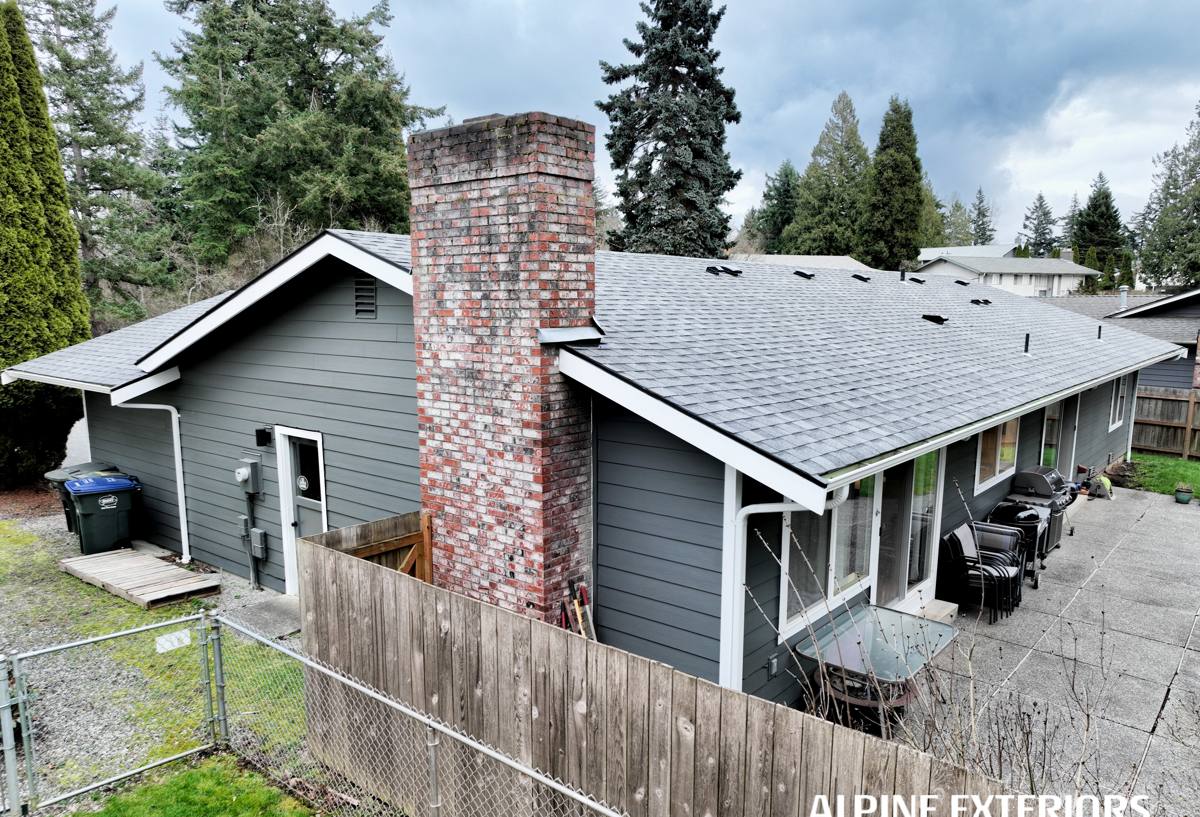
Signs a Kendall Home Needs Siding Replacement, Not Another Repair
Some damage is obvious. Some isn't, especially on shaded walls where moss and mildew can mask what's happening underneath. Here's what we look for during an inspection:
- Soft or spongy spots when you press on the siding, especially near the bottom courses and around window trim
- Persistent moss or dark streaking that comes back within weeks of being cleaned off
- Visible cracking, warping, or buckling panels, particularly on north- and west-facing walls
- Paint that's peeling, bubbling, or needing repainting more often than every 7-8 years
- Gaps opening up at seams, corners, or trim where caulking has failed repeatedly
- A musty smell near exterior walls or unexplained interior moisture on those same walls
- Siding that's original to a home built more than 20-25 years ago, especially if it's wood or an older composite
One or two of these can sometimes be handled with spot repair. Several together, especially soft spots combined with recurring moss and failing paint, usually mean the underlying material has taken on water and a full replacement is the honest recommendation — not a patch that buys another year or two.
Why We Only Install James Hardie Fiber Cement
We made a deliberate call to install one product system: James Hardie fiber cement siding. That's not a sales pitch — it's a standard we hold because of what we've seen matter most in this climate, and we think Kendall homeowners deserve the straight explanation rather than a menu of options we don't fully stand behind.
What This Rules Out, and Why
We don't install vinyl siding. Vinyl expands and contracts significantly with temperature swings, which loosens fasteners over time, and it can crack or warp under sustained UV and cold exposure. It also doesn't hold paint, so a color change down the road means full replacement, not a repaint.
We don't install LP SmartSide, primed spruce, or cedar. These are wood-based products, and wood-based siding's core vulnerability is moisture absorption at cut edges, seams, and any point where the factory coating gets compromised. In a climate where walls stay damp for extended stretches under tree cover, that vulnerability shows up faster than it would in a drier region. We also don't install other fiber cement brands like Cemplank or Allura — the category is similar, but we've standardized on one manufacturer's system so our crews install to one spec, every time, with no guesswork about compatible trim, fasteners, or touch-up paint.
What Hardie Gets Right for This Area
James Hardie fiber cement is non-combustible, doesn't absorb water the way wood-based products do, and comes in a HardieZone HZ5 formulation engineered for climates with freeze-thaw cycles and sustained moisture — which describes Whatcom County well. The ColorPlus factory finish is baked on rather than field-applied, so it resists fading and chipping far better than site-applied paint, and touch-up matches instead of requiring a full repaint. It also carries a strong, transferable limited warranty, which matters if you ever sell the home.
What a Correct Siding Replacement Job Involves
Full Tear-Off and Wall Inspection
We don't install new siding over old. Full tear-off lets us see the sheathing underneath, which is the only way to catch rot, soft framing, or previous water damage before it's sealed behind new siding. On shaded, moisture-prone lots like many around Kendall, this step is where problems get caught early instead of discovered later as a bigger repair.
Moisture Barrier and Flashing
A correctly installed weather-resistive barrier, properly lapped and taped, is what actually keeps bulk water out of the wall assembly — the siding itself is the second line of defense, not the only one. Flashing at windows, doors, and any horizontal trim gets installed to direct water outward, not into the wall. This detail work is where a lot of siding jobs fail years later, even with a good product on top.
Installation to Manufacturer Spec
Fiber cement has to be installed with correct fastener spacing, proper clearance from grade and roof lines, and the right gap at butt joints to allow for seasonal movement. Installed wrong, even the best product can fail early — trap moisture at a joint, or crack from over-driven nails. We install to James Hardie's published specifications because that's what keeps the manufacturer's warranty valid and the siding performing as designed.
Our Process, Start to Finish
- On-site inspection — we walk the exterior, check problem areas you've noticed, and look at sheathing condition where accessible
- Written estimate — a clear scope covering tear-off, repair allowances if rot is found, product line and color, and timeline
- Material order and scheduling — we work around Whatcom County's wetter months where possible to keep the wall assembly protected during the job
- Tear-off and sheathing repair — old siding removed, damaged sheathing replaced before anything new goes up
- Weather barrier and flashing installation — the moisture-management layer that does the real work over time
- Hardie siding installation — installed to spec, including trim, corners, and caulking
- Final walkthrough — we go over the finished work with you and address anything before calling the job complete
Cost Factors for Siding Replacement in Kendall
Every home is different, so we don't quote a number without seeing the property, but these are the variables that move the estimate:
| Factor | Why It Matters |
|---|---|
| Home size and wall complexity | More square footage, more corners, dormers, and trim details all add material and labor time |
| Condition of sheathing underneath | Rot found during tear-off requires repair before new siding goes on — this is the biggest source of estimate variance |
| Siding profile chosen | Lap siding, shingle-style, and panel systems differ in material cost and install labor |
| Access and lot conditions | Tree cover, slope, and rural driveway access on Kendall properties can affect equipment staging and scaffolding needs |
| Trim and detail work | Window trim, corner boards, and fascia replacement add cost but also add to how well water sheds off the wall |
Why a Crew That Already Works in Kendall Matters
Kendall isn't downtown Ferndale, and it isn't Bellingham. It's rural, often wooded, and properties here have their own quirks — longer driveways, well and septic systems to work around, tree cover that affects drying time and staging. A crew that's already worked in this specific area knows to plan for those things instead of discovering them mid-job. That local familiarity also extends to Whatcom County permitting requirements and to knowing which detailing choices actually hold up on a shaded, damp lot versus which ones look fine on paper.
It also matters for warranty support down the line. A contractor with a track record in the area, still around and reachable years later, is worth more than the lowest bid from a crew passing through.
Caring for New Fiber Cement Siding
James Hardie siding is low-maintenance, not no-maintenance. A few habits keep it performing for decades:
- Rinse off moss, algae, and debris buildup once or twice a year, especially on shaded walls
- Keep gutters clear so overflow doesn't run down the siding face repeatedly
- Trim back tree branches and shrubs that keep siding wet or shaded against the wall
- Re-caulk joints and trim if you ever see separation or cracking in the caulk line
- Have any impact damage (a stray branch, equipment bump) repaired promptly so it doesn't become a moisture entry point
If you're seeing moss that won't stay off, soft spots, or siding that's simply reached the end of its service life, we're happy to take a look. We offer free, no-pressure estimates for Kendall homeowners — no obligation, just a straight assessment of what your home actually needs.