 Ferndale Exterior
 Lummi Island's Climate Is Hard on Siding — Here's Why
Lummi Island sits surrounded by water, which sounds pleasant until you're the siding on a house that faces it. Homes here take a steady diet of salt-laden air off the water, wind-driven rain that gets pushed sideways into wall assemblies, and long stretches of shade and dampness that keep moisture sitting on exterior surfaces far longer than it would on a home a few miles inland in Ferndale. That combination is what actually damages siding — not one big storm, but months of repeated wetting, drying, and salt exposure that most siding materials were never designed to handle indefinitely.
Whatcom County's marine climate already means more rain days and higher ambient humidity than most of the country. Island-facing homes get an extra layer of that: airborne salt accelerates corrosion on fasteners and trim, and the persistent moisture creates ideal conditions for moss, algae, and mildew to take hold on siding, especially on north- and west-facing walls that don't get much direct sun to dry out between rain events.
What This Actually Does to Siding Over Time
Different siding materials fail differently under this kind of pressure. Wood-based products can swell, delaminate, or rot at seams and cut edges where moisture gets in. Vinyl can warp or crack as it cycles through temperature and moisture swings, and its seams are a common entry point for wind-driven rain. Metal fasteners that aren't corrosion-rated for coastal exposure will rust, streak the siding face, and eventually lose their grip. None of this is a defect — it's just what happens when a material meant for general use gets asked to perform in a marine environment year after year.
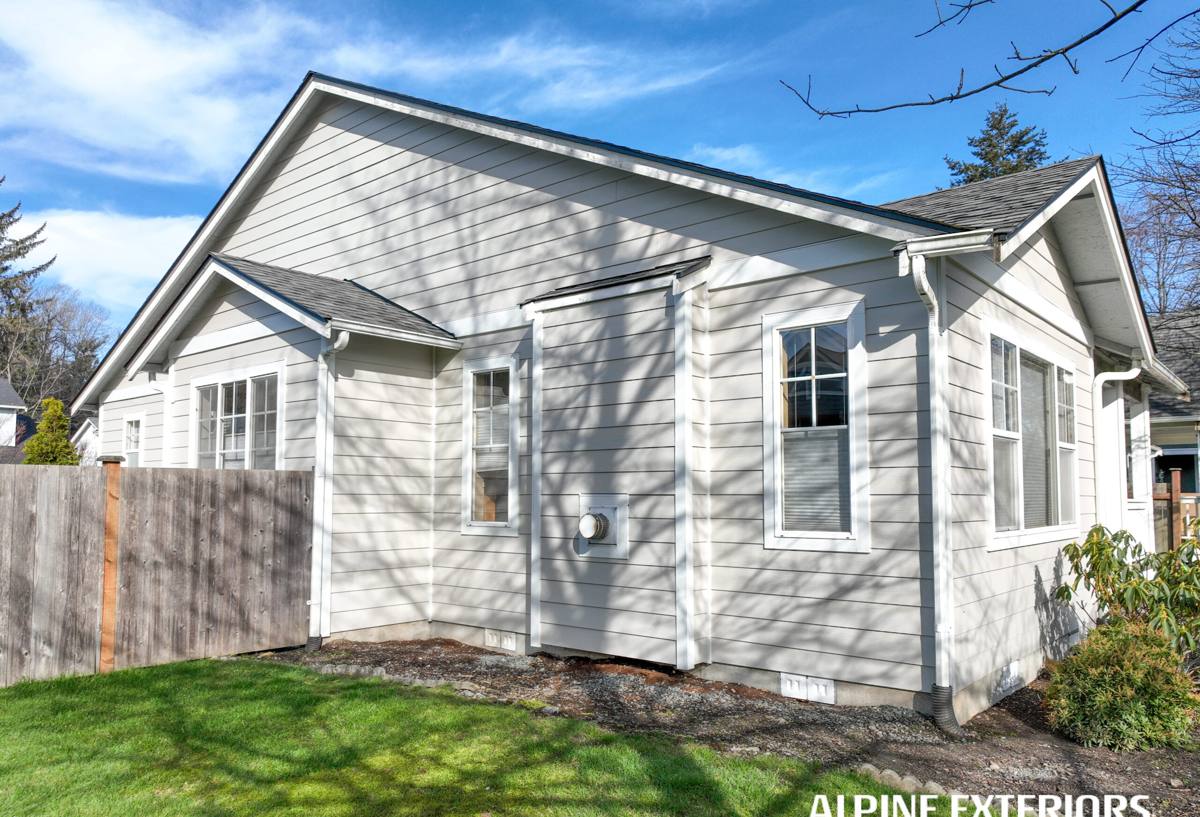
Signs Your Lummi Island Home Needs Siding Repair
Catching damage early is the difference between a straightforward repair and a much bigger project. On island homes, we typically see problems show up first at the most exposed elevations — usually the sides facing open water or prevailing wind — and around penetrations like windows, hose bibs, and vents where the water-resistive barrier can be compromised.
- Soft, spongy, or visibly swollen boards, especially near the bottom courses or window trim
- Persistent green or black staining that keeps returning shortly after cleaning
- Cracked, buckled, or separated panels, particularly on the weather-facing side of the house
- Rust streaks running down from nail heads or trim fasteners
- Paint or factory finish that's peeling, chalking, or bubbling in patches rather than evenly
- Gaps opening up at seams, corners, or where siding meets trim, window, or door casings
- A musty smell or visible moisture staining on interior walls that back up to exterior siding
Any one of these on its own might just need a targeted repair. Several showing up together, especially on the same wall, usually means moisture has been getting behind the siding for a while and the repair needs to address what's underneath, not just what's visible.
What a Correct Siding Repair Actually Involves
A repair that only replaces the damaged board and leaves everything else alone tends to fail again within a year or two, especially in this climate. Doing it right means treating the repair as a small construction project, not a patch job.
The Steps We Don't Skip
First, we remove the damaged material and inspect what's behind it — the water-resistive barrier, flashing, and sheathing. If moisture has already reached the sheathing, that gets addressed before any new siding goes back on; covering up wet or damaged sheathing just hides the problem. Second, we check and repair flashing at windows, doors, and any penetrations in the repair area, since a failed flashing detail is very often the actual root cause of siding damage, not the siding material itself. Third, we match materials and profiles carefully so the repaired section performs — and looks — consistent with the rest of the wall. Last, fasteners and sealants used in the repair are chosen for coastal-grade corrosion resistance, not general-purpose hardware that will just rust out again in a few seasons.
Skipping any of these steps is how a "repaired" wall ends up with the same problem back within a couple of years — which is a common story we hear from island homeowners who've had patch-style repairs done before.
Why We Repair and Replace With James Hardie Fiber Cement — Not Vinyl or Wood-Based Alternatives
Ferndale Exterior Company installs James Hardie fiber cement siding exclusively. We don't install vinyl, LP SmartSide, or primed wood siding, and on a repair job that distinction matters just as much as it does on a full re-side, because whatever material goes into the repaired section has to survive the same marine exposure as the rest of the house.
Vinyl siding is inexpensive and low-maintenance in mild conditions, but it's a thin material that expands and contracts significantly with temperature swings, and its interlocking seams aren't sealed — they rely on lapped joints to shed water, which is a weaker defense against the kind of wind-driven, horizontal rain that hits exposed island elevations. Wood-based composite products like LP SmartSide perform well when the factory finish and sealed edges stay intact, but any cut edge, fastener puncture, or finish failure exposes the wood-strand core to moisture, and once that core starts absorbing water, swelling and delamination follow. Primed wood and cedar require the most diligent maintenance of any option — repainting and resealing on a schedule that most homeowners find hard to keep up with, especially in a climate that gives you fewer dry days to do the work.
James Hardie fiber cement is cement, sand, and cellulose fiber — it doesn't absorb water the way wood or wood-composite products do, it won't rot, and it's non-combustible. Hardie's ColorPlus factory finish is baked on and warranted separately from the substrate, which matters in a climate where UV and salt exposure break down field-applied paint faster than inland areas. It's a heavier, denser material than vinyl, which helps it hold up to wind-driven rain and resist the kind of impact and warping damage that shows up on exposed coastal walls. None of this makes fiber cement maintenance-free — it still needs to be installed to Hardie's specifications, with correct flashing, fastening, and clearances — but it gives island homes a much longer runway before repair or replacement becomes necessary again.
Repair or Replace? How We Help You Decide
Not every damaged section needs a full re-side, and not every "repair" is actually worth doing instead of replacing a larger section. We walk through this with every homeowner before recommending anything.
| Factor | Leans Toward Repair | Leans Toward Replacement |
|---|---|---|
| Extent of damage | Isolated to one or two wall sections | Spread across multiple elevations |
| Underlying moisture | Sheathing and barrier intact | Rot or moisture found behind siding |
| Age of existing siding | Relatively recent, otherwise sound | Near or past expected service life |
| Material match | Current siding still available/matchable | Discontinued profile or color, poor match |
| Root cause | Fixable flashing or fastener issue | Systemic drainage or design flaw |
On older homes where the existing siding is nearing the end of its useful life anyway, we're often upfront that a repair is a short-term fix and full replacement with Hardie fiber cement is the better long-term investment. We'd rather tell you that plainly than sell you a repair we don't think will hold up.
Our Process for Lummi Island Jobs
Working on an island brings a logistics layer that mainland jobs in Ferndale or Bellingham don't have — materials, equipment, and crew all have to move by ferry, which means the job gets planned around ferry access from the start rather than treated as an afterthought. We build that into scheduling upfront: materials are staged and confirmed before the crew crosses, so we're not making repeat trips or leaving a job partially open longer than necessary.
What Happens on a Typical Repair Visit
- On-site assessment of the damaged area, including a check behind the siding where damage suggests moisture has gotten in
- A clear explanation of what we found and a written scope covering repair versus replacement
- Material matching and ordering, planned around ferry logistics so the job isn't waiting on multiple crossings
- Repair work: removal, substrate inspection, flashing correction if needed, and installation of matched, coastal-appropriate materials and fasteners
- Final walk-through so you can see exactly what was done and why
Because we already build ferry timing into scheduling, island jobs don't run into the surprise delays that catch contractors who only occasionally take on island work.
What Siding Repair Typically Costs — and What Drives the Range
Every repair is different, and we won't quote a number without seeing the damage, but the factors below are what actually move the price up or down on Lummi Island jobs specifically.
| Cost Factor | Why It Matters |
|---|---|
| Size of damaged area | More linear feet of siding and trim means more material and labor |
| Hidden moisture damage | Sheathing or framing repair adds scope beyond the visible siding |
| Access and elevation | Upper stories, steep grades, or limited staging space affect labor time |
| Material match availability | A close color/profile match is faster than a full-section replacement |
| Ferry logistics | Material staging and scheduling around crossings affects trip planning |
We give straightforward, itemized estimates so you know what you're paying for and why — no vague lump-sum numbers.
Protecting Your Siding After the Repair
A good repair only holds up if the maintenance around it keeps pace with the climate. For Lummi Island homes specifically, that means a few habits worth keeping up:
- Rinse salt residue off siding periodically, especially on walls facing open water
- Keep gutters and downspouts clear so water isn't running down the wall face
- Trim back vegetation and tree cover that keeps walls shaded and slow to dry, since that's what feeds moss and algae growth
- Treat moss and algae growth early rather than letting it establish, particularly on north-facing walls
- Do a visual check of siding, trim, and caulking once or twice a year, paying extra attention after major windstorms
These are small, low-cost habits, and they matter more here than they would on a sheltered inland lot — they're the difference between a repair that lasts and one you're revisiting in a couple of years.
Why Hiring a Crew That Already Works Lummi Island Matters
Island work isn't the same job as a repair three miles down the road in Ferndale. A crew that hasn't planned around ferry access before will either underbid the logistics and run into delays, or pad the price to cover their uncertainty. A crew that already knows how the scheduling works can price and plan the job accurately the first time, without surprise return trips or half-finished walls left exposed longer than they should be.
There's also a practical trust factor: an island home is often not somewhere the owner is checking on daily, so it matters that the crew doing the work is straightforward about what they found, what they're recommending, and why — not upselling a full re-side when a targeted repair will genuinely hold, and not underselling a repair when the damage really does call for more.
If you've got siding damage on Lummi Island — or you're not sure whether what you're seeing is a simple repair or something bigger — we're happy to take a look. Reach out for a free, no-pressure estimate using the form below, and we'll give you a straight answer about what your siding actually needs.