 Ferndale Exterior
 Roof Repair Built for Lynden's Climate, Not a Generic Checklist
Lynden sits far enough inland from Bellingham Bay that people sometimes assume it's spared the coastal wear that hits shoreline properties harder. It isn't, not really. Whatcom County's weather doesn't stop at the water's edge — the same wet Pacific air mass that soaks Ferndale and the coastline pushes east across the flats and farmland around Lynden, and the moisture, wind, and moss pressure on a Lynden roof are close to what we see anywhere else in the county. What changes is the housing stock: more farmhouses, more mid-century ranch homes on larger lots, more detached shops and barns with their own roofing needs, and a good number of newer builds mixed in. A repair approach that works on one style doesn't always translate cleanly to another, which is why we treat Lynden roof repair as its own job, not a copy-paste of what we do elsewhere.
This page is about one thing: repairing an existing roof in Lynden — not a full tear-off, not a new install. Repair work is a different discipline. It's diagnostic first, surgical second. Get the diagnosis wrong and you can spend money patching a symptom while the real leak keeps working its way into the sheathing underneath.
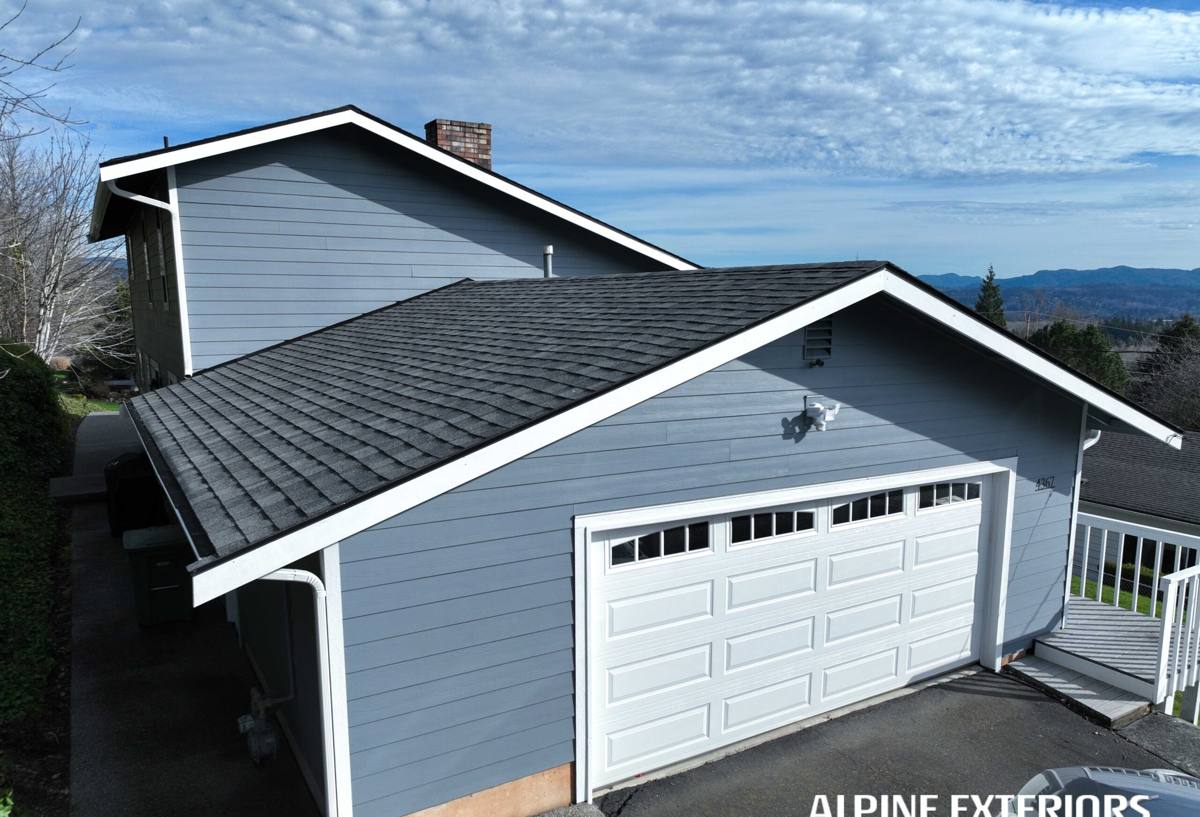
What Whatcom County Weather Actually Does to a Roof
Three things drive most of the repair calls we get in this area, and Lynden gets all three:
Driving Rain
Storms coming off the Pacific rarely fall straight down here. Wind pushes rain sideways into roof valleys, up under shingle tabs, and against anything that penetrates the roof plane — vent stacks, chimneys, skylights. A roof that would shed water fine in a calm downpour can leak in a wind-driven one, because water finds its way in laterally, not just from above.
Long Moss Season
Whatcom County's moss season runs long — cool, damp conditions linger for months at a stretch, and shaded north-facing slopes or roofs under overhanging trees barely get a chance to dry out between storms. Moss isn't just cosmetic. It holds moisture against the roofing material, lifts shingle edges as it grows, and works its way into laps and seams where it doesn't belong.
Salt Air
Lynden is inland, but Whatcom County's marine air still carries salt further than most people expect, and it accelerates corrosion on exposed metal — flashing, fasteners, gutter hardware, and vent caps. Corroded metal fails quietly. A rusted-through flashing edge doesn't announce itself until water is already inside.
None of these show up as one dramatic failure. They show up as a slow accumulation — a little lifted moss here, a little rust there, a soft spot near a vent — until one storm finally pushes water past the point the roof can handle.
Signs a Lynden Homeowner Should Not Ignore
- Dark streaks or green growth on north-facing or shaded roof slopes
- Granules collecting in gutters or at downspout outlets
- A ceiling stain that appears only during or right after a windy rainstorm
- Curling, cupping, or lifted shingle edges, especially near valleys
- Rust staining running down from metal flashing or vent caps
- Soft or spongy decking felt underfoot near chimneys or skylights
- Daylight visible through the roof deck from inside an attic or shop loft
Any one of these on its own might be minor. Two or three together, especially after a windy stretch of weather, usually means it's time for a proper look before the next storm makes the problem bigger.
What a Correct Repair Actually Involves
A roof repair done right isn't just "find the leak, cover the hole." It's a sequence, and skipping steps is how a $400 repair turns into a $4,000 repair a year later.
1. Find the Real Source
Water travels. A stain on a ceiling in one room can trace back to a failure point ten feet away on the roof, following a rafter or sheathing seam downhill before it drips. We trace the path from the interior damage back to the actual entry point rather than patching wherever the stain happens to be.
2. Check What's Underneath
Once we're at the source, we check the decking and underlayment, not just the visible roofing material. If water has been getting in for a while, the wood underneath may be soft, delaminated, or starting to rot. Patching over compromised decking doesn't fix anything — it just hides it for a little while longer.
3. Match the Repair to the Material
Repairing asphalt composition shingles, metal roofing, and cedar shake all require different techniques and different fasteners. A repair that isn't compatible with the existing material — wrong fastener metal, incompatible sealant, mismatched profile — can actually accelerate failure at the repair site.
4. Rebuild the Water Path, Not Just the Hole
Roofs shed water through layering — each course, each flashing piece, overlaps the one below it so water is always directed downhill and off the roof. A repair has to restore that layering correctly. A patch that just seals a hole without respecting the shingle or panel overlap can create a new low point where water pools or backs up.
5. Address the Cause, Not Just the Symptom
If moss caused the lift that let water in, we deal with the moss and the conditions letting it grow back — not just the leak it caused. If a corroded fastener let a flashing edge work loose, we replace the fastener with something suited to this climate, not just re-seat the old one.
Repair vs. Replacement: How We Help You Decide
Not every roof problem in Lynden needs a full replacement, and we don't push toward one when a repair will genuinely hold. But there's a point where repeated patching stops making financial sense. Here's roughly how we think about it:
| Factor | Leans Toward Repair | Leans Toward Replacement |
|---|---|---|
| Roof age | Well within expected lifespan for the material | Near or past the end of its typical service life |
| Extent of damage | Isolated to one area or penetration | Spread across multiple slopes or repeat leak sites |
| Decking condition | Solid, dry, no rot found | Soft, delaminated, or rotted in more than one spot |
| Repair history | First or second repair on this roof | Recurring patches in the same general area |
| Moss/growth pattern | Surface growth, roof structure sound | Growth tied to a chronic moisture problem underneath |
We'll always tell you honestly which side of that table your roof falls on, and why — including when the answer is "this is a repair, don't let anyone talk you into more."
Our Process for a Lynden Roof Repair Call
- Inspection. We walk the roof (weather permitting) and check the attic or loft space from inside, looking at both the surface and what's underneath.
- Honest diagnosis. We tell you what's actually wrong, what caused it, and what it will take to fix — including if the answer is smaller than expected.
- Written estimate. A clear scope of work and price before anything is touched, so there are no surprises mid-job.
- The repair itself. Matched materials and fasteners suited to this climate, proper layering and flashing technique, and cleanup of debris and old materials.
- Final walk-through. We show you what was done and what to watch for going forward, especially if moss or drainage was part of the original problem.
Why Hiring a Crew That Already Works in This Area Matters
Roofing crews that work across Whatcom County day in and day out develop a feel for how local weather actually behaves on a roof, versus what a general how-to guide says. That's not a marketing point — it changes real decisions on the job. It affects which fastener metal we reach for near corrosive salt air, how aggressively we address moss versus just removing it once, and how we detail flashing around penetrations knowing wind-driven rain is a regular event here, not a rare one.
It also means we're not guessing at what "normal" wear looks like for this region. A roof in Lynden that's showing moderate moss growth after a wet winter isn't unusual — but knowing where the line is between normal seasonal buildup and a real structural concern takes having seen a lot of roofs in this specific climate, not just roofs in general.
Maintenance Steps That Reduce Future Repair Calls
- Keep gutters and downspouts clear so water isn't backing up under the roof edge
- Trim back tree branches that shade roof slopes and slow drying after rain
- Have moss growth addressed before it lifts shingle edges, not after
- Check attic or loft insulation and ventilation — poor airflow speeds up moss growth and can cause its own moisture problems
- Schedule a roof check after any unusually severe windstorm, even if nothing looks obviously wrong from the ground
None of this requires expensive equipment or specialized skill on the homeowner's part — mostly it's about not letting small, normal wear sit unaddressed through an entire wet season.
Getting a Straight Answer on Your Roof
If you're dealing with a leak, some moss buildup, or you just want a second opinion before committing to a bigger project, we're happy to take a look. We'll tell you plainly whether it's a repair or something more, and why — no pressure either direction. Reach out for a free estimate using the form below, and we'll get a look at your roof and a straight answer back to you.