 Ferndale Exterior
 Siding Repair in Marietta: A Different Set of Problems Than Inland Ferndale
Marietta sits close to the water on the edge of Ferndale, and that proximity changes what siding repair actually looks like here. Homes a few miles inland deal mostly with rain and general Pacific Northwest dampness. Homes in Marietta deal with that plus salt-laden air coming off the bay, wind-driven rain that hits walls at an angle instead of falling straight down, and a moss season that runs longer than most homeowners expect. Each of those factors attacks siding in a slightly different way, and a repair that doesn't account for all three tends to fail again within a year or two.
This page is about one thing: getting siding repair right for a Marietta home. Not a general overview of siding, not a sales pitch for a full replacement you don't need — just a straight explanation of what local homes need, what a correct repair involves, and how to tell the difference between a patch job and a problem that's actually bigger than it looks.
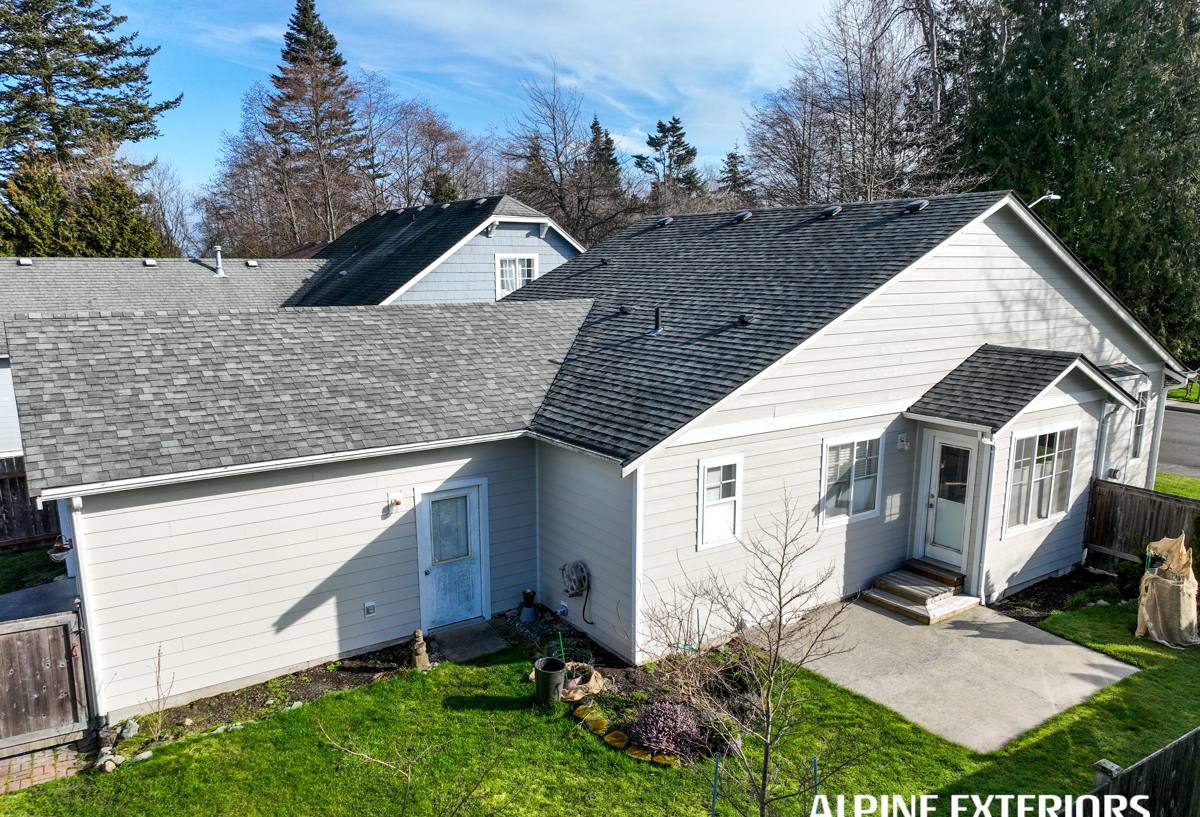
Why Salt Air and Driving Rain Make Repairs Trickier Here
Salt air accelerates corrosion at the fasteners and flashing
Siding itself might look fine while the metal holding it up or draining water away from it is quietly failing. Nail heads, flashing, and any exposed metal trim corrode faster in a salt-influenced environment than they would a few miles inland. A repair that only addresses the visible siding damage and ignores the fastener or flashing underneath is a repair that's going to need to be redone.
Wind-driven rain finds gaps that straight-down rain never would
Marietta's exposure to open water means wind doesn't just blow rain sideways occasionally — it does it often enough that any small gap in caulking, trim, or panel overlap becomes a water entry point. A crack that would stay dry on a sheltered inland lot can be actively taking on water here, which means moisture damage often extends further behind the siding than it appears from the outside.
Moss holds moisture against the surface for months at a time
Whatcom County's moss season is long, and Marietta's damp, shaded, water-adjacent conditions make it worse. Moss isn't just cosmetic — it holds water against siding and trim continuously, which is exactly the kind of sustained moisture exposure that breaks down caulking, softens wood trim, and can eventually work its way into seams. Repairs that don't address moss growth around the repaired area are treating the symptom, not the cause.
Signs Your Marietta Home Needs Siding Repair
Some damage is obvious. Some isn't visible until you know what to look for. Use this list as a starting point before you decide whether you're looking at a repair or something larger:
- Soft or spongy spots when you press on siding or trim near the bottom of walls
- Visible cracking, warping, or bubbling in panels, especially on the side of the house facing prevailing wind
- Caulk that's cracked, shrunk, or pulled away from joints and trim
- Peeling or bubbling paint, which often signals moisture trapped underneath rather than just old paint
- Rust streaks below nail heads or metal trim pieces
- Persistent moss or dark staining that keeps coming back after cleaning
- Gaps or separation where panels meet corner trim, window trim, or the foundation line
- A musty smell or visible staining on interior walls that share an exterior wall with damaged siding
Any one of these on its own might be minor. Several of them together, or any sign of soft/spongy material, usually means moisture has already gotten past the surface — which changes the scope of the repair.
What a Correct Siding Repair Actually Involves
A repair that's done right isn't just "cut out the bad piece, nail in a new one, caulk the edges." That approach covers up damage instead of fixing it. Here's what should actually happen:
1. Find out how far the damage goes
Visible damage on the surface is rarely the full extent of it. Before any new material goes on, the area needs to be opened up enough to check the sheathing, house wrap, and framing underneath for water damage or rot. Repairing over a wet or compromised substrate just guarantees a repeat visit.
2. Fix the water source, not just the symptom
Damaged siding is usually a downstream effect of a water intrusion point somewhere — bad flashing, failed caulk, a gap at a penetration (vent, light fixture, hose bib), or grading that pushes water toward the wall. If the source isn't corrected, new siding in that spot will fail the same way the old siding did.
3. Replace or dry out the substrate as needed
Any wet or rotted sheathing, framing, or house wrap needs to be dried, repaired, or replaced before new siding goes back on. This is the step that gets skipped most often on cheap repairs, and it's the one that determines whether the fix lasts five years or fifteen.
4. Match materials and technique to what's already there
A patch needs to tie into the surrounding siding correctly — proper overlap, correct fastening pattern, and flashing detail that matches how the rest of the wall was built to shed water. Done wrong, a repair can actually create a new water trap where none existed before.
5. Reseal and refinish properly
Correct caulking at joints and trim, and a finish that matches (or comes close enough to be acceptable) the surrounding siding, finishes the job. On fiber cement, this means using products and techniques appropriate to that material — not treating it like wood or vinyl.
Repairing What's There vs. Replacing With James Hardie
We repair siding of various materials when a patch is the right call — not every damaged section needs to become a full siding project. But how much a repair is worth doing, versus how soon a section should just be replaced, depends heavily on what the siding is made of. This is where we're upfront with Marietta homeowners:
| Situation | Vinyl or wood siding | LP SmartSide or engineered wood | James Hardie fiber cement |
|---|---|---|---|
| Small crack or hole, substrate dry | Patchable, but color/gloss match is often imperfect and gets worse over time | Patchable if caught early, but any moisture exposure at the damaged edge accelerates future swelling | Patchable; material doesn't swell or rot, so a clean patch tends to hold long-term |
| Water has reached the substrate | Repair plus substrate work; wood trim especially prone to repeat rot in this climate | Higher risk — engineered wood products are more sensitive to sustained moisture exposure than fiber cement | Substrate repair needed, but the fiber cement panel itself is not the weak point |
| Recurring moss/algae staining | Cleanable, but wood and some vinyl finishes hold staining in the texture | Cleanable with care; factory finish can be affected by aggressive cleaning | ColorPlus factory finish is formulated to resist this and hold color longer between cleanings |
| When repair no longer makes sense | Once several areas show the same failure, full re-siding is usually more cost-effective than repeated patching | Same — repeated moisture-related failures in one product generation are a sign to reconsider the material | Individual panels can be replaced without redoing the whole wall, since the product doesn't have the same systemic moisture sensitivity |
We don't install LP SmartSide, vinyl, Cemplank, Allura, primed spruce, or cedar as new siding — James Hardie fiber cement is the only product we put on homes. That doesn't mean we won't repair what's already on your house. It means that when a repair turns into a replacement decision, or when a homeowner asks us what to install instead, our answer is Hardie: it's non-combustible, it carries a factory-baked ColorPlus finish instead of field-applied paint, it's engineered for climates like ours, and it holds up to salt air and driving rain better than the materials it replaces.
How We Approach a Siding Repair Job in Marietta
- On-site inspection — we look at the damaged area and check surrounding sections, trim, flashing, and grading for related issues before quoting anything.
- Open and assess — where damage suggests moisture intrusion, we open the area enough to see the sheathing and framing condition before finalizing scope.
- Honest scope discussion — we tell you plainly whether you're looking at a patch, a larger repair, or a case where replacement is the more cost-effective long-term answer.
- Repair or replace — we correct the water source, address any substrate damage, and install matching or appropriate replacement material with correct flashing and fastening.
- Finish and seal — proper caulking, trim work, and finish matching so the repair holds up and looks intentional, not patched.
Repair Now, or Wait? Cost Factors to Weigh
Homeowners often ask whether it's worth fixing a small area now or waiting until more damage shows up. In a climate like Marietta's, waiting almost always costs more, for a few specific reasons:
| Factor | Effect of repairing promptly | Effect of waiting |
|---|---|---|
| Substrate exposure | Limited to the damaged area, lower repair cost | Continued rain and moss exposure spreads moisture damage further into sheathing and framing |
| Interior risk | Contained to the exterior wall | Prolonged intrusion can reach insulation and interior finishes, adding to the repair bill |
| Material availability | Easier to match existing siding while it's still in reasonably good condition | Older siding fades and weathers, making new patches more visually obvious over time |
| Seasonal timing | Repairs completed before the wet season hold up through winter | Damage discovered mid-winter often needs temporary protection before permanent repair is possible |
Why It Matters That We Already Work in Marietta
Siding repair in a water-adjacent, salt-air community isn't the same trade as siding repair on a sheltered inland lot, even within the same city limits. A crew that regularly works Marietta homes already knows to check flashing and fastener condition even when the visible siding damage looks minor, knows which wall orientations take the worst of the wind-driven rain, and doesn't need to relearn the local moss-and-moisture pattern on your dime. That familiarity shows up in fewer surprises during the job and repairs that are scoped correctly the first time — not underscoped and back on the schedule again next year.
We serve Ferndale and the surrounding Whatcom County communities, including Marietta, and we see the same climate stresses on siding here that show up house after house: salt air working on fasteners and trim, driving rain finding the gaps other Northwest homes never have to deal with, and moss holding moisture against surfaces for months at a stretch. That pattern recognition is part of what you're getting when you hire a local crew instead of someone unfamiliar with this specific stretch of coastline.
Get an Honest Look at Your Siding
If you're seeing cracked or soft siding, failing caulk, recurring moss staining, or you're just not sure whether what you're looking at is a simple patch or something bigger, we're glad to come take a look. We'll give you a straight answer about scope and cost — no pressure toward a bigger job than you need. Fill out the form below for a free, no-obligation estimate on siding repair for your Marietta home.