 Ferndale Exterior
 Bellingham's Climate Is Hard on Roofs — Here's Why
Bellingham sits right where Pacific storm systems, Bellingham Bay salt air, and a long wet season all converge on the same roofs, year after year. It's not one dramatic event that wears a roof down here — it's the slow accumulation of small things: driving rain that finds every gap in flashing, salt-laden air off the water that speeds up corrosion on metal fasteners and flashing, and a moss season that can run from early fall through late spring in shaded, north-facing sections of a roof. Any one of these is manageable on its own. Together, they're why roofs in this part of Whatcom County age differently than roofs in drier climates, and why repairs that look "close enough" from the ground often aren't close enough underneath.
We're based in Ferndale and work Bellingham regularly, so this isn't a generic write-up about roofing in the abstract. It's how we actually think about repair work on homes dealing with this specific mix of rain, moss, and salt air.
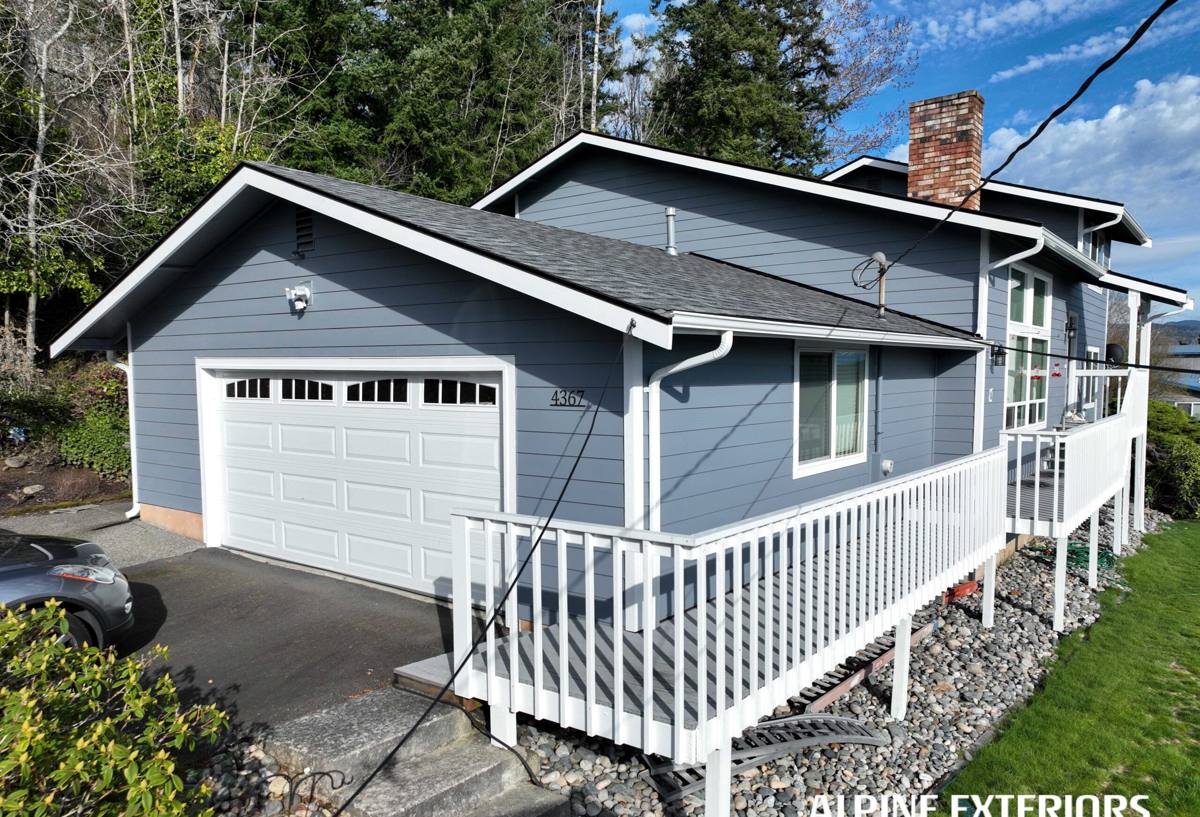
Signs a Bellingham Roof Needs Repair (Not a Full Replacement)
Most roofs don't fail all at once. They fail in one spot first, and if that spot gets addressed early, the rest of the roof can often keep going for years. Here's what typically signals a repair situation rather than a full tear-off:
- A stain on an interior ceiling or wall that appears after heavy rain, especially wind-driven rain
- Missing, cracked, or curling shingles in one area rather than spread evenly across the whole roof
- Visible daylight or gaps around a chimney, skylight, or vent pipe from the attic
- Moss buildup that's thick enough to hold water against the roof surface, especially on shaded slopes
- Granules collecting in gutters, which signals asphalt shingles wearing thin in that section
- Sagging or soft spots near valleys, where water concentrates the most
When a Patch Job Is the Right Call
If the roofing material itself is still in reasonable shape — meaning it's not brittle, delaminating, or past its expected service life across the whole roof — and the damage is localized to flashing, a section of shingles, or a specific penetration point, a targeted repair is usually the honest recommendation. There's no reason to sell a homeowner a full replacement when the underlying roof still has years of life left.
When Repair Isn't Enough
Sometimes what looks like a single leak is actually a symptom of a roof that's failing more broadly — widespread granule loss, multiple layers of old roofing underneath, or moisture damage that's spread into the decking in more than one area. In those cases, we'll tell you directly if a patch is just going to be a temporary fix, because a repair that doesn't hold isn't doing you any favors.
The Repair Issues We See Most Often on Bellingham Roofs
Moss and Trapped Moisture
Moss doesn't just look bad — it holds moisture against the roofing material long after the rest of the roof has dried out. Over a full wet season, that constant dampness breaks down shingle adhesive, accelerates granule loss, and can work its way under shingle edges. Roofs with mature tree cover or north-facing slopes in Bellingham's older, more established neighborhoods tend to see this the most, simply because those areas get less sun exposure to dry things out between storms.
Flashing Failures Around Chimneys, Vents, and Valleys
Flashing — the metal or sealed material that closes the gap where a roof plane meets a chimney, vent, skylight, or another roof plane — is the single most common source of the leaks we get called out for. It's a small component doing a disproportionate amount of the roof's actual waterproofing work, and years of expansion, contraction, and wind-driven rain gradually work sealant loose or corrode fasteners.
Gutter and Edge Damage from Wind-Driven Rain
Storms coming off the water don't always fall straight down — wind pushes rain sideways under shingle edges and into gutter systems that weren't built to handle it at that angle. Loose or undersized gutters and drip edge that's pulled away from the fascia are a frequent contributor to water intrusion at the roof's perimeter, separate from anything wrong with the shingles themselves.
Salt Air and Fastener Corrosion
Proximity to Bellingham Bay means airborne salt is a real factor for exposed metal — nails, flashing, and fasteners that aren't rated for coastal exposure corrode faster here than they would further inland. A repair that reuses the wrong grade of fastener or flashing might hold for a season or two before it starts failing again, which is why material choice matters as much as the labor.
What a Correct Roof Repair Actually Involves
A repair that actually solves the problem — instead of covering it up — follows a consistent sequence, whether it's a single flashing replacement or a multi-area patch job.
- Find the real source, not just the visible symptom. Water travels along the underside of roofing material before it shows up as a stain, so the leak's entry point is often several feet from where the damage appears inside the house.
- Inspect the decking underneath. If plywood or sheathing has softened from prolonged moisture, that has to be addressed before new roofing goes back on — patching over compromised decking just hides the problem.
- Remove and replace only what's actually failed. This means matching shingle type, color, and profile as closely as possible, and using new underlayment and flashing rather than reusing corroded or brittle material.
- Rebuild the water path correctly. Flashing, underlayment, and shingles all have to be layered in the right order — shingles over flashing, flashing over underlayment — so water is shed downhill at every layer, not funneled sideways into a seam.
- Check ventilation while we're up there. Poor attic ventilation contributes to moisture problems and premature aging from the underside, and it's worth flagging even if it's outside the scope of the immediate repair.
Matching Materials: What We Consider Before Any Repair
Not every roofing material behaves the same way once it's had years of exposure, and repair strategy changes depending on what's already on the roof.
| Roofing Type | Common Repair Need in This Climate | Repair Consideration |
|---|---|---|
| Asphalt composition shingle | Granule loss, curling, moss-related lifting | Matching color/profile gets harder as shingles age and fade; we source the closest available match |
| Wood shake/shingle | Moss growth, splitting, moisture absorption | Requires more frequent moss management; individual shakes can often be replaced without disturbing surrounding ones |
| Metal roofing | Fastener backing out, seam and flashing wear | Coastal-grade fasteners matter here; re-torquing or replacing fasteners is often enough without touching panels |
| Flat or low-slope membrane | Seam separation, ponding near drains | Ponding water needs a drainage fix, not just a seam patch, or the same failure repeats |
Whatever the material, our standard is the same: we don't cut corners on the parts that are hard to inspect later, like underlayment and flashing, because those are exactly the components that cause the next leak if they're done wrong.
Our Process, Start to Finish
- Inspection. We get on the roof (or in the attic, depending on access and safety) to trace the actual source of the problem — not just look at the spot you're worried about.
- Honest assessment. We tell you plainly whether it's a repair, a larger repair, or something that's better addressed with replacement, and why.
- Written estimate. You get a clear scope of what's being done and what materials are being used, before any work starts.
- The repair itself. Work is done to match the existing roof as closely as possible, with attention to flashing and underlayment, not just surface shingles.
- Cleanup and walkthrough. We clear debris and walk you through what was fixed, so you know exactly what was done and why.
What Roof Repair Typically Costs in Bellingham
Every roof and every leak is different, so the only honest way to give you a number is to inspect the specific situation. That said, here's what generally drives the cost of a repair up or down.
| Factor | Effect on Cost |
|---|---|
| Size and number of areas needing repair | A single flashing fix costs far less than repairs spread across multiple roof planes |
| Roof pitch and access | Steeper roofs or ones needing extra safety setup take more labor time |
| Decking condition underneath | Rotted or softened sheathing adds material and labor beyond the surface repair |
| Material availability and match | Older or discontinued shingle lines can be harder and pricier to match closely |
| Moss removal needed first | Heavy moss buildup often needs to be cleared before the actual repair can be assessed properly |
Simple, single-area repairs are often a modest expense measured in a few hundred dollars; repairs involving decking replacement, multiple areas, or difficult access can run well into the low thousands. We'll never quote a number without seeing the roof first, and we'll explain what's driving the cost either way.
Keeping a Repaired Roof in Good Shape Between Visits
A repair holds longer when it's not fighting the same conditions unchecked in between. A few habits go a long way in this climate:
- Keep gutters clear, especially heading into fall storms, so water isn't backing up under the roof edge
- Trim back tree branches overhanging the roof to reduce shade, debris buildup, and moss growth
- Have moss treated or removed before it gets thick enough to hold standing moisture through the winter
- Check the attic occasionally for musty smells, daylight gaps, or damp insulation — early warning signs before ceiling stains appear
- After a major windstorm, do a visual check (from the ground or a ladder, not by walking the roof yourself) for obviously lifted or missing shingles
- Don't ignore a small stain — the earlier a leak is caught, the smaller and cheaper the repair usually is
Why It Matters That Your Roofer Already Works in Bellingham
A roof repair done by someone unfamiliar with this area's specific combination of salt air, moss cycles, and storm patterns can look correct on the day it's finished and still fail within a season, because the underlying causes weren't accounted for. Working Bellingham regularly out of our Ferndale base means we're not guessing at how this climate treats a roof — we're seeing the same moss patterns, the same flashing failures, and the same fastener corrosion on a routine basis, and building repairs that are meant to hold up against exactly that.
If you've got a leak, a stain, missing shingles, or just want an honest read on what shape your roof is in, we're happy to take a look. Reach out for a free, no-pressure estimate using the form below — we'll tell you straight what we find and what it would take to fix it right.