 Ferndale Exterior
 Why Windows Take a Beating Near Semiahmoo
Homes in and around Semiahmoo sit close to open water, and that changes what a window has to survive. It's not just rain — it's salt-laden air that settles on glass and hardware, wind-driven rain that gets pushed sideways into gaps a landlocked house would never test, and a long stretch of the year where shade, moisture, and mild temperatures add up to prime moss and algae conditions. None of this is dramatic on its own. It's cumulative. A window that would last twenty years a few miles inland can start showing corrosion, seal failure, or soft spots in half that time if it wasn't built or installed with this exposure in mind.
We work on homes throughout Whatcom County, and the waterfront and near-waterfront properties around Semiahmoo consistently show a different wear pattern than homes further from the water — more hardware corrosion, more moisture staining at sills, more seal failure on the weather side of the house. Energy-efficient windows here need to do two jobs at once: keep conditioned air where it belongs, and shrug off a climate that's actively working against the seals and finishes doing that job.
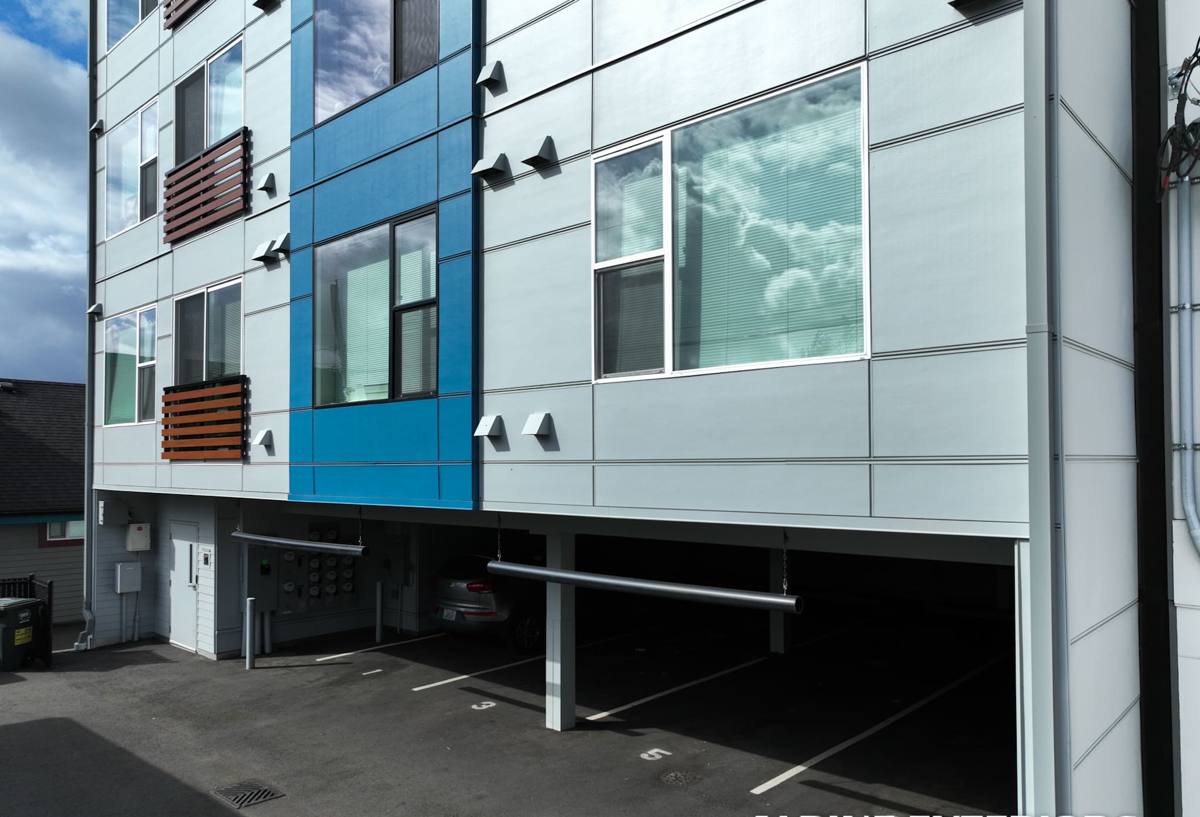
What "Energy-Efficient" Actually Means in This Climate
In a hot, dry climate, energy-efficient windows are mostly about blocking solar heat gain. That's not the main problem here. Whatcom County's marine climate means relatively mild temperatures but near-constant humidity and frequent gray, wet stretches. The real energy costs come from steady heat loss through poorly sealed frames, cold drafts around aging sashes, and condensation that signals a window is no longer managing moisture correctly.
That shifts what actually matters in a window package:
- U-factor (how well the window resists heat loss) matters more here than solar heat gain coefficient, since blocking summer sun isn't the priority
- Low-E coatings should be selected for a heating-dominated climate, not a cooling-dominated one — the wrong coating spec can leave a home colder than it needs to be
- Warm-edge spacers and quality gas fills (argon is standard) reduce the cold-glass effect that drives condensation on interior panes
- Installation air-sealing often matters more than the glass package itself — a top-tier window installed with gaps at the flashing performs worse than a mid-tier window installed correctly
We'd rather spend the budget on a properly sealed, well-flashed installation with a solid mid-range window than sell an upgraded glass package on a window that leaks air around the frame.
Signs Your Current Windows Are Underperforming
Most homeowners don't notice window failure as a single event — it shows up as a slow accumulation of small annoyances. Here's what we look for during an assessment, and what you can check yourself:
- Fogging or a permanent haze between panes of a double-pane window (the seal has failed and the gas fill is gone)
- Condensation forming on the inside of the glass regularly, especially in the morning
- A noticeable draft near the frame when standing close to the window on a windy day
- Visible white or greenish corrosion on hinges, cranks, or locking hardware
- Moss, algae, or black streaking building up on sills and lower frames faster than you can keep up with
- Sashes that stick, drag, or won't latch fully anymore
- Single-pane glass or original aluminum-frame windows, especially on the weather-facing side of the house
- A heating bill that's crept up without any change in how you use the house
Any one of these on its own might just mean a repair or a reseal. Several of them together, especially on the side of the house that faces open water, usually means it's time to talk about replacement rather than patching.
What a Correct Installation Involves
Window replacement quality is decided by details most homeowners never see once the trim is back on. In an exposure like Semiahmoo's, a few of these details matter more than they would elsewhere:
Flashing and Water Management
The window itself is almost never where a leak starts — it's the interface between the window and the wall. A sill pan flashing that directs any water that gets past the window back out, properly lapped house wrap, and correctly integrated flashing tape all matter more here because wind-driven rain hits that interface harder and more often than in a sheltered inland lot.
Hardware and Fastener Choice
Standard fasteners and hardware corrode faster in salt air. We pay attention to hardware finish and fastener material on homes with direct water exposure so you're not dealing with seized cranks or rusted screws in a few years.
Frame-to-Wall Sealing
Every gap around the frame is a path for both air leakage and moisture intrusion. Proper low-expansion foam and sealant at the right points — not overfilled, not skipped — is what actually delivers the energy performance the window's rating promises.
Respecting Manufacturer Installation Specs
Nailing fin placement, shimming, and squaring all affect both how the window seals and how the warranty holds up. Skipping steps to save time on install day is the single biggest cause of early window failure we see.
Choosing the Right Frame Material for This Exposure
There's no single "best" window material — the right choice depends on how exposed the specific wall is, what look you want, and how much upkeep you're willing to do. Here's how the common options actually compare for a salt-air, high-moisture setting:
| Frame Material | Salt Air / Moisture Behavior | Maintenance | Typical Fit |
|---|---|---|---|
| Vinyl | Doesn't corrode; performs well in most exposures | Low — occasional rinse | Good all-around choice for most homes, including waterfront |
| Fiberglass | Very stable in moisture and temperature swings; holds paint well | Low to moderate | Strong option for higher-exposure walls or larger openings |
| Wood / Wood-Clad | Attractive but the most vulnerable to moisture if finishes aren't kept up | High — regular refinishing needed near water | Best reserved for sheltered elevations, not direct water exposure |
| Aluminum (uncoated) | Prone to corrosion and pitting in salt air over time | Moderate to high | We generally steer clients away from bare aluminum on exposed elevations here |
For most Semiahmoo-area homes, we lean toward vinyl or fiberglass on the sides of the house that take direct weather, and reserve wood-look or wood-clad options for sheltered elevations where the maintenance burden is manageable. This isn't a knock on any one product — it's about matching material behavior to what a specific wall actually experiences.
How Our Process Works
The steps are the same on paper for every house, but what we look for at each one changes based on exposure:
- On-site assessment — we look at each elevation separately, since the wall facing open water often needs a different spec than the sheltered side of the same house
- Product selection — frame material, glass package, and hardware are matched to each elevation's actual exposure, not a one-size-fits-all spec
- Measuring and ordering — precise measurements to avoid gaps that would need to be over-filled with foam or shimmed excessively
- Install day prep — protecting interior and exterior finishes, removing old units carefully to check for hidden rot or damage before it's covered back up
- Flashing, sealing, and insulation — the part of the job that actually determines long-term performance
- Cleanup and walkthrough — operating every sash and lock with you before we consider the job done
- Warranty registration — so the paperwork is handled and on file, not left for you to track down later
What Affects the Cost
Window replacement pricing varies widely based on real factors, not guesswork. The broad ranges below depend heavily on your specific home:
| Cost Factor | Why It Matters |
|---|---|
| Number and size of openings | More and larger windows mean more material and labor |
| Frame material | Vinyl is typically the most budget-friendly; fiberglass and wood-clad cost more |
| Glass package | Double-pane covers most needs; triple-pane adds cost but can help on the most exposed walls |
| Access and elevation | Waterfront homes with multiple stories or difficult access add labor time |
| Condition behind the old window | Hidden rot or water damage found during removal adds repair scope |
| Trim and finish work | Matching existing trim or upgrading finish carpentry adds to the total |
We'll always tell you honestly if we find something during removal that changes the scope — we'd rather explain an added repair than cover it up and have it resurface as a leak later.
Living With Salt Air and Moss Season
Even the best window installation benefits from a little seasonal attention in this climate:
- Rinse salt residue off glass and frames periodically, especially after storms — it's abrasive and corrosive if left to sit
- Keep weep holes (the small drainage openings at the bottom of the frame) clear of debris and moss so water can actually drain out
- Check exterior caulking once a year for cracking or gaps, particularly after the wettest months
- Avoid pressure washers directly on window seals and weatherstripping — it's an easy way to force water past a seal that would otherwise hold
- If you have wood-clad windows on any elevation, keep finishes maintained rather than waiting until you see bare wood
None of this is heavy maintenance, but skipping it in a high-moss, high-salt environment shortens the life of even a well-installed window.
Why Hiring a Crew That Already Works Semiahmoo Matters
A contractor who mostly works inland jobs isn't wrong about windows in general — they just haven't had to build the habits this exposure demands. Knowing which elevations need upgraded hardware before corrosion shows up, scheduling installs around the wettest stretches of moss season, and flashing details tuned for wind-driven rain aren't things you learn from a spec sheet. They're things you learn by doing the work here, repeatedly, and seeing what actually holds up a few years later.
We're based in Ferndale and work throughout Whatcom County, including the Semiahmoo area, so this exposure isn't a special case for us — it's routine. That familiarity shows up in smaller decisions throughout the job: the hardware we spec, the sequencing on install day, and what we flag during the walkthrough as worth watching.
If you're dealing with drafty, fogged, or corroding windows, or you're just planning ahead before the next wet season, we're happy to take a look and walk you through what your home actually needs. Reach out for a free, no-pressure estimate — we'll assess each elevation honestly and give you straight answers, not a one-size-fits-all sales pitch.