 Ferndale Exterior
 Siding Repair Built for Sumas Conditions, Not a One-Size-Fits-All Patch Job
Homes in and around Sumas deal with a specific kind of wear. Whatcom County's marine-influenced climate pushes salt-tinged air inland, storms roll through with driving, wind-blown rain, and a moss season that can run nearly ten months out of the year. None of that is dramatic on its own, but stacked together over a decade or two, it finds every weak point in a home's exterior. Siding repair here isn't just about matching a color or covering a crack — it's about understanding why that crack, that soft spot, or that streak of green growth showed up in the first place, and fixing the actual cause instead of just the symptom.
We work on siding repair calls throughout Whatcom County, and Sumas homes tend to show a consistent pattern: moisture that gets in slowly, sits because the siding material or the original installation didn't let it dry out, and eventually shows up as rot, staining, or bowing months or years after the initial exposure. A repair that doesn't account for that pattern is a repair that fails again.
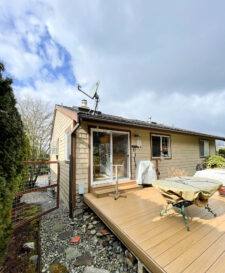
What This Climate Does to Siding Over Time
It helps to understand the mechanism, not just the outcome. Three regional factors do most of the damage:
- Salt-influenced air — even homes well inland from the coast pick up airborne salt on windier days, which accelerates corrosion of fasteners, trim flashing, and any exposed metal components tied into the siding system.
- Driving rain — wind-driven storms push water sideways into laps, seams, and butt joints instead of letting it simply run down the face of the wall. Siding that isn't installed with the right overlaps and clearances takes on water it was never designed to handle.
- Extended moss and algae season — near-constant dampness for much of the year means anything that holds moisture against the wall — moss, lichen, organic debris in gaps — keeps that section of siding wet far longer than the rest of the wall, which is exactly where rot starts.
Wood-based and moisture-sensitive siding products struggle most with this combination, because once water gets past the surface, the material itself starts to break down. That's a big part of why we've standardized on a product engineered specifically to resist it — more on that below.
Common Siding Problems We Diagnose on Sumas Homes
Every home is different, but repair calls in this area cluster around a handful of recurring issues:
- Soft or spongy siding near the bottom courses, often from splash-back off grade or a downspout dumping water against the wall
- Bubbling, peeling, or discolored paint where moisture is trapped behind the surface rather than a simple weathering issue
- Warped or buckled panels/boards where a section never fully dries between rain events
- Persistent moss or algae staining on north-facing or shaded walls, which signals a wall that stays damp longer than it should
- Gaps or separation at seams, corners, and trim where old caulk has failed and water has been quietly getting behind the cladding
- Corroded or failing fasteners, particularly on older installations using materials not rated for this level of moisture exposure
The tricky part is that surface symptoms don't always point to the true cause. Staining might be cosmetic, or it might be the visible edge of a much larger area of hidden moisture damage in the wall assembly. That's why diagnosis has to come before any repair decision.
What a Correct Siding Repair Actually Involves
A repair that's done right is more than swapping a damaged board. It typically includes:
- Diagnosis of the moisture source — grading, gutter/downspout performance, flashing condition, and whether the damage is isolated or spreading behind adjacent panels
- Removal of all compromised material — not just the visibly damaged section, since rot and hidden moisture often extend beyond what's obvious from the outside
- Inspection of the water-resistive barrier underneath — if the house wrap or building paper has failed in that area, replacing the siding without addressing it just resets the clock on the same failure
- Correcting the underlying cause — re-grading a low spot, extending a downspout, replacing failed flashing, or adjusting clearances so water has somewhere to go
- Installing new material to spec — proper fastening, correct overlaps and gaps, and sealant only where the manufacturer calls for it
- Color and profile matching so the repaired section blends with the rest of the wall rather than reading as an obvious patch
Skipping any of those steps is how homeowners end up paying for the same repair twice.
Patch, Panel Replacement, or Full Re-Side: How We Help You Decide
Not every repair calls for the same scope of work. Part of an honest estimate is telling you which category your home actually falls into.
| Approach | Best For | What to Watch For |
|---|---|---|
| Spot patch | Isolated, recently discovered damage with no hidden spread | Only appropriate once the moisture source is confirmed and fixed — otherwise it's temporary |
| Section/panel replacement | Damage concentrated in one wall area, elevation, or run of boards | Requires a close color and profile match to avoid a patchwork look |
| Full re-side | Widespread failure, aging original material, or repeated repairs in multiple spots | Often more cost-effective long-term than chasing repairs across an entire home |
We'll walk you through where your home sits on that spectrum and why, rather than defaulting to whichever option is easiest to sell.
Our Process, Start to Finish
Every siding repair we take on in Sumas follows the same sequence:
- On-site inspection of the affected area and a check of surrounding sections that could be hiding the same problem
- A plain-English explanation of what's causing the damage — not just what's visible
- A written estimate that separates the repair itself from any underlying fix (grading, flashing, ventilation) it depends on
- Careful removal of damaged material with attention to the water-resistive barrier and framing underneath
- Correction of the root cause before any new siding goes on
- Installation to manufacturer specification, with color and texture matched as closely as possible
- A final walkthrough so you know exactly what was done and why
Why We Repair Exclusively With James Hardie Fiber Cement
When a repair calls for new material — whether it's a few boards or a full section — we install James Hardie fiber cement, and we don't install vinyl, LP SmartSide, cedar, primed spruce, or other fiber cement brands. That's a deliberate standard, not a sales preference.
Fiber cement doesn't absorb and swell the way wood-based products can, and it's non-combustible, which matters to a lot of homeowners regardless of climate. James Hardie's HZ5 product line in particular is engineered for wetter, harsher climates like ours — it's built to handle moisture exposure and freeze-thaw cycling better than a general-purpose product. The factory-applied ColorPlus finish also matters for repair work specifically: it resists fading and holds its color far longer than field-applied paint, which makes color-matching a repaired section to older Hardie siding far more reliable over time than trying to match a painted wood product.
We've seen enough repair calls caused by moisture-sensitive materials that we simply stopped installing them. It's a smaller product lineup for us to work with, but it means every repair we do is going back on the wall with something engineered to hold up against exactly the conditions that caused the original problem.
Signs You Should Get an Inspection Now, Not Later
Siding damage rarely announces itself all at once. Watch for:
- Soft spots you can press in with a hand or a light tap of a tool
- Paint that's bubbling, peeling, or discoloring in patches rather than evenly across a wall
- Visible warping, buckling, or separation at seams and corners
- Persistent moss, algae, or dark staining that keeps coming back after cleaning
- A musty smell or visible staining on interior walls that share an exterior wall with a problem area
- Any siding damage after a significant windstorm, even if it looks minor from the ground
Catching these early is almost always cheaper than waiting — moisture damage spreads while it's out of sight.
Why It Matters to Hire a Crew That Already Works in Sumas
Siding repair isn't generic work. A crew that regularly works Whatcom County homes already knows how driving rain and moss-heavy conditions typically show up in a wall, which cuts down on guesswork during diagnosis. Local experience also means a better sense of realistic timelines around the wetter stretches of the year, and a crew that isn't learning the region's quirks on your home. We'd rather show up knowing what to look for than treat every repair as a first encounter with this climate.
If you're seeing any of the warning signs above, or just want a second opinion on a repair another contractor quoted, we're happy to take a look. Reach out for a free, no-pressure estimate — there's a form below to get started.